Sourdough Bread for Toast: How to Choose, Slice and Toast It
Sourdough makes excellent toast, and it is one of the best breads to put in a toaster. The best loaf has a fairly dense, even crumb and a sturdy crust. Cut it into slices of about 1 cm and toast it gently until it is golden outside and still tender inside. Below you will find how to pick the loaf, how to slice it, how to toast it in a toaster, a pan or an oven, what to put on top, and how to keep bread so it is ready for the next morning.
TL;DR
- Choose a sourdough with a close, slightly dense crumb and a thick crust: it holds heat and toppings without collapsing.
- Slice at about 1 cm (3/8 inch), evenly. Thinner slices burn, thicker ones toast unevenly.
- Use moderate heat. A firm sourdough crumb needs a little time to crisp without drying out.
- Slice and freeze what you will not eat within a few days, then toast straight from frozen.
- Olive oil, butter, ripe tomatoes, cheese and honey all work: sourdough’s gentle tang suits both sweet and savory toppings.
Table of Contents
- Why sourdough suits toast
- Choosing the right loaf
- Fresh or day-old bread?
- How to slice sourdough for toast
- How to toast sourdough, step by step
- Toppings that suit sourdough
- Keeping sourdough for toast
- Making your own sourdough toast loaf
- Is sourdough toast good for you?
- Our perspective
- Find sourdough for your toast
- FAQ
- Sources
Why sourdough suits toast
Toast asks three things of bread: a structure that survives heat, a crumb that stays tender, and a flavor that still tastes like something once it is browned. Sourdough delivers on all three, and the reasons are in how it is made.
The French baking school INBP explains in its technical file on sourdough that the crumb of a sourdough bread is generally denser, and that its thicker crust improves keeping and chew. It adds that the acidity slows staling, which comes from the starch retrograding. For toast, that means a slice with some body that takes the heat and carries butter, oil or a topping without turning to mush.
There is a practical consequence. A firmer crumb tolerates toasting well, but it may call for moderate heat rather than the highest setting on your toaster. We come back to that below.
What “sourdough” means in France
In France the words pain au levain are protected. Decree no. 93-1074 of 13 September 1993 reserves the name for breads whose crumb has a pH of 4.3 at most and an endogenous acetic acid content of at least 900 ppm. The same text defines the starter as a dough of wheat and/or rye flour, drinking water and possibly salt, undergoing natural acidifying fermentation and containing mainly lactic bacteria and yeasts. It also allows a small amount of baker’s yeast in the dough for the final mixing, up to 0.2% of the flour weight used at that stage.
Why does this matter for toast? Because a loaf sold as pain au levain in a French bakery has to meet a real standard, and that standard shapes the crumb and crust you are about to toast. If you want to understand how a starter compares with commercial yeast, our article on sourdough versus yeast goes into it.

Choosing the right loaf
Not every sourdough toasts the same way. Three things matter: crumb, crust and flour.
Crumb: close or open?
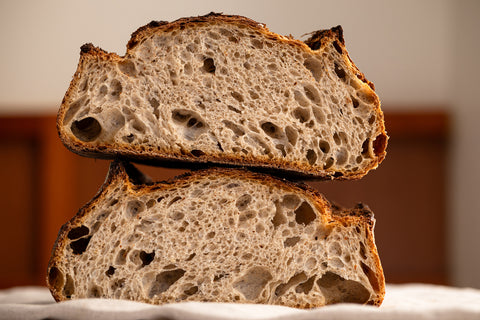
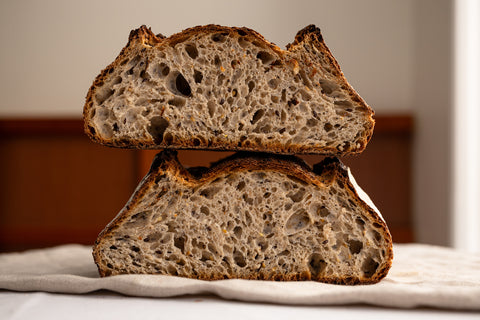
An open, airy crumb with big holes is beautiful on a board, but toppings fall through it and the thin walls between holes dry out quickly. A medium crumb, regular and slightly dense, gives you a surface that crisps evenly and a center that stays soft. Sandwich-style sourdough loaves, baked in a tin, are naturally even and slice into neat rectangles that fit a toaster. We wrote about that style in our sourdough sandwich bread piece.
Crust: thick is good
A thick crust is an advantage for toast. It stays chewy at the edges while the cut faces turn crisp, which gives you the contrast people look for. If you want to understand how a crackling, well-colored crust is built, see our guide to getting a crispy sourdough crust.
Flour: lighter or wholegrain?
The Guardian’s piece on how to eat toast describes a good slice as crisp outside with a soft interior, and suggests favoring lighter breads over wholemeal, brown or seeded ones, unless you are pairing with a very sweet jam. That is a matter of taste, of course. A rustic country loaf with ancient-grain seeds toasts beautifully too, but it behaves differently: the seeds toast and sometimes darken before the crumb is done, so watch it closely.
| Loaf type | Crumb | Toasts best with | What to watch |
|---|---|---|---|
| Sourdough sandwich loaf | Even, soft-dense | Butter, jam, eggs, honey | Moderate heat so it does not dry out |
| Country sourdough (pain de campagne) | Medium, chewy | Olive oil, tomato, cheese, avocado | Slice evenly; crust can be tough |
| Seeded or wholegrain sourdough | Dense | Savory toppings, cheese, smoked fish | Seeds brown fast, lower the heat |
| Very open-crumb artisan loaf | Airy, irregular | Olive oil, garlic, a drizzle of honey | Toppings fall through the holes |
Fresh or day-old bread?
The Guardian notes that fresh bread generally gives livelier toast, while stale bread can be rescued in a toaster but is not presented as the ideal. Our view, as bakers: sourdough’s acidity slows staling, so a loaf baked two or three days ago still toasts very well. A loaf that has just left the oven is a different pleasure, and you may prefer to eat it as it is, then toast it from the second day on.
Wet, freshly baked loaves need a little patience. Dualit, the toaster maker, advises in its guide to toasting artisan bread that a very moist sourdough should be left to dry for at least six hours before toasting. The same guide suggests a very light dampening of the edges of the cut face, and dry hands when you handle a toaster.
How to slice sourdough for toast
The slice decides half the result.
- Aim for about 1 cm. Dualit recommends slices of roughly 10 mm, cut to a regular size. Too thin and they burn quickly; too thick and they toast unevenly, with a hot crust and a cool middle.
- Cut evenly. A long serrated bread knife and a steady saw-like motion beat pressing down. If your loaf is round, cut from the center outward and keep the slices parallel.
- Use the heel, too. The end slices are mostly crust and make superb toast for dipping in eggs or soup.
- Mind the width. If your country loaf is wider than your toaster slot, use the oven or a pan instead.
How to toast sourdough, step by step
In a toaster
- Cut slices of about 1 cm, all the same thickness.
- If the loaf is very fresh and moist, let the slices air-dry for a while first, as Dualit suggests.
- Start on a medium setting. A dense crumb needs gentle, steady heat.
- Toast in two short cycles instead of one long one if the edges brown faster than the center. Dualit recommends intermittent toasting for breads that vary in moisture and sugar.
- Serve immediately. Toast left standing on a plate steams and softens.
In the oven
The oven is the best choice when you are toasting for several people, or when the slices are too big for a toaster. The recipe at Simply Recipes uses sourdough slices of about 1 inch, generously oiled on both sides, baked at 400°F (about 200°C) until colored: 7 to 10 minutes on the first side, then 5 to 10 minutes on the second. Oil gives a crisp, almost fried surface. For plain buttered toast, use less oil and keep the time shorter.
In a pan
A cast-iron or heavy skillet gives you the toast of a good café. Melt a little butter or warm some olive oil over medium heat, lay the slice in, and press lightly. Give it two to four minutes per side, until deeply golden. The pan is also the best method for a slightly stale slice, as the fat rehydrates the surface.
Under the grill
For open-faced toasts with cheese, grill the bread on one side first, turn it, add the cheese on the toasted side, and finish under the grill. Stay close: sourdough with sugars from the crust browns quickly.

Toppings that suit sourdough
Sourdough has a gentle tang, which is why it works with both rich and fresh toppings. A few combinations we like:
- Butter and flaky salt. The plain test of a good loaf.
- Olive oil, tomato and burrata. Serious Eats brushes the bread with olive oil and toasts both sides before adding drained tomatoes, burrata and pesto. Draining the tomatoes keeps the toast crisp.
- Avocado, lemon and chili. Mash the avocado with lemon juice and salt, and toast the bread a shade darker so it holds the weight.
- Soft-cooked or poached egg. The yolk runs into the crumb; a thicker slice helps here.
- Ricotta or fresh goat cheese with honey. A sweet and savory balance, finished with black pepper or thyme.
- Sweet options. Salted butter and jam, hazelnut spread, or ripe figs and a spoon of honey.
- Garlic and herb butter. Spread it on the bread and bake it in the oven, then serve it alongside soup or salad.
A rule of thumb: the wetter the topping, the crisper the toast should be. Add juicy toppings at the last minute.
Keeping sourdough for toast
Because of its acidity and thick crust, sourdough keeps better than most breads. Here is how we would handle a loaf at home.
- Days one to three. Keep the loaf cut side down on a board, or in a cloth bag or bread bin. Avoid sealing a still-warm loaf in plastic, which softens the crust.
- Longer than that. Slice the whole loaf, separate the slices with baking paper, and freeze them in a bag. You can put a slice straight from the freezer into the toaster, usually with a slightly longer cycle.
- If a slice is dry. Use it in the pan with butter, or make French toast or garlic toast.
If you bake your own, let the loaf cool completely before slicing, as the crumb is still setting inside when it is warm. If you work with rich sourdough doughs, our advice on keeping brioche soft applies the same logic: protect the crumb from air.
Making your own sourdough toast loaf
If you bake at home, a tin-baked sandwich loaf gives you slices of identical size, which is ideal for toast. A typical recipe of this kind runs over most of a day: a starter that is fed and ready, a long bulk fermentation, a final proof, then baking and a full cooling. As a guide, the INBP recommends bringing a sourdough dough to a final temperature of about 26 to 28 °C to support fermentation, aroma and acidity. Rather than watching the clock alone, watch the dough: it should rise visibly and show bubbles before you shape it.
A few tips specific to toast:
- Shape the loaf in a tin so the slices are regular.
- Bake it until the crust is well colored; a pale crust gives pale, soft toast.
- Let it cool for at least a couple of hours before cutting.
- Slice it the next day if you can. It cuts cleaner and toasts more evenly.
Is sourdough toast good for you?
People often ask about carbohydrates, digestion and glycemic response. We cover these questions in more detail in our pieces on sourdough bread benefits and the glycemic index of sourdough. If you have a medical condition such as irritable bowel syndrome, celiac disease or diabetes, ask your doctor or a registered dietitian what suits you: sourdough made from wheat or rye still contains gluten, and toasting does not change that.
Our perspective
We make sourdough for a living, and toast is one of the best ways we know to taste a loaf honestly. There is nowhere to hide: heat reveals the flour, the fermentation and the bake.
At Christophe Louie, we work with a living starter and slow fermentation, the same approach that lies behind our 72-hour panettone. A long process builds flavor and a crumb with real structure, and that structure is exactly what you want under a knife of butter or a spoonful of ricotta.
Our advice is simple. Pick a loaf with character, cut it evenly, toast it patiently and eat it right away. Our country loaf with ancient-grain seeds, for example, is a fine candidate for olive oil and tomato.
Christophe
Find sourdough for your toast
If you are in Paris, you can come to our boutique at 12 rue Dupetit-Thouars in the Marais, or order online anywhere in France. Browse our sourdough breads, including the country loaf with ancient-grain seeds, made with natural sourdough.

Our range also includes sourdough brioches, madeleines, cakes and flans, and our sourdough panettone, available in sweet and savory versions. You will find everything on christophelouie.com.
FAQ
Should I toast my sourdough?
Yes, and sourdough handles it well. The denser crumb and thicker crust stand up to heat, and the flavor deepens as it browns. Use moderate heat and even slices of about 1 cm so the outside crisps while the inside stays tender.
What thickness of sourdough is best for toast?
About 10 mm (roughly 3/8 inch) for a toaster, according to Dualit, cut evenly. In the oven, slices closer to 1 inch work, as in the Simply Recipes method. Thinner slices burn, and thicker ones toast unevenly.
Can I toast day-old or frozen sourdough?
Yes. Sourdough’s acidity slows staling, so bread from a few days ago toasts very well, though very fresh bread gives livelier toast. For longer storage, slice the loaf, separate the slices with baking paper and freeze them. Toast them straight from the freezer, adding a little time if needed.
Is sourdough bread good for IBS or high in carbs?
Sourdough is still a bread made from wheat or rye flour, so it contains carbohydrates and gluten. How it affects digestion varies from person to person. If you have IBS or another condition, talk to your doctor or a dietitian before changing what you eat.
What can I put on sourdough toast?
Butter and salt, olive oil with tomato and burrata, avocado with lemon, an egg, ricotta with honey, or jam. Sourdough’s slight tang works with both sweet and savory toppings. Keep juicy toppings for the last moment so the toast stays crisp.
Sources
- Décret n° 93-1074 du 13 septembre 1993 (Légifrance)
- Spécial levain, INBP technical file
- How to eat: toast, The Guardian
- How to get the best toast from your artisan bread, Dualit
- Soupy Toasts Recipe, Simply Recipes
- Sourdough Toasts With Tomato, Pesto, and Burrata, Serious Eats