Glycemic index of sourdough bread: what artisans know
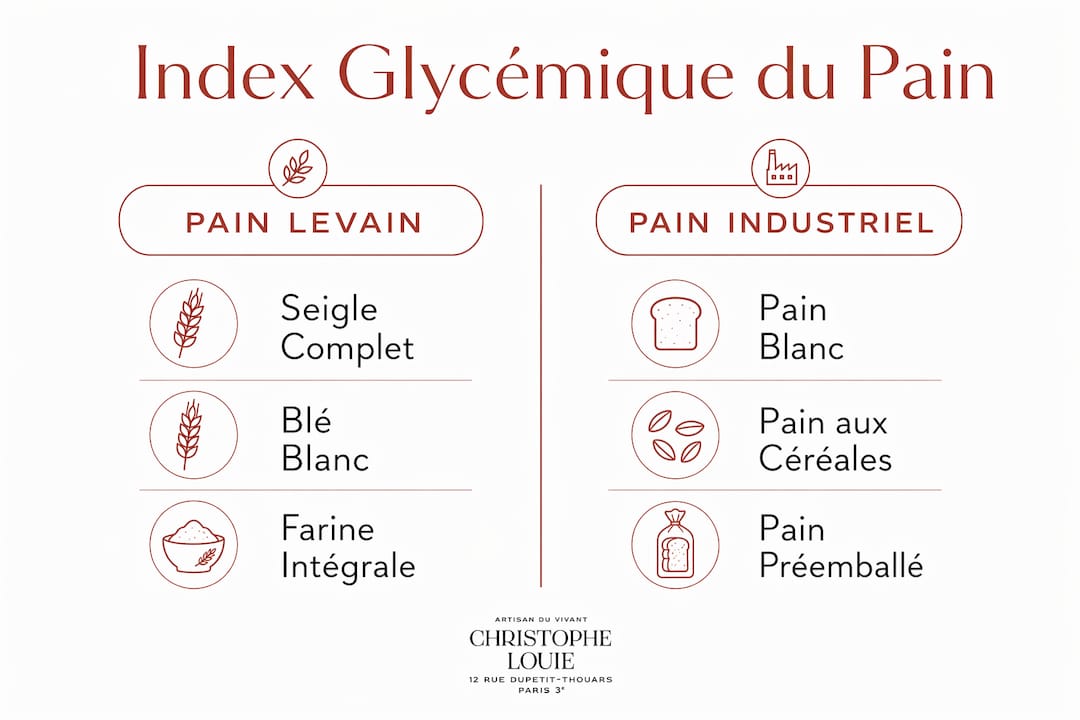
Artisanal sourdough bread has a glycemic index between 40 and 54, depending on the flour and fermentation method. Whole-grain rye sourdough can go as low as about 40, while white wheat sourdough bread sits closer to 54. By comparison, industrial white bread can exceed 70, sometimes reaching up to 95.
Three factors significantly influence this value:
- Type of flour: The higher the extraction rate (T110, T150, rye), the lower the GI, thanks to the fiber and starch structure.
- Fermentation time: Long fermentation (at least 8 hours, up to 72 hours for artisanal processes) produces organic acids that slow down carbohydrate digestion.
- Crumb density: A dense crumb resulting from slow fermentation releases glucose more slowly than a very airy crumb.
Key takeaway: For the lowest possible GI, choose a natural sourdough bread made from whole-grain flour (T150 or rye) that has been fermented for at least 12 hours.
Table of contents
- What does the glycemic index really measure, and what are its limitations?
- What GI values apply based on flour and process?
- How to eat sourdough bread to limit glycemic spikes
- Why does sourdough fermentation modify the glycemic impact?
- How to identify lower-GI sourdough bread in a bakery
- Christophe Louie, 72-hour fermentation: a case study
- Precautions for diabetics or those monitoring glycemic levels
- Key points
- Long fermentation: a technical and ethical choice
- Looking for artisanal sourdough bread in Paris or for delivery?
What does the glycemic index really measure, and what are its limitations?
The glycemic index (GI) measures how quickly the carbohydrates in a food raise blood sugar levels, compared to pure glucose, which is set at 100. A GI below 55 is considered low, between 56 and 69 is moderate, and above 70 is high.
However, the GI alone does not tell the whole story. The portion consumed, chewing, cooking, and especially what you eat alongside the bread significantly alter the actual glycemic response. A moderate-GI bread eaten with an egg and avocado will produce a much lower blood sugar increase than the raw GI would suggest.
“The GI alone is insufficient: portion size, food combinations, and post-meal physical activity strongly modulate the metabolic result.” Dietitians quoted by Top Santé
The glycemic load (GL), which considers both the GI and the actual amount of carbohydrates in a serving, is often more useful in practice. A moderate serving of natural whole-grain sourdough bread results in a controlled glycemic load. Fiber, digestive tolerance, and reduced FODMAPs complete the nutritional picture that the GI alone cannot summarize.
Pro tip: In a bakery or restaurant setting, aim for portions of 40 to 50 g per guest. At this weight, even white wheat sourdough bread stays within a controlled glycemic load.
What GI values apply based on flour and process?
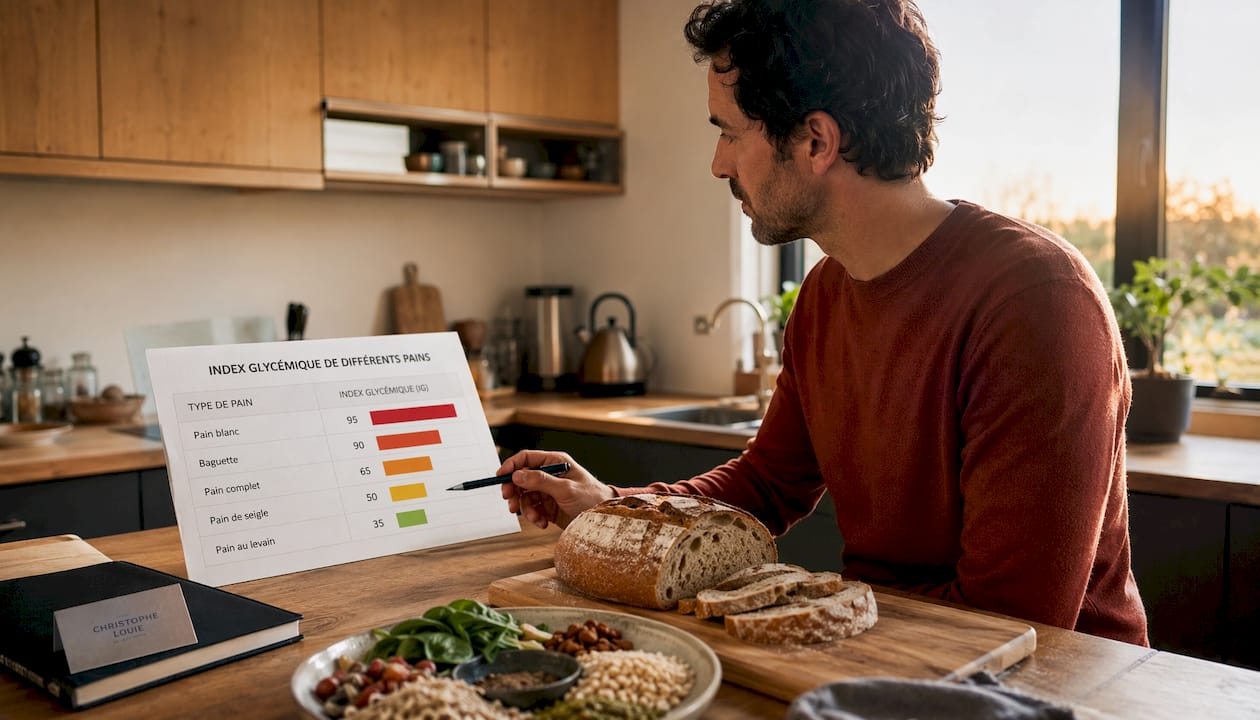
| Type of bread | Indicative GI | Glycemic Load (150 g) |
|---|---|---|
| Whole rye sourdough bread | low | reasonable |
| Natural whole-grain sourdough bread (T150) | low | reasonable |
| Whole spelt sourdough bread | low | reasonable |
| White wheat sourdough bread (T55) | moderate | moderate |
| Industrial white bread (fast yeast) | high | high |
Sources: nutri-coach-synergie.com, DietPro.fr, Medisite.
Sourdough fermentation can reduce the GI to moderate values of 35 to 55, compared to 70 to 95 for industrial white bread. The gap is significant, but it depends as much on the process as on the flour. Whole-wheat bread made with fast-acting yeast can have a GI close to 75, showing that "whole-grain" does not automatically mean "low-GI."
How to eat sourdough bread to limit glycemic spikes
Portion size is the primary lever. Dietitians recommend limiting intake to 40–50 g per meal, which is one to two slices depending on thickness. Beyond that, even a low-GI bread can generate a significant glycemic load.
Food pairings do the rest:
- Proteins: egg, fresh cheese, smoked salmon. Combining 15 to 30 g of protein slows gastric emptying and increases satiety.
- Healthy fats: avocado, olive oil, nuts/seeds. These curb carbohydrate absorption without making the meal heavy.
- Fiber-rich vegetables: cucumber, arugula, tomatoes. They dilute the carbohydrate density of the plate.
- Avoid: sugary spreads (industrial jam, large amounts of honey), which cancel out the bread's glycemic advantage. For jams, artisanal versions generally have a lower GI than their industrial counterparts.
A light 10 to 15-minute walk after the meal also helps reduce the glycemic spike, regardless of the bread chosen.
Pro tip: For breakfast or hospitality service, offer pre-cut 40 g portions accompanied by a protein condiment (cottage cheese, hummus). It is a signal of quality that nutrition-conscious customers notice immediately.
Why does sourdough fermentation modify the glycemic impact?
The mechanism is chemical before it is nutritional. During fermentation, lactic acid bacteria produce lactic and acetic acids that modify the starch structure and slow down gastric emptying. The result: glucose enters the bloodstream more slowly, and the glycemic curve stays flatter.
Long fermentation also reduces FODMAPs, particularly fructans found in wheat, which improves digestive tolerance for sensitive guts. It also degrades some phytates, releasing minerals (iron, zinc, magnesium) that are better absorbed. The partial synthesis of B vitamins is an additional, often underestimated benefit.
“To achieve notable effects on the GI, fermentation of at least 8 hours is necessary. Artisanal processes often go up to 72 hours for complex sourdough products.” DietPro.fr
The 8-hour threshold is practical but insufficient for the most complex products. Below that, organic acids do not have time to sufficiently modify the starch structure. A bread sold as "sourdough" but produced in two or three hours with added yeast will not replicate these effects.
How to identify lower-GI sourdough bread in a bakery
Three steps to evaluate a shop purchase:
- Read the ingredient list: T110 or T150 flour, rye, water, salt, sourdough starter. No baker's yeast, no additives (ascorbic acid, emulsifiers). The label must explicitly state "natural sourdough," not just "cereal bread" or "traditional."
- Ask the right questions: What flour extraction do you use? What is the bulk fermentation duration? Do you work with a maintained mother starter or with yeast? A serious artisan will answer without hesitation.
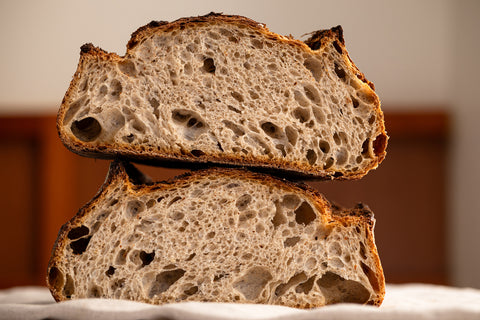
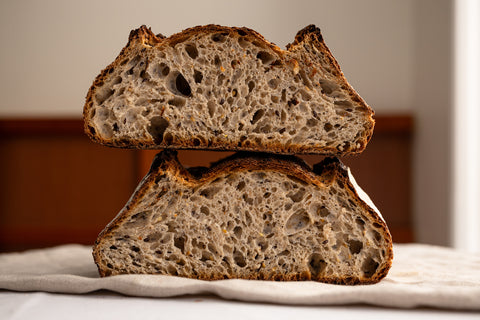
- Evaluate the texture: A dense, slightly moist crumb with a subtle acidity on the palate. A very airy and light crumb may indicate short fermentation or the addition of yeast.
Quick checklist in the shop:
- T110–T150 or rye flour mentioned
- Stated fermentation duration (ideally ≥ 12 hours)
- Absence of additives in the ingredients
- Dense crumb to the eye and touch
- Perceptible acidity when tasting
Be wary of labels like "cereal bread" or "whole-wheat bread" without details on the process. An industrial whole-wheat bread made with fast-acting yeast can have a GI near 75, far from the values of true artisanal sourdough bread.
Pro tip: Ask to taste a small slice before buying. An artisan who refuses this test deserves to be questioned about the transparency of their process.
Christophe Louie, 72-hour fermentation: a case study
The Christophe Louie bakery-pastry shop, located in the Marais (12 rue Dupetit-Thouars, 75003 Paris), illustrates exactly what long fermentation changes in a sourdough product.
Their signature process relies on a live starter (lievito madre) maintained continuously and a double dough process spread over 72 hours. This duration is not a marketing gimmick: it is the time required for organic acids to deeply modify the starch structure, reduce amylolytic activity, and give the product a slower glucose release after ingestion. The selected Italian flours (Grassi, Dalla Giovanna) are chosen for their specific technical behavior during long fermentation, not for their origin.
The house’s sourdough breads follow the same logic: live starter, long fermentation, high-extraction flours. For a demanding enthusiast or a catering professional looking for a controlled-GI bread, it is precisely the combination of flour + time + live starter that makes the difference.
Precautions for diabetics or those monitoring glycemic levels
The GI of a bread, no matter how low, does not replace individualized medical monitoring. Several limitations apply:
- Individual variability: Two people eating the same sourdough bread can show very different glycemic responses based on their insulin sensitivity, gut microbiome, and physical activity.
- Medication interactions: Certain hypoglycemic treatments alter glycemic response independently of diet. Adjusting portions without medical consultation can be counterproductive.
- GI vs. glycemic load: A low-GI bread consumed in large quantities can still generate a high glycemic load. Portion size remains the most direct control factor.
- Empirical testing: Measuring your blood sugar before and two hours after a meal remains the most reliable method for evaluating the actual impact of a specific bread on your own blood sugar.
“Do not systematically oppose sourdough and whole-wheat bread: alternation and food context offer the best strategy for glucose-sensitive clientele.” Doctissimo
This article provides general information, not medical advice. If you have diabetes or are on hypoglycemic treatment, consult your doctor or dietitian before changing your diet.
Key points
Artisanal long-fermentation sourdough bread has a glycemic index between 40 and 54—up to twice as low as industrial white bread—provided you choose a whole-grain flour and a fermentation process of at least 8 hours.
| Point | Details |
|---|---|
| Typical GI range | Between 40 (whole rye) and 54 (white wheat sourdough), vs. 70–95 for industrial bread. |
| Role of flour | T150 and rye lower the GI thanks to fiber and starch structure. |
| Long fermentation | At least 8 hours for a notable effect; artisanal processes reach 72 hours. |
| Recommended portion | 40–50 g per meal, paired with protein or healthy fats to limit the glycemic spike. |
| Christophe Louie | Live starter and 72-hour fermentation for panettone and breads, available in Paris and online. |
Long fermentation: a technical and ethical choice
Working with long fermentation is not a pose. It is a constraint one imposes because the results are incomparable: a denser crumb, balanced acidity, extended natural preservation, and a glycemic impact that is truly different from what an express fermentation produces.
At Christophe Louie, the live starter is maintained daily. Panettone relies on a 72-hour process—not because it is a sales pitch, but because below that threshold, the aromatic structure and crumb stability are not up to standard. The same logic applies to breads: fermentation is not shortened to save time; it is adapted to each flour and each season.
Ultimately, we seek a product that justifies itself upon tasting. Low GI is a consequence of the care taken in the process, not a marketing objective. Tasting a long-fermentation sourdough bread next to a supermarket loaf is the most direct demonstration possible.
Looking for artisanal sourdough bread in Paris or for delivery?
At Christophe Louie, every sourdough product rests on the same foundation: live starter maintained continuously, long fermentation, and flours selected for their technical performance. The orange blossom panettone, crafted in a double dough process over 72 hours, is the most refined example: a stretchy crumb, natural shelf life of up to five weeks, and a more progressive glucose release than that of industrial pastry.

Our sourdough breads are available in our shop in the Marais and for online orders with delivery throughout France. For catering professionals or gourmet grocery stores, we also offer B2B partnerships. Place your order at christophelouie.com or come taste them in person at 12 rue Dupetit-Thouars, 75003 Paris.