Sourdough vs. yeast: which to choose for your homemade bread?
For quick, light bread with a very airy crumb, baker's yeast remains the simplest choice. For a complex taste, longer shelf life, and perceived better digestibility, natural sourdough is the way to go. Yeast, a monoculture of Saccharomyces cerevisiae, makes dough rise quickly. Sourdough, an ecosystem of wild yeasts and lactic acid bacteria, requires a longer fermentation time, which can vary significantly, but transforms the dough profoundly.
- You are in a hurry or a beginner: stick with yeast, guaranteed results in one evening.
- You are looking for taste and shelf life: sourdough is worth the time investment.
- You want both: a hybrid dough, a little yeast and a little sourdough, exists and works well.
- The MNHN confirms it: both agents produce CO2, but through different biological pathways.
Key points
The choice between sourdough and yeast depends on one decisive criterion: do you prioritize speed or depth of flavor and shelf life?
| Point | Details |
|---|---|
| Yeast for speed | Choose yeast if you want bread ready in one evening with a light and uniform crumb. |
| Sourdough for taste | Opt for sourdough if you are looking for complex aroma, long shelf life, and perceived digestibility. |
| Substitution possible | Count on a significant amount of sourdough to replace 1 g of yeast, adjusting flour and water accordingly. |
| Regular maintenance mandatory | Refresh your sourdough daily at room temperature or weekly in the fridge. |
| Hybrid possible | Combining a small dose of yeast and sourdough allows you to combine lightness and aromatic complexity. |
Table of contents
- Definitions: what is baker's yeast and what is sourdough?
- How does fermentation work in each case?
- What are the real differences between sourdough and yeast?
- Can you replace yeast with sourdough, or vice versa?
- How to organize your home baking schedule?
- Pros and cons for an amateur baker
- Why do professionals bet on sourdough?
- Should you choose sourdough or yeast for your next bread?
- The real issue is not speed, it's consistency
- Does sourdough really nourish better than yeast?
- How long can you keep a sourdough starter without feeding it?
- Can baking powder replace sourdough or baker's yeast?
- Sources
Definitions: what is baker's yeast and what is sourdough?
Baker's yeast is Saccharomyces cerevisiae cultured industrially and sold in various forms, including fresh, active dry, or instant. It is a monoculture selected for its fermentation power and consistency, as noted by the MNHN.
Natural sourdough, however, is not a product you buy in a packet. It is obtained by letting a mixture of water and flour ferment spontaneously, which attracts and cultivates wild yeasts and lactic acid bacteria naturally present in the environment and on the grains.
- Baker's yeast acts quickly and alone.
- Sourdough hosts a complex and living microbial community.
- Chemical leavening (baking soda, baking powder) has nothing to do with the previous two: it releases gas through an instant chemical reaction, without fermentation, and is mainly used in quick baking.
How does fermentation work in each case?
With yeast, the reaction is simple: Saccharomyces cerevisiae cells consume the sugars in the flour and release carbon dioxide and ethanol.
Sourdough works on a different principle. Lactic acid bacteria produce lactic acid and acetic acid, which give bread its characteristic acidity and extend its shelf life, while wild yeasts ensure a slower rise, over six to twenty-four hours or more, according to Ouest-France.
- Yeast dough doubles in volume in 1 to 2 hours at room temperature.
- An active sourdough starter can take an entire night for the same performance.
- A difference of 1 to 2 °C in storage is enough to significantly speed up or slow down sourdough fermentation.
The number to remember: a sourdough starter can shift from a mild lactic profile to a more acetic and tangy profile in just a few days, simply by changing flour or maintenance temperature.
What are the real differences between sourdough and yeast?
| Criterion | Baker's yeast | Natural sourdough |
|---|---|---|
| Rising time | 1 to 3 hours | 6 to 24 hours or more |
| Aromatic profile | Neutral, discreet | Complex, tangy, lactic or acetic notes |
| Texture / crumb | Regular and airy crumb | Denser crumb, irregular and characteristic aeration |
| Shelf life | Stales in 1 to 2 days | Keeps for several days thanks to acidity |
| Ease of use | Simple, fixed dosage | Requires regular maintenance and monitoring |
| Cost and equipment | Packet or cube, no equipment | No direct cost but time and consistency |
| Perceived digestibility | Standard | Often considered more digestible, with nuances |
This difference in speed is not just a matter of patience. According to Culture Levain, the polyculture of sourdough chemically modifies the dough, which explains why two loaves made from the same flour can have totally opposite tastes.
- The tight crumb of yeast bread suits brioches and viennoiseries that aim for lightness.
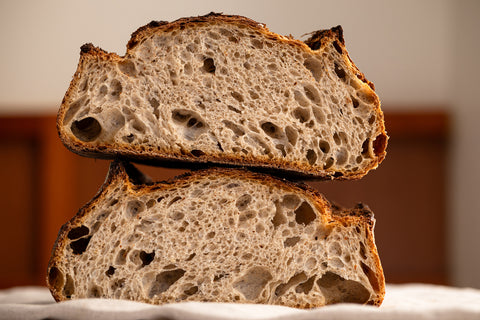
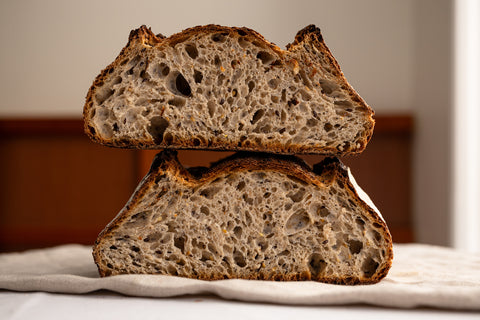
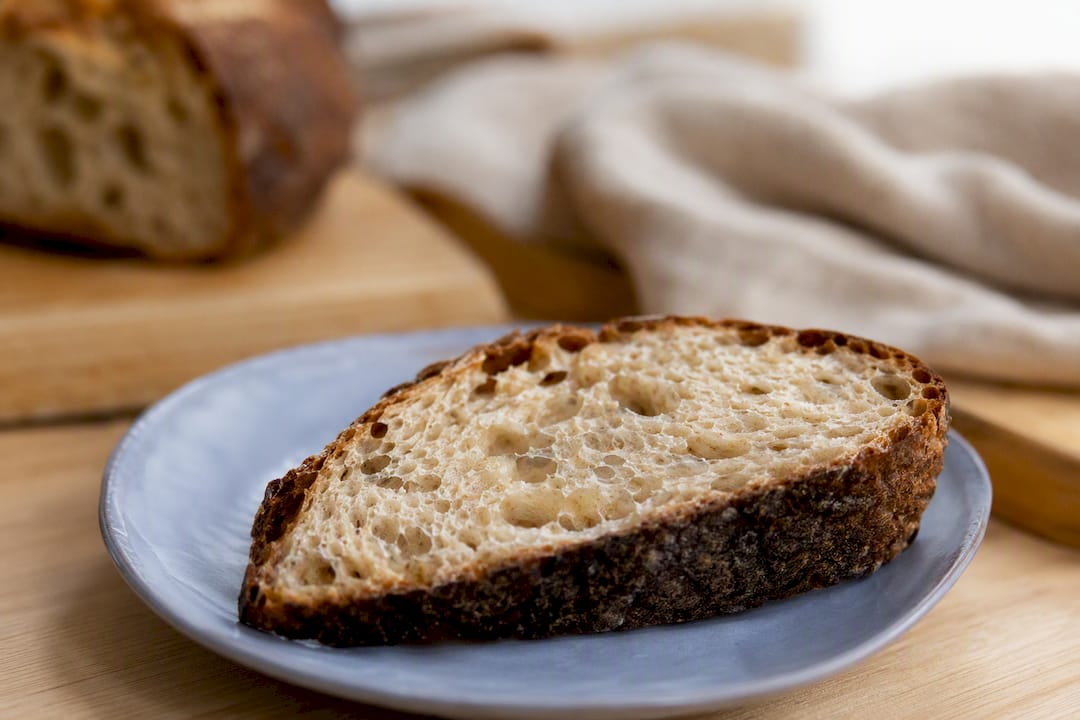
- The irregular aeration of sourdough, however, marks a country loaf or a rustic round.
- The extended shelf life of sourdough limits waste, a real asset for a household that doesn't eat a whole loaf in one day.
Can you replace yeast with sourdough, or vice versa?
Yes, provided you adjust the proportions and the time. The most cited rule in amateur baker circles is that 1 gram of fresh yeast is equivalent to a much larger quantity of active sourdough, depending on the strength of the latter and the hydration of the recipe, adjusted accordingly.
| Substitution | Reference quantity | Necessary adjustment |
|---|---|---|
| Yeast to sourdough | 1 g yeast ≈ 50 to 100 g sourdough | Reduce the flour and water in the recipe by the weight of the sourdough added |
| Sourdough to yeast | 100 g sourdough ≈ 1 to 2 g dry yeast | Compensate for the missing acidity with a little yogurt or vinegar if a pronounced taste is desired |
Pro tip: Never substitute blindly. First test on a small amount of dough, note the rising time obtained, and adjust the next recipe accordingly: each sourdough has its own strength.
- Common mistake: under-dosing the sourdough thinking that "a little is enough," which results in dough that never rises.
- Common mistake: leaving sourdough dough for too long, which produces excess acidity and a crumb that collapses.
- Tip: in case of yeast to sourdough substitution, slightly reduce the salt, as the acidity of the sourdough already accentuates the salty perception.
How to organize your home baking schedule?
- The night before: mix flour and water (autolyse), then add your refreshed sourdough or your yeast depending on the desired bread.
- Night or several hours: let the first fermentation happen at a cool room temperature, ideally between 18 and 22 °C for sourdough.
- In the morning: shape the dough, then let it rest for one to two additional hours (second fermentation).
- Before baking: preheat the oven to a high temperature, with a container of water to create steam if you are aiming for a crispy crust.
For the maintenance of the sourdough starter itself, a refresh (adding fresh flour and water) every day at room temperature, or once a week if stored in the refrigerator, is enough to keep it alive.
- Dough collapsing after shaping: the second fermentation probably lasted too long, or the room temperature was too high.
- Acetic smell too marked: the sourdough has fermented too long or stored too warm, refresh it more often.
- Crumb too dense despite an active starter: the flour used may lack strength, or hydration was insufficient.
Pros and cons for an amateur baker
Sourdough seduces with its aroma, extended shelf life, and perceived digestibility, but it requires time, regular maintenance, and accepts a degree of variability from one loaf to another.
- Yeast: fast, consistent, simple to dose, but more neutral taste and bread stales faster.
- Sourdough: complex aroma, better shelf life, digestibility often cited as superior, but requires patience and rigor.
- Practically: yeast suits a busy lifestyle, sourdough rewards consistency.
Why do professionals bet on sourdough?
The two-dough process spread over 72 hours relies entirely on a living sourdough, called lievito madre, whose precise temperature control and programmed refreshing guarantee both the microbiological safety and the aromatic consistency of a product like panettone.
This rigor, documented even in professional training standards such as the CAP boulanger, explains why Christophe Louie's sourdough panettone keeps for up to five weeks without additives, a result impossible to achieve with a classic yeast dough.
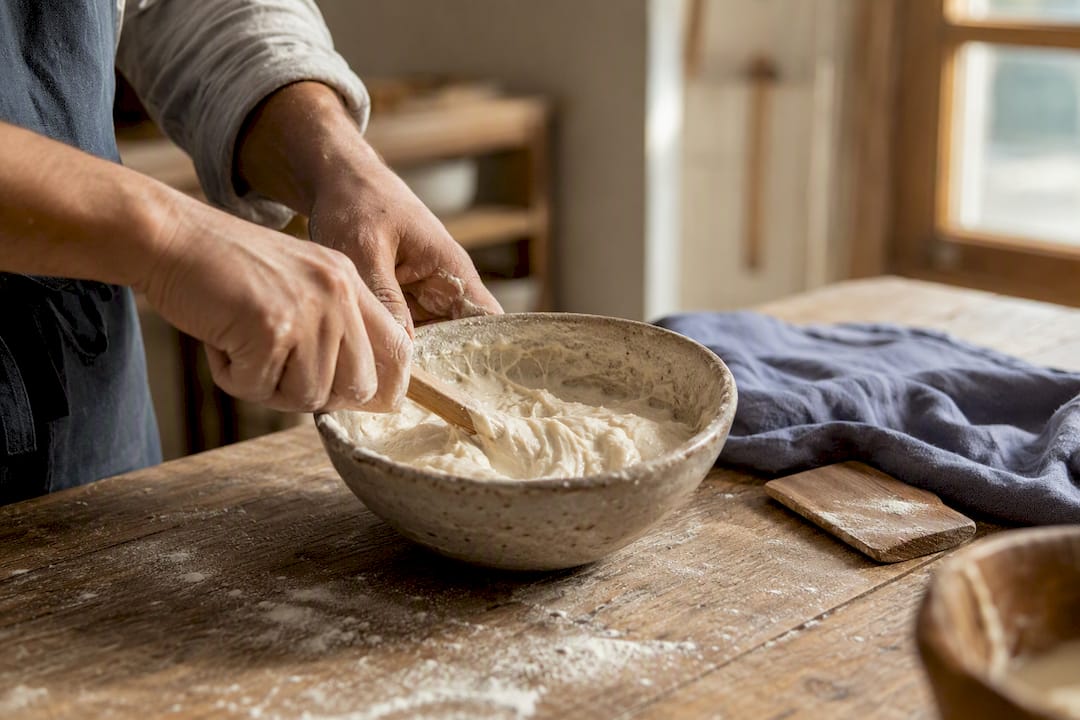
Pro tip: At home, reproduce the spirit of the professional protocol on a small scale: a refresh at a fixed time, a stable fermentation temperature, and patience. It is this trio, not the equipment, that makes the difference.
Should you choose sourdough or yeast for your next bread?
Sourdough bread, like that of Christophe Louie, clearly illustrates what long fermentation can bring to an everyday product: a crust that holds, a crumb that retains flavor three days after baking, and an aromatic profile that no yeast can replicate. If you are tempted to get started with sourdough without wanting to maintain your own culture daily, the house's collection of sourdough breads offers an accessible alternative, made according to the same principles of long fermentation.
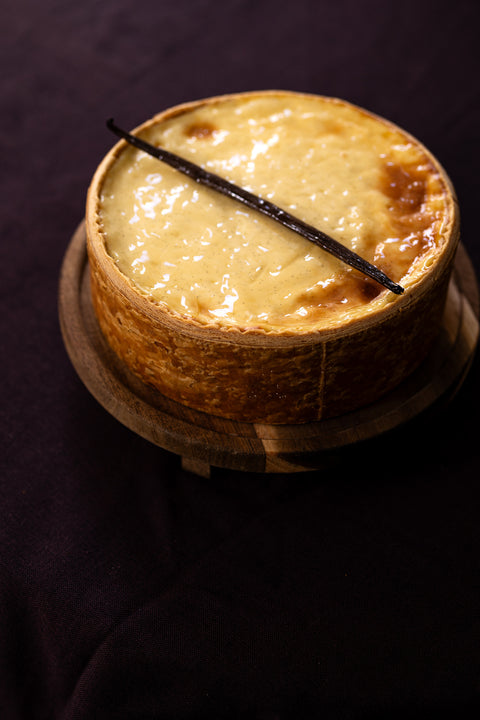
For enthusiasts curious to go further in the world of sweet sourdough, the orange blossom panettone remains a reference of the 72-hour two-dough process mentioned above, available in the boutique in the Marais or for delivery.
The real issue is not speed, it's consistency
Most guides on this subject sell speed as the number one criterion. This is a misplaced angle. A beginner who chooses yeast because it is simpler will give up quickly if they don't understand why their bread lacks flavor. A beginner who chooses sourdough without accepting the constraint of regular refreshing will end up with a dead culture at the back of the fridge.
The true criterion is your ability to maintain a rhythm. Sourdough rewards consistency, not occasional Sunday passion. If you cannot guarantee even minimal maintenance, yeast remains honest and effective: nothing obliges you to idealize sourdough as a matter of principle.
What I take away from professional protocols like the 72-hour two-dough panettone is that technical rigor counts for more than equipment. A methodical beginner with a simple glass jar will obtain better results than a baker in a hurry with professional equipment. Start small, take notes on everything, and let time do its work.
Does sourdough really nourish better than yeast?
Sourdough is often cited for its benefits on digestibility, notably because it activates phytase, an enzyme that reduces phytic acid and improves the availability of minerals, as highlighted by Aventure culinaire. Long fermentation is also associated with a perceived lower glycemic index, but these effects remain variable depending on the recipe and deserve to be nuanced rather than presented as an absolute guarantee.
How long can you keep a sourdough starter without feeding it?
A sourdough starter kept in the refrigerator can survive several weeks without refreshing, by simply slowing down its activity. At room temperature, it must be fed every day to prevent it from weakening or developing an overly marked acetic smell.
Can baking powder replace sourdough or baker's yeast?
No, baking powder acts by an instant chemical reaction without fermentation. It is suitable for cakes and quick pastries, never for bread that needs to develop structure and aroma over several hours.
Sources
To delve deeper into the biology of both agents, the MNHN remains the clearest reference. Ouest-France details the fermentation times, and Culture Levain offers a comprehensive practical comparison. To start your own culture, check out our article on the nutritional benefits of sourdough bread.
- What is the difference between yeast and sourdough? | MNHN
- What is the difference between yeast and sourdough? We have the answer | Ouest‑France
- What is the difference between yeast and sourdough? - Culture Levain
- Sourdough vs. yeast: The great French fermentation war - Aventure culinaire