Cake Gift Box: How to Choose One That Arrives Perfect
A good cake gift box does three things: it holds a cake that tastes as good as it looks, it fits the box without moving, and it reaches the recipient in the state you intended. Get the cake, the size and the logistics right and the rest is ribbon. This guide walks you through each step for gifts bought and sent in France, with the checks a pastry professional would make.
TL;DR
- Choose a stable, long-keeping cake (a loaf cake, a sourdough brioche, a panettone) when the gift will travel or wait a few days. Cream-filled entremets are for same-day gifts.
- Check the claims: “fait maison” and “pur beurre” must be truthful in France, and packaged boxes must carry an ingredient list, allergens and a storage date.
- Leave 1 to 2 cm of clearance between the cake board and the box walls, and use a rigid base.
- Fresh pastry with milk and eggs keeps about 3 to 4 days in the fridge, so match the cake to the delivery date.
- Carriers expect a closed, sturdy, well-wedged parcel, and the sender bears the risk if packing fails.
Table of Contents
- What a cake gift box usually contains
- Pick the cake first: what survives a gift journey
- How to judge quality and ingredients
- Choosing the box: size, rigidity and presentation
- Allergens and labeling: what should come with the box
- Storage and serving: keeping the gift at its best
- Sending a cake gift box in France
- Our point of view
- Offering a Christophe Louie cake box
- FAQ
- Sources
What a cake gift box usually contains
There is no single definition. In practice a cake gift box is one of three things: a single whole cake presented in a rigid, closed box; an assortment of small cakes (madeleines, financiers, mini loaves); or a themed set pairing a cake with something else, such as coffee, tea or chocolate.
The occasions are wide. French cake makers build their calendars around Christmas, Valentine’s Day, Mother’s Day, Father’s Day, Easter, Eid, thank-you gifts for teachers and nannies, weddings and ceremonies. That tells you something useful: the same box often has to work for very different recipients, from a colleague you barely know to a grandmother who loves tradition.
So start from the recipient and the date, not the box. Three questions settle most choices:
- When will it be opened? Same evening, within three days, or after a week or more.
- How far will it travel? Across town by hand, by train, or by parcel carrier.
- Who is eating? A table of ten, a couple, or one person with a dietary need.
Pick the cake first: what survives a gift journey
A gift is often opened later than planned. The cake has to forgive that.
Stable cakes travel and wait well
Butter-based loaf cakes, madeleines, brioches and panettone are made to be sliced over several days. They hold their texture in a box, they do not leak, and they do not need a cold chain. That makes them the natural choice for a gift that crosses a city or a country.
At our Paris workshop this is the logic behind our travel cakes. Two examples: our Madagascar vanilla and chocolate marble cake and our artisanal lemon loaf cake. Both are simple, recognizable flavors that suit nearly every recipient, which is exactly what you want when you are unsure of someone’s taste.
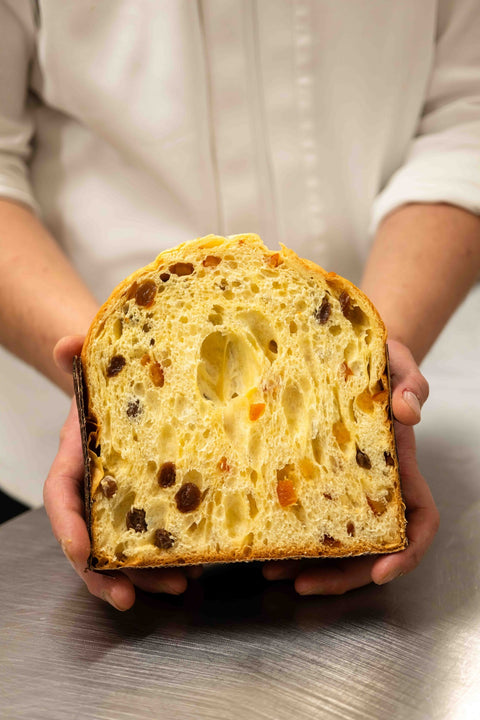
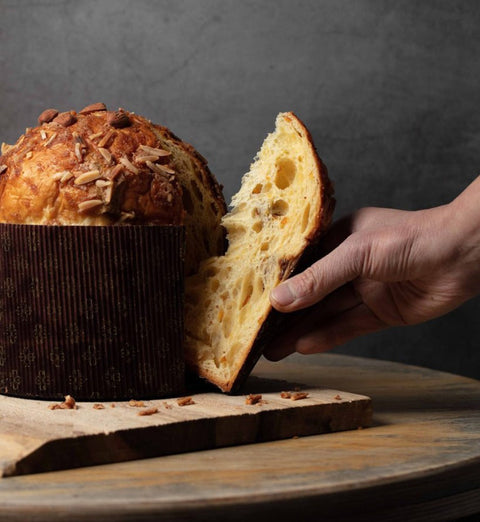
For the festive season, our sourdough panettone is made over 72 hours with a living starter (lievito madre). We designed it to keep up to five weeks, which is why it works as a gift that can be enjoyed when the recipient is ready, not when the courier decides.
Fresh, creamy cakes are for same-day gifts
Cakes with cream, custard or fresh fruit are at their best within hours. Professional hygiene guidance gives a sense of the margins: in one HACCP guide for pâtisserie, entremets and bavarois are given a shelf life of 3 days at +3 °C, and fresh-fruit tarts just 1 day. If you are handing the box over in person at the dinner table, these are wonderful. If it is going in the post, they are the wrong choice.
A quick matching table
| Situation | Best type of cake | Why |
|---|---|---|
| Dinner tonight, delivered by hand | Entremets, fruit tart, layer cake | Peak freshness, visual impact |
| Gift for a colleague, opened within days | Loaf cake, madeleines, brioche | Stable texture, easy to share |
| Parcel sent across France | Loaf cake, panettone | Robust, no cold chain |
| Festive gift for a host | Panettone, sweet or savory | Long keeping, impressive presentation |
| Aperitif gift | Savory panettone, savory cake | Works before the meal, not only dessert |
Savory is an underrated option. Our range includes savory panettone (truffle, cacio e pepe) for the hosts who already own too many sweets.
How to judge quality and ingredients
A beautiful box can hide an ordinary cake. Here is what to look at.
Read the claims on the label
In France, wording is regulated. Prefecture guidance on bakery and pastry fairness lists “fait maison” and “pur beurre” among the claims that must be truthful. It treats frozen or third-party pastries as noncompliant with “fait maison”, and a croissant made with fat other than butter as noncompliant with “pur beurre”. For you as a buyer, that means a producer who uses these words is making a commitment, and one who explains what happens in the workshop is giving you more to go on.
Ask what the process is
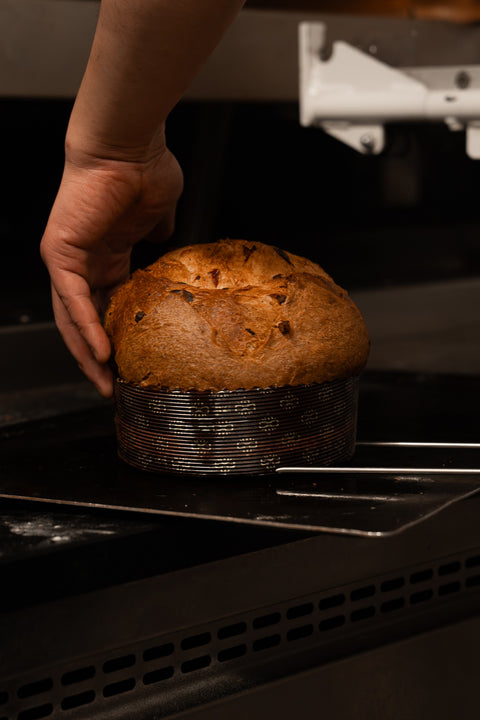
Good artisans like to talk about method. For us it is concrete: a two-dough process spread over 72 hours, a living sourdough starter, careful temperature control and hand shaping. The flours (Grassi and Dalla Giovanna) come from Italy for their technical qualities, and every other ingredient is sourced in France. A producer who can tell you this kind of detail about a cake is usually one who pays attention to everything else in the box.
Look at the simple signals
- A short, readable ingredient list, with butter, eggs, flour and real flavorings named plainly.
- A storage instruction and a date.
- A producer name and address on the box.
- Consistent shaping and baking color across the cakes in an assortment.
Choosing the box: size, rigidity and presentation
A cake that slides in transit is a cake that arrives damaged. Sizing is the point where gifts most often go wrong.
Size: measure the finished cake
Packaging suppliers give a consistent rule. According to a French guide to pastry boxes, leave 1 to 2 cm of clearance between the cake board and the carton walls. A tart is comfortable in a 5 cm-high box, while a tall entremets needs about 10 cm. Measure the finished, decorated cake, not the mold, then round up to the next standard size.

For loaf cakes and panettone the same principle applies. If you are weighing formats, our guide to panettone sizes and formats explains how to match the size to the number of guests.
Rigidity and the base
The same guide recommends a rigid round or square cake board to secure the cake and make it easy to slide out, and notes that cardboard can soften when it meets cream or fruit. For a heavier cake, choose a rigid carton in white or kraft. A flimsy box looks cheap and, more importantly, flexes when someone carries it with one hand.
Three common box styles
Packaging specialists commonly distinguish three types of pastry boxes:
- Classic carton box: flexible but sturdy, handles light rain and small knocks.
- Window box: shows the cake off, good for large cakes and fruit tarts.
- Handle box: meant for small individual pastries and mignardises.
For a gift, a plain closed box with a ribbon often feels more premium than a window, because the recipient discovers the cake when they open it. A window is better when the cake itself is the spectacle.
Presentation that also respects the planet
Many buyers now look at what happens to the box afterward. If this matters to you, our guides to premium panettone packaging formats and recyclable panettone packaging cover how to choose and sort cardboard.
Allergens and labeling: what should come with the box
A gift is eaten by people the buyer may not know well. That is why information matters.
In France, allergen information is required for processed products whether or not they are packaged, including prepackaged products sold immediately and products packed at the customer’s request. On packaged products, allergens must be named and easy to tell apart in the ingredient list.
The European food information regulation (INCO) goes further for prepackaged foods. Its mandatory particulars include:
- the name of the food;
- the list of ingredients;
- allergens from Annex II present in the finished product;
- the net quantity;
- the date of minimum durability or the use-by date;
- storage or usage conditions;
- the name and address of the business responsible;
- a nutrition declaration, where required.
The same text says allergens must be emphasized within the ingredient list through a typeface, style or background color that sets them apart. The 14 allergens include gluten-containing cereals, eggs, milk, tree nuts, peanuts, soy and sesame, all common in pastry.
In practice, before you give a cake to someone with an allergy, look at the printed label, not at the shop’s general description. And if you are buying for a person with a lactose issue, read our guide on what to check in lactose-free panettone before choosing.
Storage and serving: keeping the gift at its best
Tell the recipient how to keep the cake. A short note in the box does more for the gift than another ribbon.
Fresh pastry
Consumer organization Que Choisir states that pâtisserie containing milk and eggs keeps 3 to 4 days in the refrigerator. It also explains the difference between a use-by date (DLC) for perishable products and a date of minimum durability (DDM) for stable ones, and advises wrapping foods separately and never putting hot food in the fridge. If the cake is cream-based, follow the artisan’s own instructions first.
Stable cakes and panettone
Loaf cakes, brioches and panettone are made for room temperature and for slow eating. Keep them in their box or well wrapped, away from heat and direct sun. For panettone in particular, we explain our view in do you need to refrigerate panettone.
Serving ideas that make the gift feel considered
- Slice a loaf cake thick and serve it at room temperature with tea or coffee.
- Warm a slice of panettone briefly and serve it with a spoon of mascarpone or a hot chocolate.
- Pair a lemon loaf with a citrus tea, and a marble cake with a strong coffee.
- Serve a savory panettone in small squares with an aperitif.
Sending a cake gift box in France
If you cannot hand over the box, delivery becomes part of the product.
Packing rules carriers apply
Parcel carriers set clear conditions. Chronopost’s consumer terms of sale require a closed, strong package suited to the contents and the transport, with the contents wedged and stabilized. If the packing does not meet this, the parcel travels at the sender’s risk, and the sender answers for the consequences of missing or poor packaging, wedging or labeling. The same terms exclude perishable foods and goods requiring controlled temperature.
The lesson is simple: send stable cakes by parcel, never fresh cream cakes. A stable cake in a rigid box, wedged so it cannot move, in a strong outer carton, is the right combination.

Paris: delivery and pickup
If the recipient lives in Paris, local options are simpler. We have a page on cake delivery in Paris, and you can also order ahead through our click and collect bakery service and pick the box up yourself at our boutique in the Marais, 12 rue Dupetit-Thouars, 75003. Check those pages for current conditions and time slots.
A short checklist before you order
- Choose a cake that keeps for at least a few days beyond the planned delivery.
- Confirm the delivery date and that someone can receive the parcel.
- Add a card with storage advice and, if useful, a note on allergens.
- Avoid sending gifts just before a weekend if the recipient is away.
- Order early in December: festive periods fill quickly.
Our point of view
We make cakes the way we learned to in professional kitchens: slowly, with few ingredients and a lot of attention. That is why we believe the best cake gift box is not the most decorated one, but the one that tastes right on the day the recipient opens it.
Our panettone is built on a living sourdough starter and a 72-hour process, with hand shaping and flours chosen for how they behave. Our approach is to make products that last naturally, up to five weeks for panettone, so a gift does not turn into a race against the calendar.
We also think gifts should not be limited to December. Our sourdough brioches, madeleines, loaf cakes, flans and breads exist so that you can offer something good in March or in August, with the same care. A marble cake with Madagascar vanilla or a lemon loaf is a simple gift, and a simple gift done well is often the one people remember.
When you choose, ask what is in the cake, how it is made and how long it keeps. We are happy to answer those questions about ours.
Christophe
Offering a Christophe Louie cake box
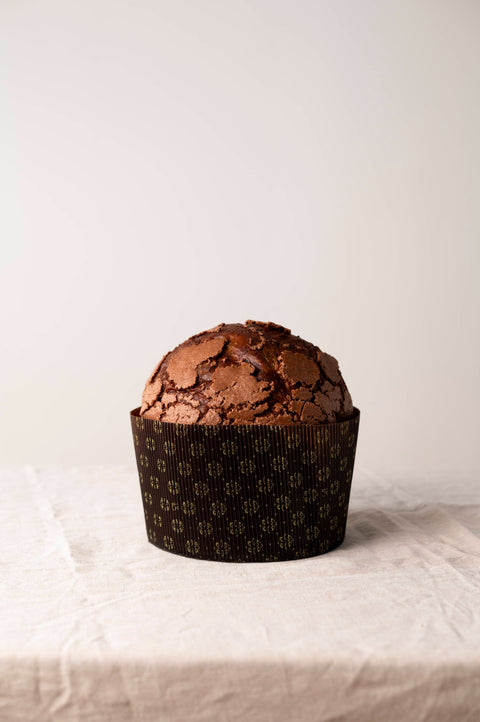
If you want a gift that holds up in transit and tastes of real butter, vanilla and sourdough, start with our panettone collection, available sweet or savory, including the chocolate Gianduja panettone. For something lighter, our marble cake and lemon cake are made to travel.

You can order online for delivery in France, or visit the boutique in the Marais. Our full range of brioches, madeleines, flans and breads is on christophelouie.com.
FAQ
What should I put in a cake gift box?
Choose one stable cake, such as a loaf cake or a panettone, or a small assortment of madeleines and mini cakes. Add a note with storage advice. If you pair it with tea, coffee or chocolate, keep the cake the centerpiece.
How long will a cake from a gift box stay fresh?
It depends on the cake. Fresh pastry with milk and eggs keeps about 3 to 4 days in the fridge according to Que Choisir, while stable cakes follow the date printed on their label. For our panettone, we designed the recipe to keep up to five weeks.
Can I send a cake gift box by post in France?
Yes, if the cake is stable and the parcel is well packed. Carriers require a closed, sturdy package with the contents wedged, and they exclude perishable goods. Choose a loaf cake or panettone, not a cream dessert.
Which box size is right for my cake?
Measure the finished cake and add 1 to 2 cm of clearance on width and length, then take the next standard size. A tart fits in about 5 cm of height, a tall entremets needs about 10 cm. A rigid board under the cake helps it stay stable.
What allergen information should I expect?
In France, allergens must be indicated for processed foods, packaged or not, and highlighted in the ingredient list on packaged ones. The label should also show storage conditions, a date and the producer’s name and address. If anyone has an allergy, check the label before gifting.
Sources
- Calendrier commercial cake designer 2026-2027
- HACCP pâtisserie : crèmes, allergènes et chaîne du froid
- Comment choisir ses boîtes à gâteau ?
- Boîtes pâtissières : lesquelles choisir ?
- Quels allergènes doivent être mentionnés sur un produit ? (Service-public.fr)
- Règlement (UE) n° 1169/2011, texte consolidé (EUR-Lex)
- La durée de conservation des aliments dans le réfrigérateur (Que Choisir)
- Conditions Générales de Vente Consommateur (Chronopost)