Bread for Fondue: Which Loaf to Choose, and How to Cut It
The best bread for fondue is a firm, country-style loaf with a thick crust and a dense, close crumb. Cut it into cubes a day ahead so it dries slightly, and plan roughly 150 to 200 g per person. That combination holds on the fork, soaks up the cheese and does not collapse into the pot. Soft sandwich bread, brioche and very airy baguettes are the usual culprits when cubes slip off and sink.
Below you will find the criteria that matter, a loaf-by-loaf guide, the right quantities, a cutting method and a short section on raclette, where the logic is a little different.
TL;DR
- Choose a bread with plenty of crust and a dense crumb without big holes: pain de campagne au levain, pain paysan, pain bis or a good artisanal miche.
- Plan 150 to 200 g per person, which is about 3 to 4 slices.
- Cut cubes the day before, or dry them in the oven for a few minutes on the day, and always keep some crust on each piece.
- Skip pain de mie, brioche, rye and breads full of seeds or dried fruit for a classic cheese fondue.
- For raclette, a crusty baguette or country bread to scoop up the melted cheese works well alongside potatoes and pickles.
Table of Contents
- What makes a bread good for fondue
- The best breads for cheese fondue
- Breads to avoid
- How much bread per person
- How to cut and prepare the bread
- What else to put on the table
- Perspective: why we reach for sourdough
- Bread for raclette
- Where to find the right loaf
- A simple plan for your fondue evening
- FAQ
- Sources
What makes a bread good for fondue
A fondue bread has three jobs. It has to stay on the fork, absorb the cheese without dissolving, and add a little flavour of its own without competing with the cheese. Every recommendation below comes back to those three points.
Crust. The crust is the anchor. Swissmilk, the Swiss dairy producers’ cooperative, recommends a bread with lots of crust and a dense crumb without holes. A piece with at least one side of crust is far less likely to fall off when you swirl it through the pot.
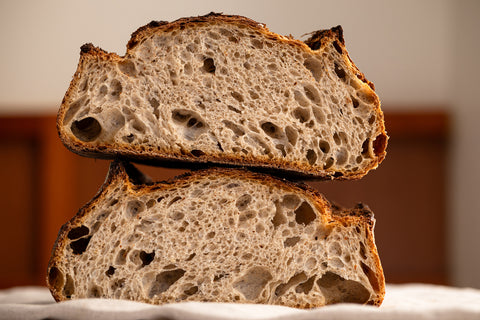
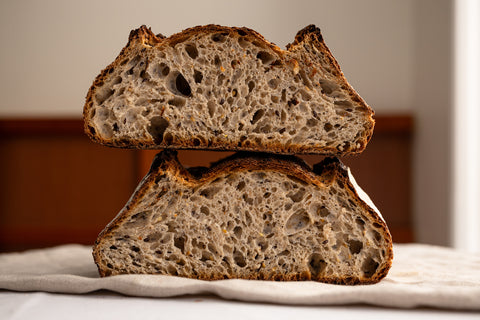
Crumb. A tight crumb carries cheese like a sponge. A very open crumb, with large holes, lets the cheese drain straight through and tears when speared. Migros, the Swiss retailer, makes the same point in its fondue tips: choose a bread with a nice crust and holes that are not too big, so you can spear it properly. (We are citing the principle; the exact tips live on their fondue pages.)
Flavour. The bread should have some character, but not too much. Cuisine Actuelle advises avoiding overbaked loaves and rye, because their taste can take over the cheese.
Freshness. Paradoxically, the freshest bread is not the best one. Very fresh, very soft bread can fall apart when speared, which is why bread from the previous day is well suited.
The best breads for cheese fondue
There is no single correct answer, and bakers disagree. One Basel baker quoted by Pain Suisse puts it simply: everything is allowed as long as it is good. Still, some loaves are safer bets than others.
Pain de campagne au levain
This is the most reliable choice in France. For a fondue savoyarde, Cuisine Actuelle recommends thick-crust, dense-crumbed breads such as sourdough country loaves and artisanal miches, because the bread must hold together in a nearly liquid fondue. Sourdough also brings a gentle acidity that sits well with a rich, nutty melted cheese.
Pain bis, pain paysan and other Swiss-style loaves
Swissmilk lists pain bis, pain tessinois, pain paysan, pain aux noix and pain de Sils as good options. In a French bakery, the closest equivalents are a pain bis (half-wholemeal), a pain paysan or a firm farmhouse loaf. A medium-dark crust and a firm but airy crumb is the target.
White and half-white bread
The traditional cubes are cut from white bread, and half-white or wholegrain bread also works well, according to the Swiss cheese promotion body. Wholemeal bread, or toasting bread fried in butter, are other options it mentions. If you serve a simple white loaf, make sure it is a proper crusty one, not a soft supermarket slice.
Mixing two breads
A light bread and a darker bread on the same board give guests variety. A Swiss kitchenware retailer notes that you can combine a light and a darker bread. A practical pairing: half white-crumbed country loaf, half pain bis.
Matching bread to the fondue
Switzerland Tourism, working with a master baker and certified bread sommelier, suggests specific pairings: Moitié-Moitié with Ruchbrot, a porcini mushroom fondue with baguette, an Eastern Swiss fondue with multigrain bread, a Central Swiss fondue with spelt bread, and a Valais tomato fondue with unsalted pretzels cut into cubes and lightly roasted in butter. You do not need to follow them to the letter, but they show the principle: the more assertive the cheese or additions, the more character the bread can carry.
Breads to avoid
| Bread | Why it struggles in fondue |
|---|---|
| Pain de mie (sandwich bread) | Light crumb, thin crust: it tears and drops into the pot |
| Industrial baguette | Airy and thin-crusted, so it softens quickly |
| Brioche | Too soft and sweet for a savory cheese pot |
| Rye bread | Strong flavour that can take over the cheese |
| Breads with seeds, dried fruit or other inclusions | Crumbs fall to the bottom of the caquelon |
| Overbaked, very dark loaves | Too hard and bitter against the cheese |
The reasoning on pain de mie, industrial baguettes, brioche, rye and inclusions comes from Cuisine Actuelle’s guide to fondue savoyarde bread. Swissmilk adds that baguette and ciabatta are less suitable for the same reason: too much air, too little body.
A useful nuance: a baguette is a poor fit when the crumb is wide open and the crust is thin, but a really good traditional baguette with a tighter crumb can still work, especially with a mushroom fondue, as the Swiss pairing above shows.
How much bread per person
Plan 150 to 200 g of bread per person. Swissmilk gives that range, equal to 3 to 4 slices. Cuisine Actuelle suggests about 200 g per person, the same weight as the cheese.
In practice:
| Guests | Bread at 150 g each | Bread at 200 g each |
|---|---|---|
| 2 | 300 g | 400 g |
| 4 | 600 g | 800 g |
| 6 | 900 g | 1.2 kg |
| 8 | 1.2 kg | 1.6 kg |
With these figures, a 1 kg country loaf feeds about five or six people at the lower end, and four to five at the generous end. Buy a little extra if the table is hungry or the fondue will be the only dish. Leftover cubes toast well the next day.
How to cut and prepare the bread
- Cut into mouth-sized cubes. Kitchen More recommends pieces that fit in one bite, preferably with some crust. Roughly 2 to 3 cm per side is a comfortable size.
- Cut the day before. Cuisine Actuelle advises cutting the cubes the day before so they dry slightly. Leave them uncovered on a tray or in a basket.
- Forgot? Use the oven. The same source suggests putting the cubes in the oven for a few minutes on the day. Keep an eye on them: you want them dry on the outside, not browned.
- Or cut a few hours ahead. With fresh bread, cut it a few hours before eating and let the cut surfaces dry slightly.
- Serve in a covered basket so the cubes stay dry until the cheese is ready.
Spearing technique
Push the fork through the soft side of the cube and all the way into the crust. The piece sits more stably on the fork and is less likely to end up in the cheese. That is the reason every cube should carry a strip of crust.

What else to put on the table
Bread is the star, but a fondue table usually has a few supporting players. In a Swiss restaurant, common accompaniments are kirsch, raw garlic, pickled gherkins, onions and olives. The garlic clove is also traditionally rubbed inside the caquelon before the wine and cheese go in. The acidity of the pickles cuts through the richness, which is why a fondue never feels as heavy as the ingredients suggest.
In France, the fondue savoyarde is usually made with Beaufort, Comté and Emmental or Gruyère, and sometimes Reblochon or Abondance. The cheese changes the bread you want: a mild blend works with almost any firm loaf, while a more assertive cheese asks for a bread with a bit more body.
Perspective: why we reach for sourdough
We bake sourdough every day, so our view on fondue bread is simple: the best loaf for the caquelon is a proper levain loaf.
A natural starter and a long fermentation give a bread with a thick crust, a close crumb and a slight acidity. Those are exactly the qualities a fondue asks for. The crust gives the fork something to hold, the crumb drinks the cheese, and the gentle tang keeps a rich fondue lively from the first cube to the last.
Our whole house is built on slow fermentation: a living starter, careful control of temperature, hand shaping and selected ingredients. We apply that same approach to our breads, and it is the reason we think a sourdough country loaf deserves a place at a winter table, whether the cheese comes from Savoie or from across the border.
Our advice if you are choosing for guests: take a large country loaf the day before, cut it yourself, let it dry overnight, and keep the crust on every cube.
Christophe
Bread for raclette
Raclette asks less of the bread. Nothing is dipped into a pot: the cheese melts under the grill, then goes over potatoes, charcuterie and pickles. Bread is there to carry and scoop.
Cheese Grotto describes the classic setup as roasted or boiled potatoes and baguettes or other artisan bread as a melted-cheese carrying device. Its tip: slice the bread into rounds in advance, or let guests tear off chunks of baguette through the evening, as the French do. A French raclette table also typically features oven-fresh baguette next to cornichons, pearl onions, ham and sausages.
So for raclette:
- Crusty baguette or ficelle: the easy default, torn by hand. Fresh is fine here, since nobody is spearing it.
- Sliced country sourdough: lightly toasted slices stand up to a generous layer of melted cheese.
- Smaller quantities than fondue: potatoes do most of the work. Count a few slices or a quarter baguette per person, more if potatoes are scarce.
The contrast with fondue is worth remembering. For fondue, firm and slightly dry wins. For raclette, a warm, crisp-crusted loaf with a tender crumb is perfectly at home.
Where to find the right loaf
For a fondue evening, a bakery that bakes country loaves on sourdough is your best starting point. Ask for a loaf with a thick crust and a tight crumb, baked the day before if possible.
We offer sourdough breads baked in our Paris workshop in the Marais, at 12 rue Dupetit-Thouars (75003), and shipped across France through our online shop. Our sourdough bread collection includes the Heritage Wheat Sourdough Loaf, 1 kg, a country-style loaf whose size suits a table of five or six. If you want to know what to expect from artisanal sourdough pricing, we explain it in our guide to the price of artisanal sourdough bread.

To build the whole winter table, browse everything we bake, from sourdough breads to madeleines and flans, on christophelouie.com. Order a day or two before your fondue so the loaf can rest and be cut ahead of time.
A simple plan for your fondue evening
The day before: buy or collect your loaf. Cut it into cubes, spread them in a basket or on a tray, and leave them uncovered overnight.

Two hours before: take out the cubes, check the crust on each piece, and set out pickles, onions, and any extras. Prepare a second bread of a different type if you want variety.
At the table: keep the basket covered, remind guests to spear from the soft side into the crust, and keep a few spare cubes in the kitchen for refills.
The next day: leftover cubes toast nicely for soup or salads.
If you want to use the same loaf for a second meal, a thick slice of sourdough toasted and topped with the leftover melted cheese is a very good breakfast.
FAQ
What kind of bread is good for cheese fondue?
Choose a firm country-style bread with lots of crust and a dense crumb without large holes. Pain de campagne au levain, pain paysan and pain bis are the safest picks. Add a little variety with a second, lighter or darker loaf if you like.
Can I use baguette for fondue?
Yes, but it is not the best choice. Swissmilk finds baguette less suitable because of its airy crumb, and an industrial baguette softens quickly. A traditional baguette with a sturdy crust can work, especially if you dry the cubes first.
Should fondue bread be fresh or stale?
Slightly dry is better. Cut the cubes the day before, or dry them in the oven for a few minutes on the day. Very fresh, soft bread is more likely to fall apart on the fork.
How much bread do I need per person?
Count 150 to 200 g per person, which is about 3 to 4 slices. For a table of six, that means roughly 900 g to 1.2 kg of bread.
What bread goes with raclette?
A crusty baguette or sliced country bread, served next to boiled potatoes, cornichons and charcuterie. Guests tear off pieces or scoop the melted cheese onto slices. Freshness matters less than for fondue.
Sources
- Fondue: quel pain, quelle quantité? | Swissmilk
- Quel pain prévoir pour une fondue savoyarde ? | Cuisine Actuelle
- Käsefondue: So gelingt’s, tips and sides | Kitchen More
- Le pain pour la fondue | Pain Suisse
- Fondue & Swiss bread | Switzerland Tourism
- Everything you need to know to chat fondue | Cheeses from Switzerland
- Fondue | Wikipedia
- Fondue Cheese Recipe and Origins | La Fromagerie
- How to Serve Raclette Cheese for the Holidays | Cheese Grotto
- Raclette: alles, was man wissen muss | Ich liebe Käse