Panettone history: origins, legends and artisanal method
Panettone is a leavened brioche originating from the Milan region, with roots dating back to medieval festive breads enriched with butter, dried fruits, and sugar. Its history blends documented facts with oral tales that no archive has ever truly confirmed. This article distinguishes between the two: on one hand, verifiable milestones, and on the other, legends that have shaped the collective imagination surrounding this cake. To ground the reflection in practice, Christophe Louie, a Parisian artisanal house specializing in natural sourdough panettone, provides technical insight into the traditional method, particularly the approximately 72-hour long fermentation that the Committee of Master Pastry Chefs of the Milanese Tradition recognizes as a marker of authenticity.
What you need to know from the start:
- Geographic origin: Milan, Lombardy, Northern Italy.
- Product nature: leavened enriched-dough brioche, baked in a cylindrical paper mold.
- Key distinction: legends (Toni, Ughetto) are oral stories without documentary evidence; historical facts are based on written attestations and product specifications.
- Artisanal marker: natural sourdough fermentation (lievito madre), often spread over 72 hours.
Table of contents
- What is the true history of panettone?
- Panettone legends: Toni, Ughetto, and court tales
- How is traditional panettone made?
- How did panettone become a global product?
- What place does panettone occupy in Italian and French culture?
- How to recognize an artisanal sourdough panettone?
- Does panettone vary by region in Italy?
- How did Italian migrations spread panettone around the world?
- Key points
- What the history of panettone taught me about sourdough
- Tasting an artisanal sourdough panettone, in Paris or anywhere in France
What is the true history of panettone?
From medieval festive breads to the Milanese Renaissance
Enriched breads existed long before the word "panettone" appeared in a dictionary. In the Middle Ages, high-quality flour, butter, and sugar were expensive enough that their use was reserved for special occasions. At the end of the year, people baked breads richer than the everyday variety, symbols of prosperity and abundance. This practice was not unique to Milan: it spanned all of Christian Europe, from Portuguese pastéis de Belém to Alsatian brioche breads.
In Milan, this tradition took a particular form. The first written mentions of a Milanese festive bread date back to the 15th century, in ducal court records. The term itself, "panettone," did not appear in Milanese dictionaries until the 19th century, which does not mean the product was absent before then, but rather that its linguistic codification is late. Gastronomic historians highlight this gap: we have descriptions of practices, but no precise recipes or stabilized names before this period.
| Era | Bread shape | Characteristic ingredients | Context |
|---|---|---|---|
| Middle Ages | Enriched flatbread | High-quality flour, butter, honey, dried fruits | Reserved for celebrations, prohibitive cost |
| 15th–17th Century | Leavened bread, variable shape | Eggs, butter, candied fruits | Milanese ducal courts, aristocratic use |
| 19th Century | Emerging tall shape | Sourdough, raisins, candied citrus | Codification of the term, first shops |
| 20th Century | Standardized cylindrical dome | Sourdough or yeast, butter, egg yolks | Industrialization, paper mold (pirottino) |
The transition to the dome shape we know today is linked to two technical factors. First, the gradual mastery of natural sourdough, which allows for a higher and more consistent rise. Second, the adoption in the 20th century of the cylindrical paper mold (pirottino), which supports the dough during baking and optimizes the height of the rise. These two innovations standardized the appearance of the modern panettone.
Panettone legends: Toni, Ughetto, and court tales
The legend of Toni, or how an apprentice saved the feast
The most famous legend attributes the birth of panettone to an apprentice cook named Toni, who worked at the court of Ludovico Sforza in Milan. The head chef reportedly ruined the Christmas dessert, and Toni, to prevent a catastrophe, improvised a brioche with leftover kitchen ingredients: butter, eggs, citrus zest, raisins. The success was said to be such that the Duke asked for the name of the cake. "Pan di Toni" thus became "panettone." A seductive story, widely circulated, but no archival document confirms it.
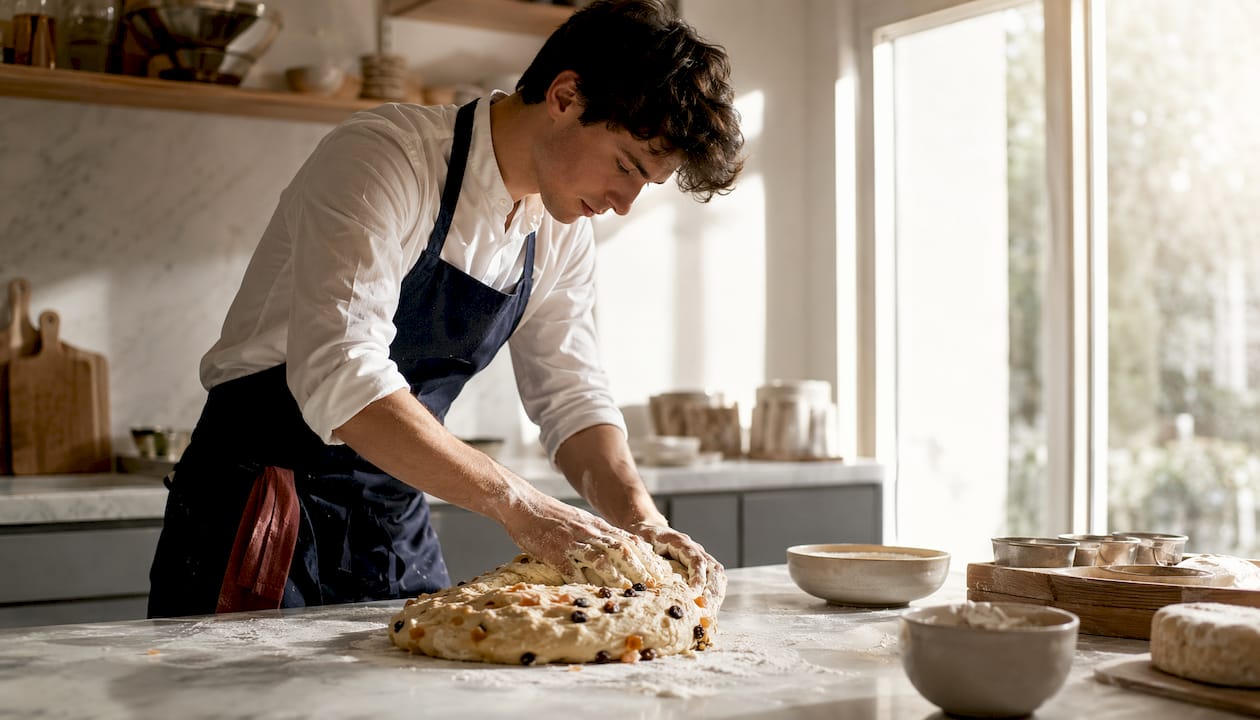
A second version features a young Milanese nobleman, Ughetto degli Atellani, in love with a baker's daughter. To win over her father, he reportedly got hired at the bakery and enriched the festive bread recipe with precious ingredients. Again, no primary source validates this story.
Pro tip: To read a culinary legend with a critical mind, ask yourself three questions: who is telling this story and for how long? Is there a written source prior to the 19th century? Does the narrative serve an interest (commercial, identity-related, tourist)? If all three answers are vague, you are dealing with a founding myth, not a historical fact.
These stories persist because they fulfill a specific social function. They humanize a product, giving it a face and a humble origin (the ingenious apprentice, the resourceful lover). They also anchor panettone in a symbolism of sharing and collective salvation, values that correspond exactly to what a successful holiday meal represents.
What these legends reveal, at heart:
- Panettone is perceived as a product born of necessity and ingenuity, not luxury.
- Oral transmission preceded written codification by several centuries.
- Milanese identity was built, in part, around this foundational narrative.
How is traditional panettone made?
Sourdough, noble ingredients, and long fermentation
Traditional panettone relies on four technical pillars: natural sourdough (lievito madre), high-fat ingredients, long multi-stage fermentation, and inverted cooling after baking.
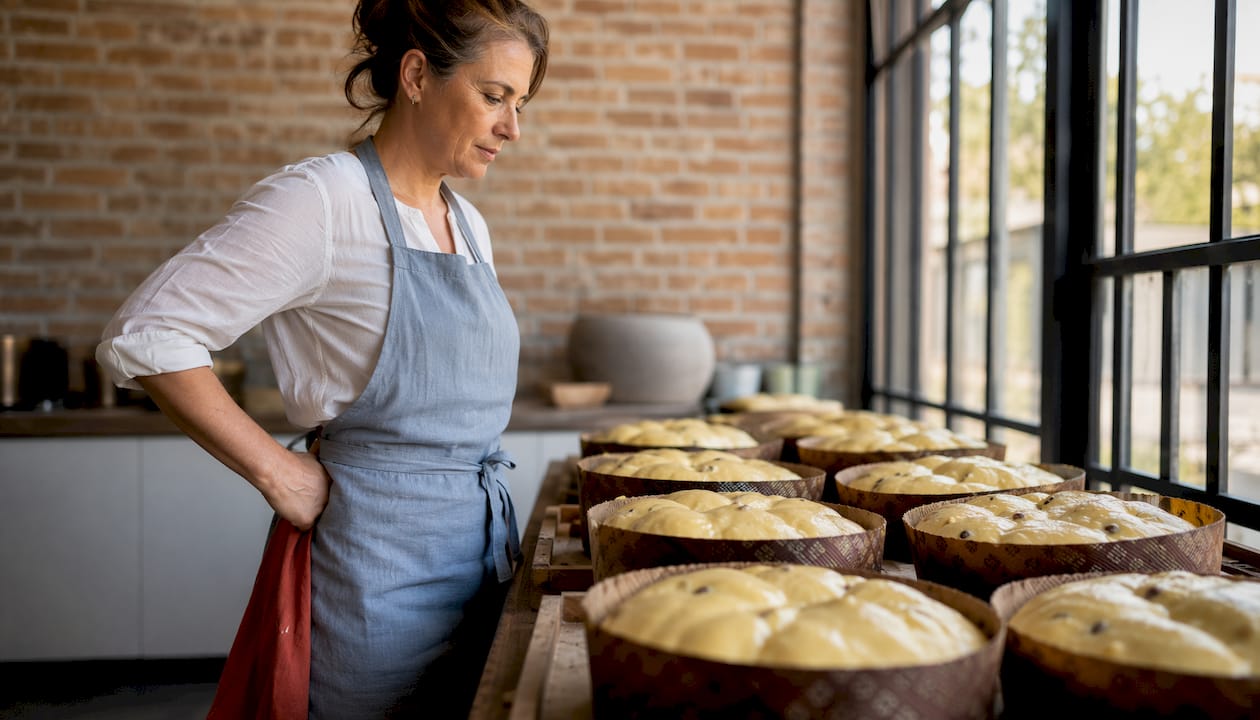
Lievito madre is a solid sourdough culture, firmer than liquid sourdough, maintained by regular feedings. Its aromatic profile, dominated by lactic notes, is irreplaceable by commercial yeast. Industrial yeast rises quickly, but it does not develop the aromatic complexity or natural shelf-life that living sourdough provides. A sourdough panettone naturally keeps for several weeks; a yeast panettone goes stale in a few days.
Typical ingredients and their role:
- Gluten-rich flour: structures the protein network that traps fermentation gases and allows for high rising.
- Butter: provides richness, aroma, and shelf-life; its percentage is a quality marker.
- Egg yolks: emulsify the dough, enrich the color and texture.
- Candied fruits and raisins: provide sugar, moisture, and aromatic complexity; their proportion is regulated by the artisanal specifications of the Committee of Master Pastry Chefs of the Milanese Tradition.
- Natural sourdough: slow fermentation, lactic aromas, extended shelf-life.
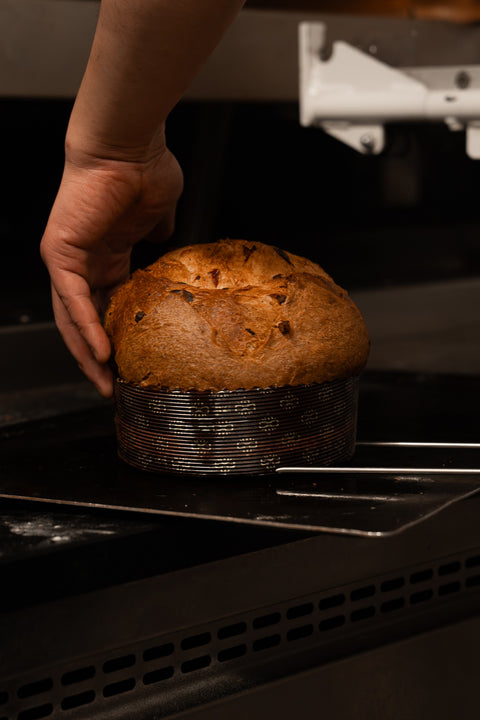
The traditional method involves two successive doughs. The first, made with a portion of the flour, sourdough, and butter, ferments for several hours. The second incorporates the remaining ingredients. Between the two, sourdough feedings maintain its activity. After shaping and placing in the pirottino, the dough rises for several more hours before baking. As soon as it comes out of the oven, the mold is turned upside down and hung: this step, often overlooked in general descriptions, is essential. It prevents the still-warm crumb from collapsing and creates the characteristic stringy texture.
| Step | Approximate duration | Technical role |
|---|---|---|
| Sourdough feedings | 12 h | Activate and stabilize the culture |
| First dough | 12 h | Develop the gluten network |
| Second dough | 4–6 h | Incorporate butter, eggs, fruits |
| Rise in mold | 6 h | Final volume development |
| Baking | 45 min | Crumb structuring |
| Inverted cooling | 12 h | Stabilize stringy texture |
Pro tip: The total artisanal production time, often cited around 72 hours, is not a marketing gimmick: it is the direct consequence of the incompressible fermentation times of natural sourdough. An artisan claiming less than 48 hours is likely working with added yeast.
How did panettone become a global product?
From the Milanese workshop to mass retail
The standardization of panettone in the 20th century is due to two simple technical decisions: the adoption of the cylindrical paper mold and the mechanization of kneading. These two innovations allowed for the production of large volumes while maintaining a recognizable shape. The Motta company, founded in Milan in the 1920s, was one of the first to industrialize production and distribute panettone outside of Lombardy. Alemagna followed shortly after, competing in the same markets and helping to make panettone a national rather than a regional product.
After World War II, democratization accelerated. Prices dropped, volumes increased, and panettone entered supermarkets in the form of decorated boxes. It became a corporate gift, a year-end gesture that employers offered their employees. This practice, still vibrant in Italy, transformed the product: it is no longer just a dessert, it is an object of social connection.
- 1920s: Motta industrializes production in Milan, standardizes the dome shape.
- 1930s–1940s: Alemagna enters the market; competition accelerates mechanization.
- 1950s–1960s: panettone enters the Italian mass retail market, prices fall.
- 1970s–1990s: massive export to Italian communities in Europe and the Americas.
- 2000s–2010s: return of craftsmanship, rediscovery of natural sourdough, upscale shift.
- Since 2015: the Panettone World Cup and other international competitions promote artisanal excellence and reignite interest in sourdough versions.
What place does panettone occupy in Italian and French culture?
Family ritual, San Biagio, and adoption in France
Panettone is not just a dessert. It is a ritual. In traditional Lombard families, it is the father who slices the panettone at the table, a symbolic gesture that opens the season of well-wishes. Each slice represents the sharing of peace and prosperity for the coming year. This social ritual goes far beyond mere tasting.
More surprisingly, some Lombard families keep a slice of panettone until February 3rd, the feast of San Biagio, patron saint of the throat. Eating this saved slice is said to provide symbolic protection against winter ailments. The practice is as much about superstition as it is about tradition, but it illustrates how deeply panettone is integrated into the Lombard ritual calendar, far beyond Christmas.
In France, the adoption of panettone came in successive waves. Transalpine grocers in the Italian neighborhoods of Paris, Lyon, or Marseille introduced it as early as the 1950s–1960s. Then, French artisans trained in Italy began producing it locally, bringing their own sensibility while respecting technical fundamentals. Today, collaborations between French and Italian houses, or between pastry chefs and delicatessens, have anchored panettone in the French culinary landscape as a premium gift product, particularly between November and January.
The gift dimension is also central in other cultures. A reflection on Christmas gift traditions in different markets shows that artisanal food products occupy an increasing place compared to material gifts, a trend that directly benefits quality panettone.
| Market | Adoption method | Main period | Dominant usage |
|---|---|---|---|
| Italy (Lombardy) | Native tradition | December, San Biagio | Family ritual, corporate gift |
| France | Transalpine grocers, artisans trained in Italy | November–January | Gourmet gift, tasting |
| South America | Italian migrations (19th–20th c.) | December | Festive dessert, local production |
| Australia, USA | Italian diaspora | November–December | Holiday product, mass retail |
How to recognize an artisanal sourdough panettone?
An artisanal panettone stands out by sight, smell, and the label. Here are the unmistakable criteria:
- Natural sourdough mentioned: the label must indicate "lievito madre" or "natural sourdough" among the first ingredients, not just "yeast."
- Short ingredient list: butter, eggs, flour, sugar, candied fruits, sourdough. No hydrogenated oils, no artificial flavors, no cascade of emulsifiers.
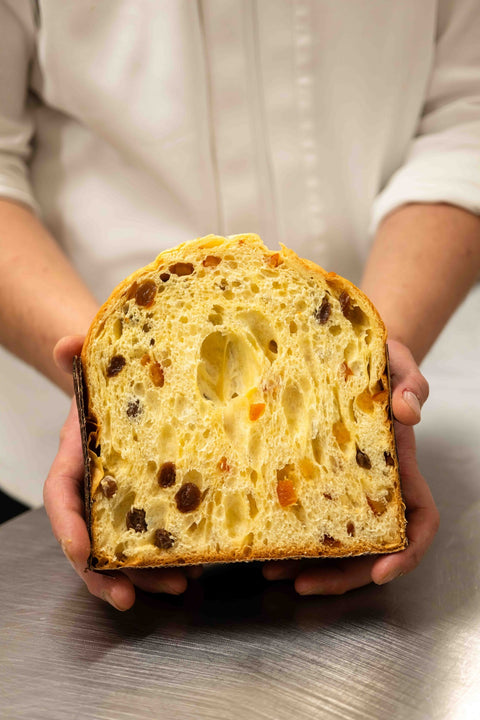
- Visible proportion of fruit: a classic panettone must contain a significant proportion of candied fruit and raisins, visible when sliced.
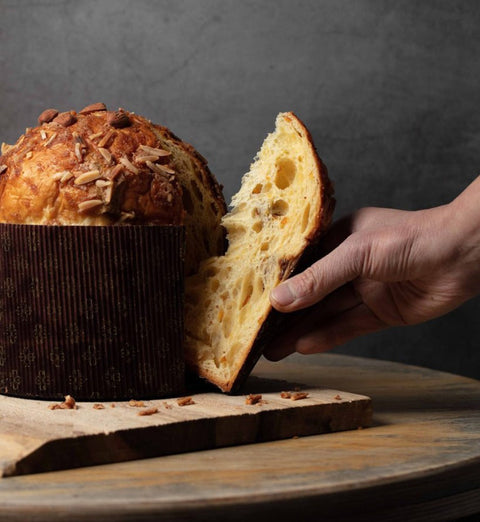
- Stringy texture: the crumb should stretch into fine strands when pulled apart, a sign of a gluten network well-developed by long fermentation.
- Long natural shelf life: a sourdough panettone will keep for several weeks without preservatives. If the expiration date is very short, it is often an indicator of commercial yeast.
- Intact paper mold (pirottino): the paper is an integral part of the structure; an artisanal panettone is never removed from the mold before sale.
- Specifications mentions: "Panettone tipico della Tradizione Artigiana Milanese" or a reference to artisanal specifications is a strong signal.
Pro tip: Ask your artisan or seller three simple questions: What is your starter? How long does your fermentation last? Do you turn your panettone upside down after baking? A serious artisan will answer without hesitation. A reseller of industrial products will change the subject.
To learn more about your purchasing criteria, Christophe Louie's how to choose a panettone page details each point with concrete examples.
Brief timeline: essential milestones in the history of panettone
| Period | Key event | Importance |
|---|---|---|
| Middle Ages | Enriched holiday breads in Lombardy | Direct ancestors, reserved for celebrations |
| 15th–17th century | Mentions in the registers of Milanese ducal courts | First written traces of a Milanese holiday bread |
| 19th century | Appearance of the term in Milanese dictionaries | Linguistic and commercial codification |
| 1920s | Industrialization by Motta, standardization of the dome | Birth of mass-market panettone |
| 1950s–1960s | Post-war democratization, entry into mass retail | Transformation into a corporate gift |
| 1970s–1990s | International diffusion via Italian migration | Establishment in Europe, the Americas, Australia |
| Since 2015 | International competitions, return of artisanal sourdough | Valuation of excellence and upscale positioning |
Does panettone vary by region in Italy?
The short answer is yes, but less than you might think. Panettone is a Milanese specialty, and other Italian regions have their own holiday cakes: the pandoro from Verona, the panforte from Siena, the Neapolitan struffoli. These products coexist without being confused, each bearing a strong regional identity.
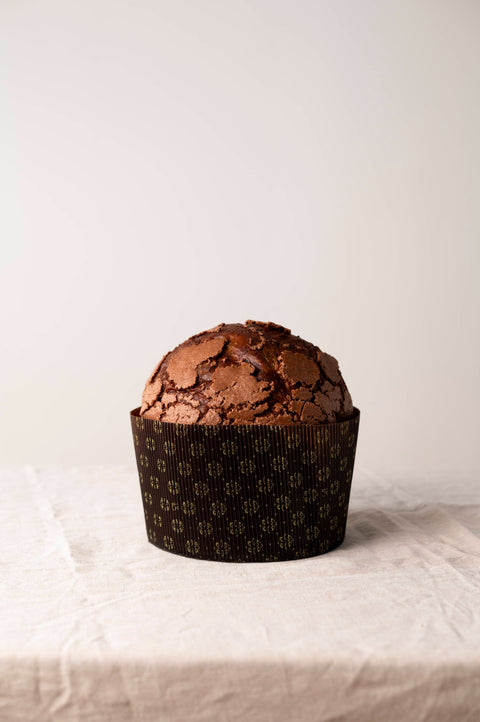
Within the Milanese tradition itself, variations exist. Some Lombard artisans work with local candied fruit, others incorporate Sicilian citrus or Corinthian raisins. The "classic" version remains the benchmark, but versions with chocolate, chestnut cream, or Bronte pistachios have emerged over the decades, driven by pastry chefs seeking to personalize their production without betraying the method.
The tension between codification and creativity is at the heart of regional evolution. The specifications of the Committee of Master Pastry Chefs of the Milanese Tradition protect the fundamentals (sourdough, minimum percentages of butter and fruit) while leaving room for artisans to express their style. This framework allows for both the preservation of a tradition and its renewal.
How did Italian migration spread panettone around the world?
The history of the international spread of panettone is inseparable from the great Italian migration waves. Between the late 19th century and the 1960s, millions of Italians left the peninsula for Argentina, Brazil, the United States, Australia, and several Northern European countries. They took their food traditions with them, and panettone was one of them.
In Argentina and Brazil, the Italian community was large enough to create local demand. Italo-Argentine bakeries and pastry shops began producing panettone as early as the beginning of the 20th century. Today, Argentina is one of the largest panettone markets in the world, with local production rivaling Italy in volume. The product is called "pan dulce" there and has adapted to local tastes, sometimes with different fillings.
International expansion was then accelerated by the commercial strategies of Italian manufacturers, who realized very early on the appeal of decorated boxes and festive editions for export markets. Panettone thus became, in many countries, a recognizable holiday product before even being a gastronomic one. The artisanal upscale shift of recent years has rebalanced this perception, by putting the quality of the sourdough and the method back at the center of the conversation.
Key points
The history of panettone blends documented facts, oral legends, and technical evolution over several centuries, with Milan as a constant anchor point.
| Point | Details |
|---|---|
| Milanese origin | Leavened brioche born in Milan, attested in ducal courts from the 15th century. |
| Legends without proof | The stories of Toni and Ughetto are founding myths, not confirmed by archives. |
| Natural sourdough, key marker | The lievito madre and a fermentation of approximately 72 hours distinguish artisanal from industrial. |
| Social ritual | The solemn slicing and the tradition of San Biagio anchor panettone in the Lombard family calendar. |
| Christophe Louie | Parisian artisanal house that produces 72-hour sourdough panettone year-round, available in their Marais boutique and via national delivery. |
What the history of panettone taught me about sourdough
We often talk about panettone as a Christmas product. That is true historically, but it is also a reductive vision. What struck me while delving into this history is that panettone has always been a product of technical constraint as much as one of tradition. 15th-century Milanese artisans did not use sourdough out of philosophical conviction: they had no other option. Commercial yeast did not exist. Long fermentation was the only way to obtain an airy crumb with ingredients so rich in fats.
What industrialization erased was not just the sourdough. It was the time constraint, and with it, part of the aromatic complexity. Returning to lievito madre means accepting that some things cannot be accelerated without loss. The stringy crumb, the lactic notes, the natural preservation for up to five weeks: all this is the direct consequence of a fermentation that cannot be shortened. This is why at Christophe Louie, the natural sourdough panettone is not a seasonal product. It is a permanent product, because sourdough, for its part, does not take vacations.
Tasting an artisanal sourdough panettone, in Paris or anywhere in France
Understanding the history of panettone is good. Tasting a real one is better.
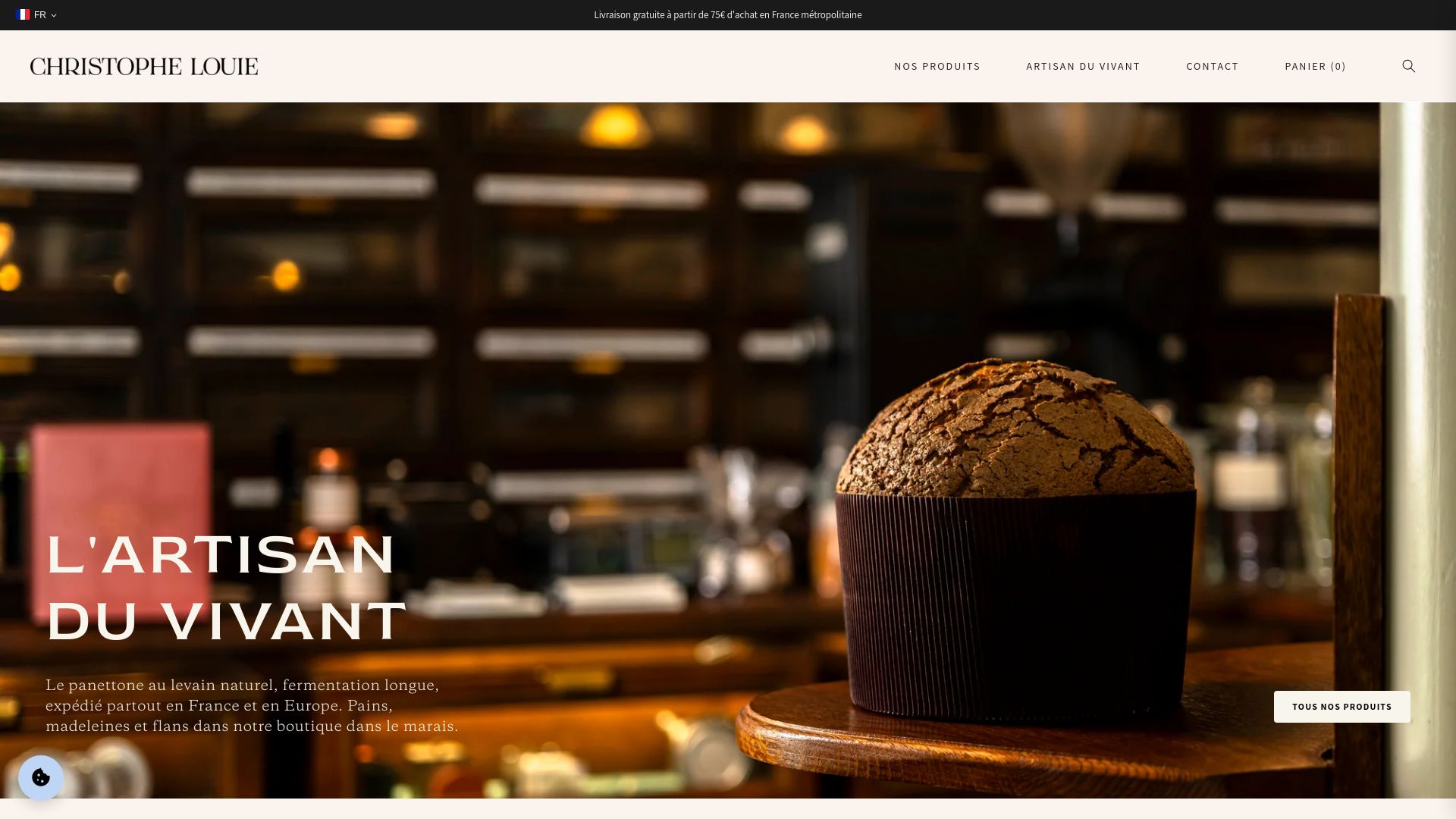
Christophe Louie produces his natural sourdough panettone year-round in his Marais workshop, following the traditional two-dough method spread over 72 hours. The flours come from Italy (Grassi, Dalla Giovanna), and other ingredients are sourced in France. The range includes the classic candied fruit panettone, the orange blossom panettone, and several signature creations. Available in the boutique at 12 rue Dupetit-Thouars (Paris 3rd), via click & collect, and for national delivery. Order directly on christophelouie.com or stop by the boutique to choose your version.
Useful sources to delve into the history of panettone
- Panettone, Wikipedia (French version): encyclopedic synthesis, a good introduction to origins and legends.
- Gault&Millau: panettone, its history and our recommended addresses: reference article on the artisanal tradition and production times.
- Milanese panettone: history and gastronomic identity (Great Italian Food Trade): details on the specifications and criteria for authenticity.
- En-vols.com: traditional panettone recipe, star of the holidays: Milanese context and shape standardization.
- Lacquolina.fr: why panettone at Christmas?: San Biagio ritual and cultural dimension.
- Ticino Welcome: panettone, king of the holidays: international perspective and artisanal competitions.
- Christophe Louie: the origins of panettone: internal page dedicated to the history and roots of the product.
- Christophe Louie: why choose a sourdough panettone?: technical explanation of the artisanal method and the benefits of natural sourdough.
- Christophe Louie: how to taste panettone?: practical guide on pairings and tasting.