Reading Panettone labels: tips for making the right choice
To choose a panettone, start with the product name, the list of ingredients, and the allergens; then, look at the QUID percentage if there is one, the nutritional table expressed per 100 grams, and the date. These five points are enough to judge a product in one minute. The INCO Regulation No. 1169/2011 sets these requirements, and the DGCCRF ensures compliance in France.
In brief:
- The presence of butter or eggs at the top of the list indicates a richer and higher-quality recipe in a panettone.
- The percentage of highlighted ingredients must be indicated, especially if the packaging or the product name refers to a specific component.
- Reading the allergens in bold or uppercase is essential to rule out any risk in case of allergy or intolerance.
- The nutritional declaration must be compared per 100 grams, paying attention to energy, fats, sugars, and salt.
- The minimum durability date and the batch number allow for checking the freshness, traceability, and compliance of the product.
Table of contents
- How to read the product name and ingredient list
- Allergens and intolerances: how to interpret the labels
- Comparing the nutritional declaration: what to look for per 100g
- Dates, storage, and traceability: DDM, batch, and storage
- Origin and marketing claims: what is regulated
- Practical checklist: four steps to distinguish between two panettones
- What the label doesn't say about craftsmanship
- Quick tips for checking in-store and online
- The recommended option: our collection of sourdough panettones
- Sources
- Frequently asked questions
How to read the product name and ingredient list
The ingredient list always follows the descending order of weight at the time of manufacture, as specified by the Ministry of the Economy. The first three ingredients therefore carry the most weight in the composition, and this is where most of what you are actually eating is determined, even before reading the rest of the label.
For a panettone, a few markers help evaluate the product without judging its quality solely on this criterion:
- Butter should appear early in the list if it is present in significant quantities, not just at the end in the form of traces.
- Eggs, often egg yolks for color and fluffiness, indicate a richer recipe.
- Natural sourdough ("levain," "lievito madre," or "sourdough starter") distinguishes a long fermentation from a fast industrial yeast.
- Candied fruits or raisins should appear with a clear percentage, not just as visual decoration on the packaging.
The QUID principle, provided for by the INCO regulation, requires that a percentage be indicated whenever an ingredient is highlighted in the product name or by an image on the packaging. A panettone "with candied orange peel" featuring a photo of oranges on the cover must therefore specify the actual percentage of peels used. The absence of this figure while the ingredient is visually featured is a signal to watch out for, as shown in a product entry example from Open Food Facts where some percentages remain vague.
Pro tip: never rely on the photo on the packaging: always look for the figure that accompanies it, or its absence.
A practical method for reading labels recommends comparing every visual claim to the corresponding numerical data before making a choice.
Allergens and intolerances: how to interpret the labels
Allergens must appear highlighted in the list of ingredients, usually in bold or uppercase, according to the DGCCRF rules on food allergens. A panettone almost always contains gluten, eggs, and often nuts or milk.
The mention "may contain traces of" signals a risk of cross-contamination in the factory, never an intentionally added ingredient. For an allergic person, however, this is the information that matters most when choosing.
- Check first for ingredients highlighted in the list itself, not just the notices at the bottom of the label.
- A short list is not a guarantee of safety if a major allergen is clearly present.
Comparing the nutritional declaration: what to look for per 100g
The nutritional declaration is always compared based on 100 grams, never per serving, because servings vary from one brand to another, making any comparison flawed. This is a direct requirement of the INCO regulation, enforced by the DGCCRF.
Five lines deserve your attention before the others:
- Energy, expressed in kilojoules and kilocalories, gives an initial idea of the product's density.
- Fats, and especially the proportion of saturated fats, distinguish a butter-based panettone from a product made with cheaper vegetable fats.
- Carbohydrates and, in particular, sugars reveal the actual proportion of added sugar beyond the candied fruits.
- Proteins remain secondary for a sweet product, but their presence confirms the real use of eggs or milk.
- Salt, often overlooked in a pastry, varies according to recipes and fermentation processes.
A claim such as "rich in fruit" or "no added sugars" does not excuse you from checking the table: these mentions fall under the regulation on nutrition and health claims, which governs their use but does not prevent a product from having a high sugar content otherwise. The figure per 100 grams remains the ultimate judge against any slogan.
Dates, storage, and traceability: DDM, batch, and storage
The DDM (minimum durability date) indicates until when the product maintains its optimal quality, while the DLC (use-by date) concerns perishable goods where exceeding the date presents a real risk. A panettone almost always shows a DDM, not a DLC, due to its low free water content.
A long DDM proves nothing about the authenticity of the recipe: it mainly reflects the sugar content, alcohol, or the preservation processes used. The batch number allows the manufacturing to be traced in case of a product recall. For online purchases, regulations require that the date and storage conditions be communicated before the order is validated, not just upon delivery. Our article on panettone DLC details this point for remote orders.

Origin and marketing claims: what is regulated
The origin of a primary ingredient must be specified when its absence could mislead the consumer, especially when the packaging suggests a particular origin through the name, flag, or evocative image. Mentions like "organic" or "farm-made" follow precise specifications and cannot be claimed freely.
- A mention of "artisanal" is not governed by a single legal definition, unlike "organic," which requires certification.
- The term "traditional" remains vague in French law: it is better to check the recipe itself (sourdough, fermentation time) than the word used.
- Always compare the marketing image with the corresponding figure on the label, whether it is a percentage of fruit or a butter content.
The 2005 Italian decree on panettone sets benchmarks for a traditional recipe that are useful for understanding industry practices, without replacing the reading of a label compliant with the law applicable in your country of purchase.
Practical checklist: four steps to distinguish between two panettones
This method, taken from a practical approach to label reading, takes one to two minutes in-store or when viewing an online product sheet.
- Read the first three ingredients: a positive signal is the presence of butter and eggs at the top of the list; a negative signal is an unidentified vegetable oil right after flour.
- Locate the QUID of the highlighted ingredient: a panettone "with tangerines" without a displayed percentage deserves your suspicion.
- Compare the nutritional table per 100 grams between two products rather than per serving, to judge the actual density of sugar and fat.
- Check the allergens in bold, the durability date, and the batch number before finalizing your choice.
Pro tip: keep these four steps in mind even for a quick purchase: they are enough to rule out most misleading presentations without requiring any specific technical knowledge.
Our page how to choose a panettone reviews these benchmarks with concrete examples drawn from our own production.
What the label doesn't say about craftsmanship
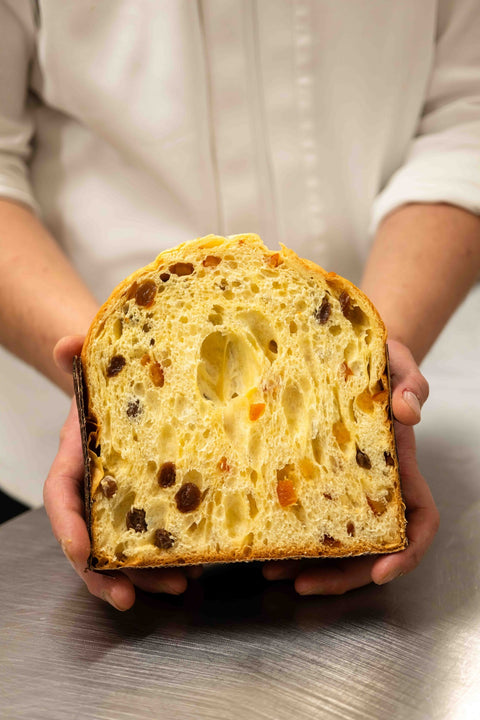
A regulatory label never reveals the fermentation time or the shaping technique, two elements that nonetheless affect the final texture. A natural sourdough worked over 72 hours in two stages provides a stringy crumb and a complex aroma that no mandatory mention can measure. Manual shaping, flour selection, or temperature control are matters of professional expertise, not something to be checked off in a box.

At Christophe Louie, labeling transparency is paired with process transparency: our pages on panettone ingredients detail the recipe beyond what the law requires, and our article on allergen management explains how we document every risk of cross-contamination in the workshop.
Quick tips for checking in-store and online
In-store, ask about the production date, storage conditions, and the origin of the flour: a seller who knows these answers inspires more confidence than a simple slogan on the packaging. Online, look for a product sheet that displays the complete list of ingredients and the nutritional table before purchasing, not just after.
— Christophe
The recommended option: our collection of sourdough panettones
At Christophe Louie, every panettone undergoes natural sourdough fermentation spread over 72 hours, with manual shaping and Italian flours selected for their technical performance. Our product sheets detail the ingredients, allergens, and benchmarks this guide has presented to you, without vague marketing claims in place of a figure.
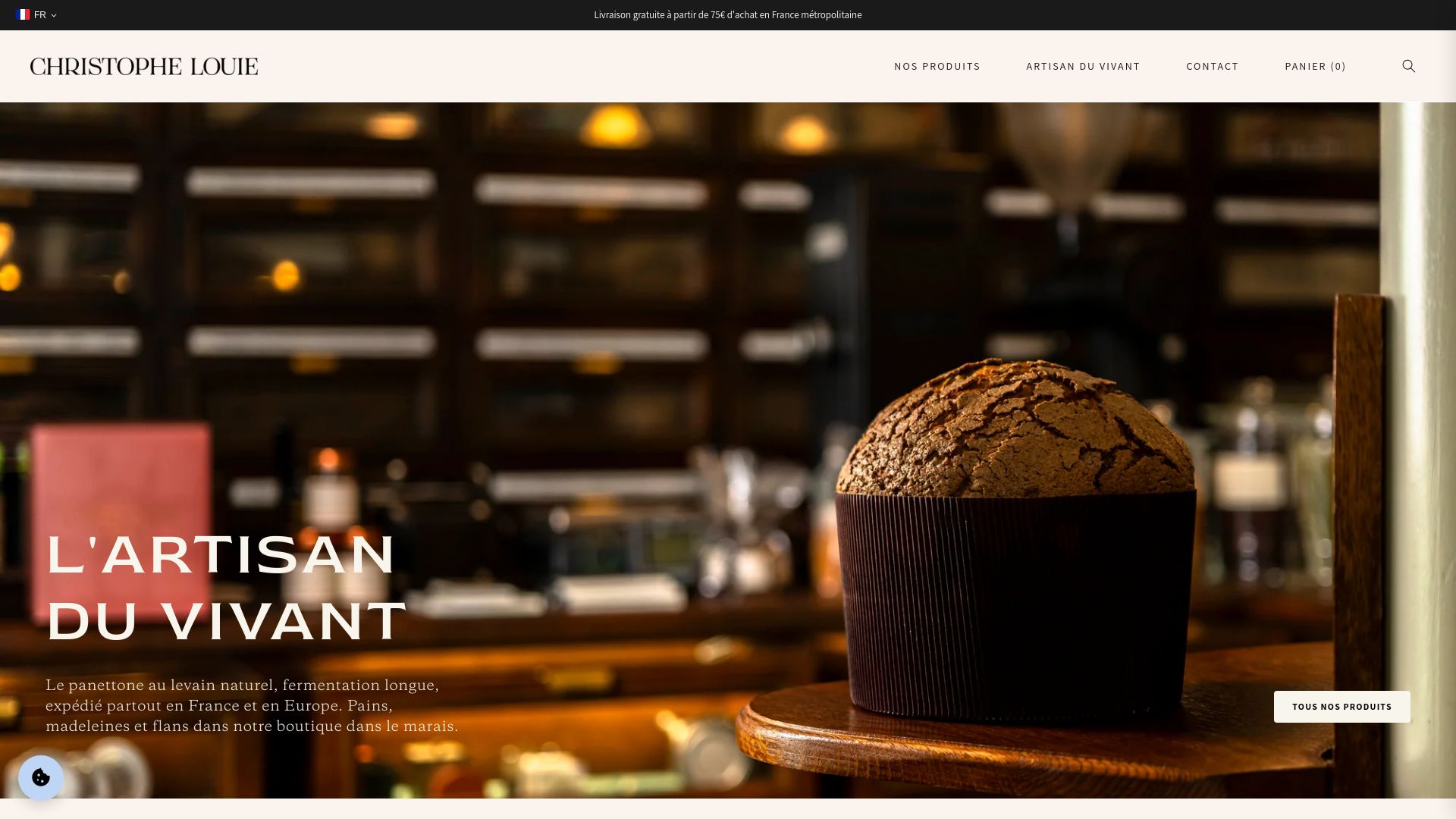
- The panettone collection presents our classic, chocolate, tangerine, or signature versions.
- The orange blossom panettone sheet concretely illustrates a detailed label with precise percentages.
- Our range also extends to sourdough breads and pastries to extend the approach beyond panettone.
Discover the panettone collection and compare the labels yourself to those of another product using the benchmarks in this guide.
Sources
To check a label yourself, three texts are sufficient: the INCO regulation No. 1169/2011 which sets mandatory mentions, the DGCCRF sheet on allergens for food safety issues, and the Ministry of Economy page on labeling for all rules applicable in France. For holiday logistical organization, a practical guide to year-end meal preparation usefully supplements these storage benchmarks.
- Foodstuffs: what are the labeling rules?
- Regulation (EU) No. 1169/2011 — INCO
- Reading a food label: practical method
Frequently asked questions
What is the difference between a panettone and a brioche?
Panettone relies on natural sourdough fermentation that often spans several days, as opposed to yeast fermentation, which is generally shorter for a classic brioche. This difference in process gives the panettone its characteristic stringy texture and a longer natural shelf life.
What is the QUID principle on a panettone label?
QUID is the obligation to indicate the exact percentage of an ingredient as soon as it is highlighted in the product name or by an image on the packaging, according to the INCO regulation. A panettone "with candied mandarins" must therefore specify the actual percentage of mandarins used.
How do I know if a panettone contains allergens?
Allergens are highlighted, usually in bold, in the ingredient list, in accordance with DGCCRF rules. The statement "may contain traces of" indicates a risk of cross-contamination in the workshop, which is distinct from an intentionally added ingredient.
Why is panettone often more expensive than other festive pastries?
The price generally reflects the fermentation time, the quality of raw materials such as butter and eggs, and the manual shaping process, all of which are elements invisible on the regulatory label itself. A long fermentation with natural sourdough, as is the case for some artisanal productions, requires more time and expertise than accelerated production.