What flour strength should I choose for a homemade panettone?
For a panettone that holds up through 72 hours of fermentation without collapsing, aim for a flour with a W index of at least 340, ideally between 370 and 410. The most reliable type remains 00 flour specifically for panettone; failing that, Manitoba flour makes for a solid alternative. This strength is not a technical detail reserved for professionals: it directly dictates how well the dough holds up during long sourdough leavening.
In short:
- A flour with a W index of at least 340, ideally between 370 and 410, is necessary for stable 72-hour fermentation without collapse.
- 00 flour specialized for panettone is the gold standard, but Manitoba can work as a reliable alternative for beginners, with a W between 350 and 380.
- In the absence of a technical flour, a blend of 70% Manitoba and 30% T45 can be used, sifting it to homogenize the blend's strength.
- The water absorption capacity of strong flours can exceed 70%, requiring hydration adjustments to avoid a dough that is too sticky or fragile.
- A frequent problem for home bakers is the sagging of the crumb, often due to insufficient flour strength or over-proofing before baking.
Table of contents
- Understanding the W index, P/L ratio, and protein content for panettone
- Which flours are recommended for a successful panettone?
- How to replace hard-to-find panettone flour
- Adapting hydration and kneading to the chosen flour
- The 72-hour fermentation schedule, step by step
- Why your panettone collapses or fails to rise
- The Christophe Louie method: Italian flours and 72-hour sourdough
- Starting your first homemade panettone: what you really need to remember
- Sources
- Frequently Asked Questions
Understanding the W index, P/L ratio, and protein content for panettone
The W measures a flour's resistance to stretching, in other words, its ability to retain the gas produced by the sourdough without tearing. A standard T45 or T55 flour typically has a W between 150 and 220, which is enough for a baguette but will crack under the weight of the butter, eggs, and sugar in a panettone. The gluten network gives way during long fermentation, and the crumb collapses during baking.
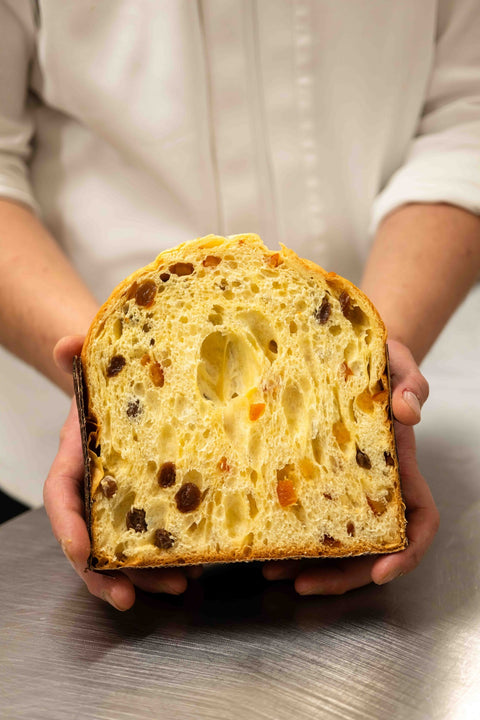
The P/L ratio completes the picture. It represents the balance between elasticity (P) and extensibility (L): too much elasticity, and the dough resists and refuses to rise; too much extensibility, and it spreads and loses its structure after baking. This balance remains underestimated by many home bakers, even though it explains a large part of the failures where the crumb shrinks in the oven. Finally, a protein content higher than 14 or 15% ensures enough gluten to support the fats without fatiguing over three days of rising.
Which flours are recommended for a successful panettone?
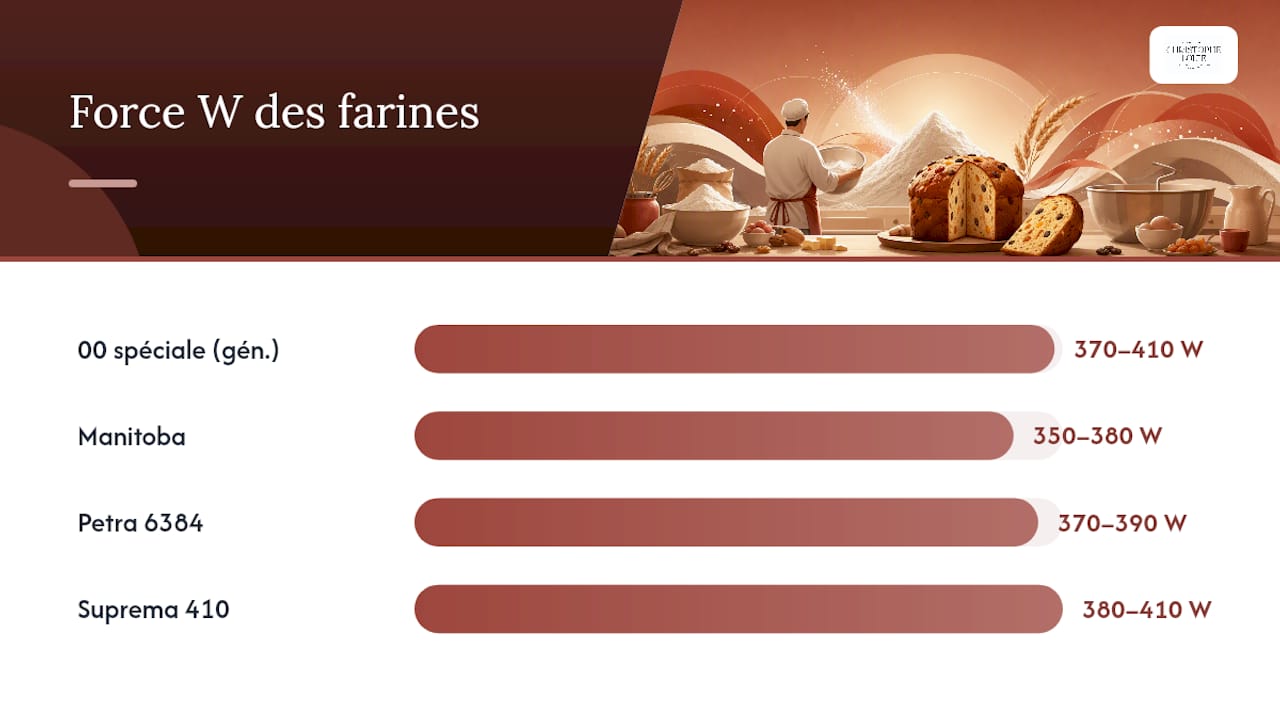
Specialized panettone 00 flour remains the technical benchmark. With a W between 370 and 410 and a protein content around 15 to 16% (https://www.giochidigusto.it/prodotto/farina-per-panettone/), it provides a "stringy" (filante) crumb and good shelf stability even after five weeks.
Three concrete options are available to you depending on your budget and access to Italian flours:
- Generic 00 special panettone flour: the default choice for artisans, designed to absorb butter, yolks, and sugar without losing its gluten network.
- Manitoba, with a W generally between 350 and 380, remains the most accessible alternative for a first amateur attempt.
- Petra 6384, a 00 flour with a W of 370 to 390 and 14 to 15% protein, used in professional bakeries for long leavened products.
- Suprema 410, which claims a W between 380 and 410 with high absorption, designed specifically for long maturations of 48 to 72 hours.
These last two references are mainly found at suppliers specializing in Italian flours, rarely in supermarkets.
How to replace hard-to-find panettone flour
When no technical flour is available, a calculated blend saves the recipe better than using T45 alone.
- Weigh 70% Manitoba and 30% T45, a ratio that compensates for the weakness of the T45 while keeping the dough a bit more supple than with pure 00.
- Sift everything together before starting to homogenize the mixture's strength and avoid uneven clumps of gluten.
- If only T45 is available, shorten the first rise and accept a result closer to a brioche than a classic panettone: the texture will be good, but shelf life over several weeks is less guaranteed.
- Test the strength visually by observing the dough's elasticity during the first kneading: if it tears instead of stretching, increase the proportion of Manitoba in your next attempt.
Adapting hydration and kneading to the chosen flour
A high-W flour absorbs more water than standard flour. Technical data sheets for panettone 00 flours mention hydration levels sometimes exceeding 70%, compared to 60-65% for a classic T45. This absorption capacity changes how you dose water and knead.
During kneading, watch for the gluten window: the dough should stretch to form a thin veil without breaking immediately. Dough that is too soft or "runs" signals a flour that is too weak for the recipe. Also keep an eye on temperature, ideally between 24 and 26°C (75-79°F) at the end of kneading, because dough that is too hot fatigues the gluten network even before the first rise.
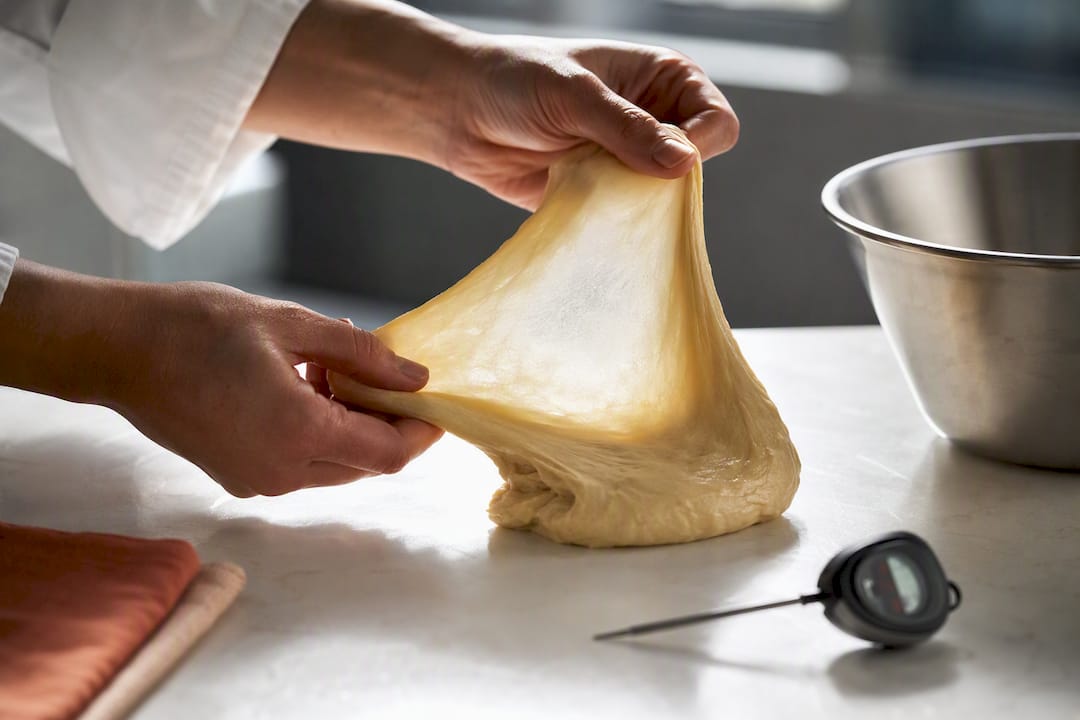
A short autolyse (flour and water mixed without sourdough, left to rest for 20-30 minutes) makes incorporating butter easier later. Only add butter and candied fruits once the gluten is well-developed, otherwise the dough loses elasticity before it has had time to structure itself.
The 72-hour fermentation schedule, step by step
A strong flour only makes sense if the fermentation schedule gives it time to work. A classic plan spans three days: successive sourdough refreshments on the first day, the first dough with a long rest (often overnight) on the second day, and then the enriched second dough, shaping, and final proofing before baking on the third day.
The most reliable sensory indicator is volume: the dough must double, sometimes triple, before each subsequent step. The poke test (light pressure that slowly bounces back) confirms the second proof is ready for the oven. It is precisely over this duration that the high W makes the difference: a weak flour would lose its structure before the end of the proofing period, while a strong flour keeps the gluten network intact over the 24 to 72 hours a true sourdough panettone requires.
Why your panettone collapses or fails to rise
Three problems occur most often for home bakers, and they can almost always be corrected by going back to the flour or the sourdough.
- The crumb collapses during baking: the flour was too weak (insufficient W) or the dough was over-proofed before entering the oven. Reduce the final proofing time or upgrade your flour.
- The dough remains sticky and impossible to shape: hydration exceeds your flour's absorption capacity. Add flour in small pinches rather than redoing everything, or cool the dough slightly.
- The dough doesn't rise at all: the sourdough lacks vigor or the ambient temperature is too low. Check your refreshments first before blaming the flour.
Pro tip: Note the temperature of your kitchen at every attempt. A panettone that "doesn't rise" often has less of a flour issue than a sourdough working at 18°C instead of 24°C.
The Christophe Louie method: Italian flours and 72-hour sourdough
The choice of flour is not to be neglected: some panettones are crafted with flours from Italy selected for their technical strength, while other ingredients may be sourced locally. The live sourdough, or lievito madre, is refreshed and then worked through a two-dough process spread over 72 hours, with manual shaping.
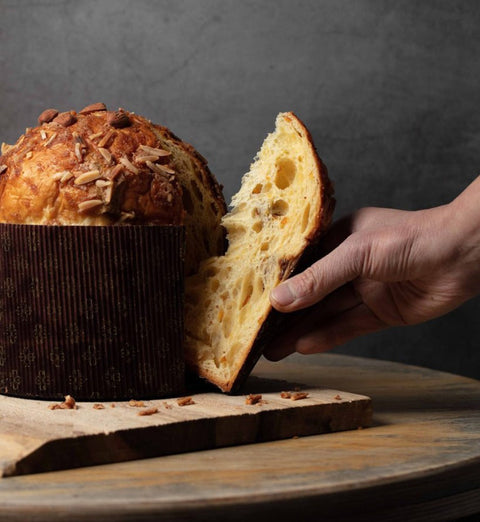
This demand for quality flour helps achieve the "stringy" (filante) crumb characteristic of panettone and promotes prolonged shelf life for the product, without relying on additives or accelerated processes. To learn more about our method, our article on long 72-hour fermentation details every step, and our page on stiff sourdough for panettone reviews the full schedule of refreshments.
Starting your first homemade panettone: what you really need to remember
Start with Manitoba flour rather than an imported 00 flour: it is more forgiving of beginner mistakes and remains easy to find, much like a well-mastered simple Pecan Pie recipe. If you have to make do with T45 alone, accept that you will get a texture closer to a brioche than a traditional panettone; it’s not a failure, it’s a milestone.
Keep a log for every attempt: weight of ingredients, temperatures, proofing times. This is the fastest way to understand how YOUR flour reacts in YOUR kitchen. Flour strength matters immensely, but a vigorous sourdough and careful kneading technique carry just as much weight in the final result.
— Christophe
Sources
To go further on the technical indices mentioned here, the product sheet for specialized 00 panettone flour details the W and protein values expected by professional suppliers. The absorption and stability parameters for Suprema 410 and Petra 6384 provide a concrete base to compare flours available from specialized retailers. TheSeven7's guide on choosing panettone flour also offers blend ratios tested by amateurs.
- Which flour for which use (La Fourche blog)
- Suprema 410 (Agricola Piano)
- Petra 6384 - Special panettone flour (BienManger)
Frequently Asked Questions
What is the minimum flour strength for a panettone?
Aim for a W index of at least 340, with an ideal range between 370 and 410 for 00 special panettone flours. Below this threshold, the gluten network risks collapsing during long sourdough fermentations.
Can Manitoba replace 00 panettone flour?
Yes, Manitoba generally has a W between 350 and 380, making it an accessible and reliable alternative for an amateur. The result remains slightly different from that obtained with a specialized 00 flour, but entirely satisfying.
Can you make a panettone with classic T45 flour?
T45 on its own has a typical W between 150 and 220, which is insufficient for an enriched dough over 72 hours.
Why does my panettone collapse after baking?
Collapse almost always comes from flour that is too weak or dough that was over-proofed before baking. Check your flour's W index first, then slightly reduce the final proofing time.
What hydration should be used with strong flour for panettone?
Special 00 panettone flours absorb more water than standard flour, with hydration levels sometimes exceeding 70% according to supplier technical sheets. Adjust gradually by observing the dough's texture rather than following a fixed number.