Which flour for panettone: how to choose and use it
To succeed with a sourdough panettone, you need a high-strength type 00 or T55 flour with a high W and sufficient protein content to ensure the dough, candied fruits, and fermentation over several hours hold up. This parameter, much more than the brand, determines whether your dough will withstand the two dough stages, the candied fruits, and the 72 hours of fermentation without collapsing.
Here is a shortlist of options available in France, from the simplest to the most technical:
- Artisanal orange blossom panettone | Christophe Louie: If you prefer to avoid the entire logistics of flour, this is the direct alternative. 72-hour *lievito madre* process, natural shelf life of up to five weeks, available in-store in Paris and for national delivery.
- Petra 6384: Type 00 flour, W 370–390, specially formulated for panettone and sourdough refreshment. The first choice for demanding enthusiasts and artisans.
- Caputo Farina Cuoco: Quality Italian flour, accessible in small packaging on French marketplaces. A good entry point for a first yeast-based panettone.
- Haubanne Panetton (Moulin de Colagne): French T55 with high baking value, professional packaging, a serious local alternative for artisans who want to source in France.
Table of Contents
- What is the comparison of panettone flours available in France?
- How to choose your flour according to your situation?
- How to adapt your recipe when you change flour?
- Why Christophe Louie chooses certain flours and how batches are controlled
- How to store your flour and detect a problematic batch?
- Key points
- Long fermentation and technical flours: a choice that changes everything
- Prefer to buy rather than manage flour supply?
- Useful sources and technical data sheets to consult
What is the comparison of panettone flours available in France?
The flours below cover most of what you will find in France, from the 1 kg bag in specialty shops to 12.5 kg packaging from a wholesaler. Strength (W) and protein data come from technical data sheets published by millers or distributors; cells marked "N/A" correspond to information not publicly disclosed.
| Flour | Type | Strength (W) | Protein (%) | Additives/Enzymes | Best use | Packaging & France availability | Indicative price |
|---|---|---|---|---|---|---|---|
| Christophe Louie — sourdough panettone | Finished product | N/A | N/A | N/A | Direct purchase, no flour management | Paris shop + national delivery | See site |
| Petra 6384 | 00 | 370–390 | ≥ 13 % | Enzymes (yes) | Natural sourdough, pros and demanding amateurs | 1 kg–12.5 kg, BienManger.com | ~€6 / kg |
| Caputo Farina Cuoco | 00 | N/A | ~13 % | N/A | Yeast or sourdough, amateur | 1 kg, marketplaces | ~€3–5 / kg |
| Haubanne Panetton (Moulin de Colagne) | T55 | High (N/A) | N/A | N/A | Sourdough or yeast, French artisan | Pro bag, direct order | N/A |
| Molino Dallagiovanna | 00 | N/A | N/A | N/A | Long sourdough, pro production | 5–12.5 kg, importers | N/A |
| Molino Grassi | 00 | N/A | N/A | N/A | Pro production, wholesale channels | 5–12.5 kg, wholesalers | N/A |
| Dalla Giovanna | 00 | N/A | N/A | N/A | Long sourdough, artisanal | Pro packaging | N/A |
Methodological note: W and protein values for Petra 6384 come from the technical data sheet published by the distributor. For other flours, this data is not publicly shared in France to date; always check the batch sheet upon receipt before any production.
A few takeaways from this table:
- Tipo 00 flour is highly refined, similar to a French T45 in terms of bleaching, but its protein composition varies greatly depending on the miller. Do not confuse the type of grind with the strength.
- Technical flours enriched with enzymes, such as Petra 6384, can extend the stability of the finished product without artificial preservatives, which is particularly interesting for artisans working in small batches.
- Molino Dallagiovanna and Molino Grassi are available in 5 to 12.5 kg packages via specialized importers; their availability in France depends on the distribution network active at the time of your order.
How to choose your flour according to your situation?
W alone is not enough. What makes a panettone hold up is the balance between tenacity and extensibility, summarized by the P/L ratio: a flour that is too rigid without extensibility causes shrinkage after baking, even with a high W. Here is what to check on the data sheet before buying.
Elements to check on the technical sheet:
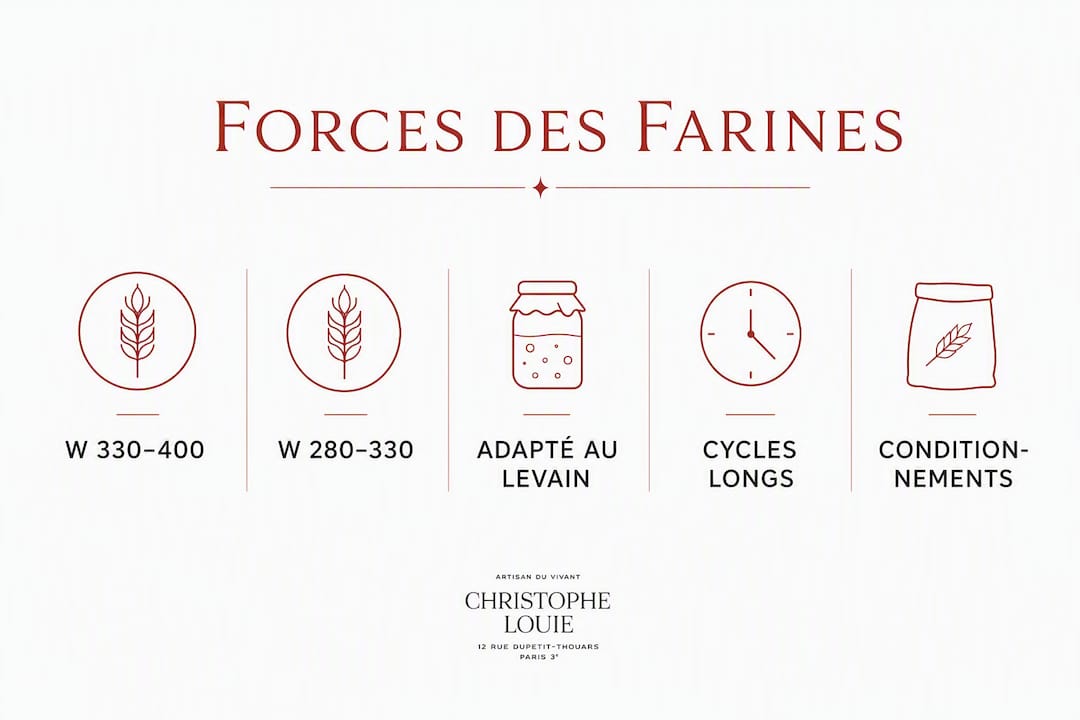
- W (strength): aim for 330–400 for a sourdough panettone, 280–330 for a yeast version
- P/L: ideally between 0.5 and 0.7 for a good extensibility/tenacity balance
- Protein content: minimum 13%, preferably 13.5–14%
- Hagberg falling number: greater than 250 s to avoid excessive amylase activity
- Presence of enzymes or additives: note this to adjust preservation and texture
- Origin of the wheat and milling method (cylinders or stone mills)
Three profiles, three approaches
Amateur without a cold room. Opt for Caputo Farina Cuoco or Petra 6384 in small packaging. With a W around 330–370 and baker's yeast, you can make a panettone in about one to two days without professional equipment. Moulin de Colagne's Haubanne Panetton is a viable French alternative if you wish to source locally.
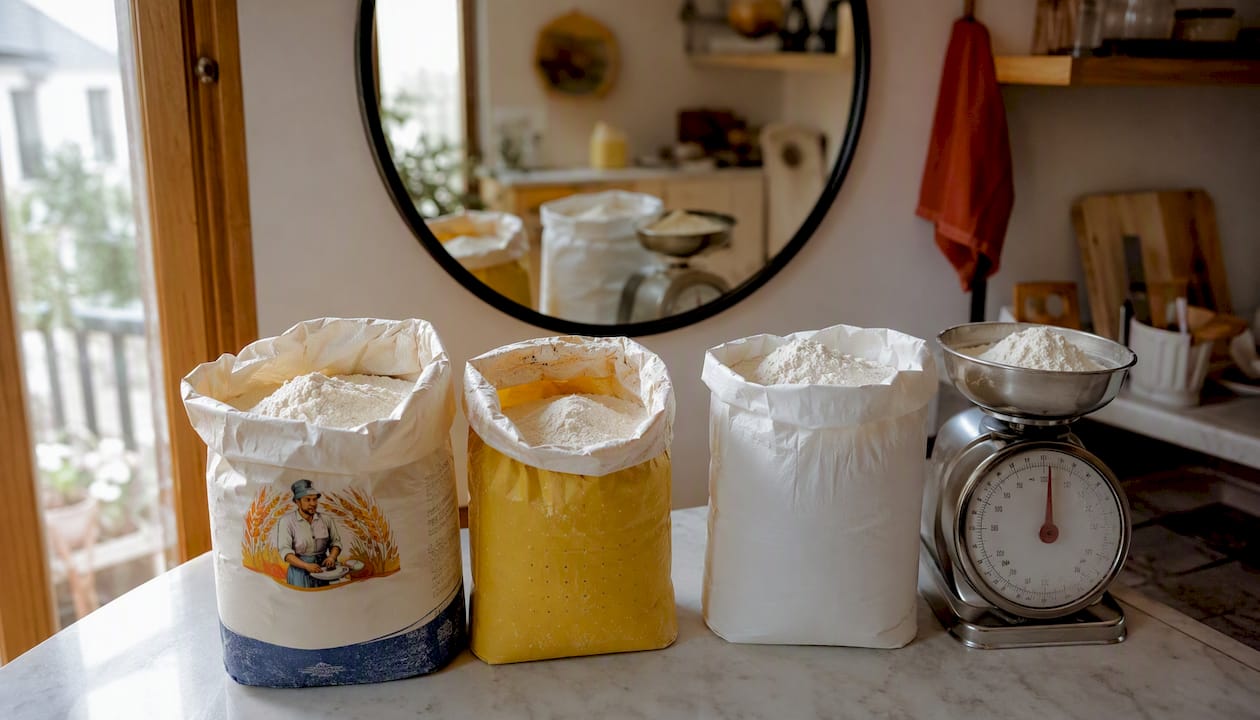
Artisan with sourdough. Petra 6384 (W 370–390) is tailored for long cycles and refreshing *lievito madre*. Its protein matrix supports enzymatic activity over several days, which stabilizes the sourdough between dough stages. Molino Dallagiovanna and Molino Grassi offer comparable performance for volume production.
Pro production. Order in 5 to 12.5 kg packages, test each batch upon receipt (see the storage section), and document the variations in W between deliveries. Professionals recommend never relying solely on the generic technical sheet: harvest variations affect sourdough stability and dough hold from one batch to the next.
Pro tip: the "cutting" technique involves mixing a very strong flour with a weaker flour to adjust the overall strength. In practice, a 70/30 mix provides an intermediate W that can be used when you do not have access to the exact reference. This is a standard method in artisanal production to adapt strength to available fermentation times.
How to adapt your recipe when you change flour?
Changing flour without adjusting the recipe is the number one cause of panettoni that collapse or tear. Here is the procedure to follow.
- Measure the absorption of the new flour. Knead 100 g of flour with water at 20 °C, adding water gradually. Note the percentage of water absorbed before the dough becomes sticky. This is your base hydration reference.
- Make a 200 g test dough. Before launching a full batch, test the new flour on a small quantity using your usual recipe. Observe the handling during kneading, elasticity, and behavior during fermentation.
- Adjust hydration according to strength. A W 200–260 flour generally supports 55–65% hydration; a W 330–400 flour can absorb 70–80% water while maintaining structure. Increase water in 2% increments so as not to destabilize the dough.
- Add dry gluten if necessary. If you use a standard T55 (W less than 280) and cannot find special panettone flour, incorporate 1–2% vital wheat gluten relative to the flour weight. This compensates for the gluten network deficit without changing the taste.
- Distribute rest times according to strength. With a W 370–390 flour, extend the bulk fermentation by 30 to 60 minutes compared to a W 300 flour. The dough needs time to develop its network; rushing the shaping leads to a tight crumb.
- Check stability after incorporating fillings. Candied fruits and butter weaken the gluten network. Incorporate them at the end of kneading, in several additions, and verify that the dough regains its hold between each addition.
Pro tip: to secure the crumb when the fat load is high (butter + egg yolks + candied fruits), lower the kneading temperature slightly by cooling the bowl. Dough that rises above 26 °C during kneading loses elasticity and does not recover easily, regardless of flour quality.
Why Christophe Louie chooses certain flours and how batches are controlled
At Christophe Louie, the choice of flours is not a catalog decision. The 72-hour two-dough process imposes precise constraints: the flour must withstand two long kneading stages, absorb a large load of butter and egg yolks, and support the *lievito madre* during its successive refreshments. This is why the flours used in the workshop come from specialized Italian millers, Molino Grassi and Dalla Giovanna, whose formulations are designed for these long cycles.
Upon receipt of each batch, the following tests are performed before any production:
- Visual and olfactory check: color, absence of rancid smell or mold
- Absorption test on a small dough (100 g) to detect variations between batches
- Control kneading: observation of elasticity and development time of the network
- Comparison with the batch sheet provided by the miller
Pro tip: always keep a 200 g sample of each received batch, labeled with the date and batch number. If a panettone shows a defect in production, you can trace it directly back to the relevant batch and adjust the recipe for subsequent ones without losing an entire batch.
Christophe Louie uses these Italian flours precisely because no French flour currently offers the same combination of strength, extensibility, and stability over 72-hour cycles. The sourdough bakery and pastry shop in Paris relies on this deliberate technical choice.
How to store your flour and detect a problematic batch?
Poorly stored panettone flour loses its strength in a few weeks. Storage conditions are as important as the choice of reference.
Recommended storage conditions:
- Temperature: 15–18 °C, away from thermal variations
- Relative humidity: below 65% to avoid fungal growth
- Original packaging sealed tightly after opening, or transferred to an airtight container
- Stock rotation: first in, first out; never mix a new batch with an old one
Quick tests upon receipt:
- Open the bag and smell it immediately: healthy flour has a neutral, slightly cereal scent. A rancid, acidic, or musty smell is a warning sign.
- Observe the color: a quality type 00 flour is uniformly creamy white. Gray or brown spots indicate contamination or poor storage.
- Perform an absorption test on 50 g: if absorption is significantly different from the technical data sheet, the batch may have undergone humidity variations during transport.
- Knead a small 100 g dough for 5 minutes: the network should form quickly and the dough should be smooth and elastic. Dough that remains sticky or does not develop a network signals weakened flour.
If in doubt, refuse the batch or isolate it for a full test before integrating it into production. Mixing a questionable flour with a good batch does not solve the problem: it degrades the whole.
Key points
To succeed with a panettone, flour is the most decisive technical parameter: a W between 330 and 400, a balanced P/L, and a protein content of at least 13% are the three non-negotiable criteria.
| Point | Details |
|---|---|
| Recommended W strength | Aim for W 330–400 for a sourdough panettone, W 280–330 for a yeast version. |
| P/L balance | A P/L between 0.5 and 0.7 prevents tearing and shrinkage after baking. |
| Reference flour in France | Petra 6384 (W 370–390, type 00) is the most documented and accessible special panettone flour. |
| Possible substitution | Mix 70% strong flour and 30% weaker flour ("cutting" technique) to adjust the overall W. |
| Christophe Louie | Uses Italian Molino Grassi and Dalla Giovanna flours for his 72-hour *lievito madre* process. |
Long fermentation and technical flours: a choice that changes everything
Most guides on homemade panettone insist on the recipe, proportions, and equipment. What they systematically underestimate is that flour is not a passive ingredient. It is the structural framework within which everything else is built.
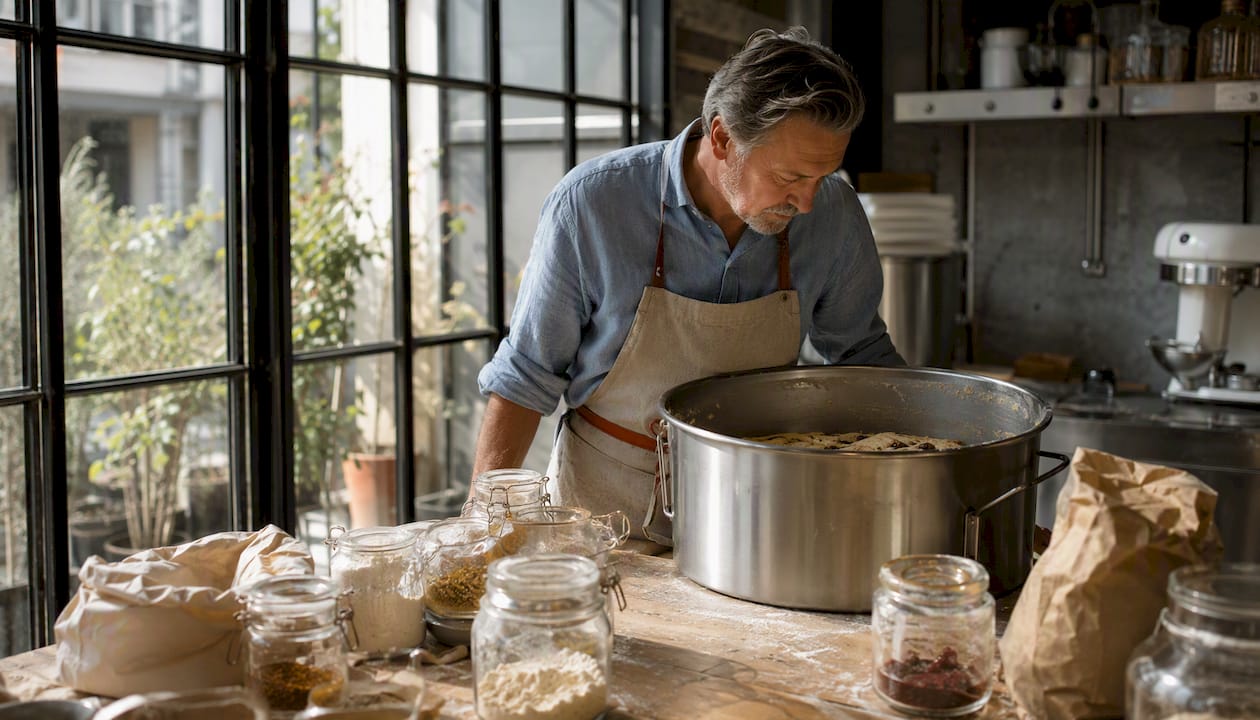
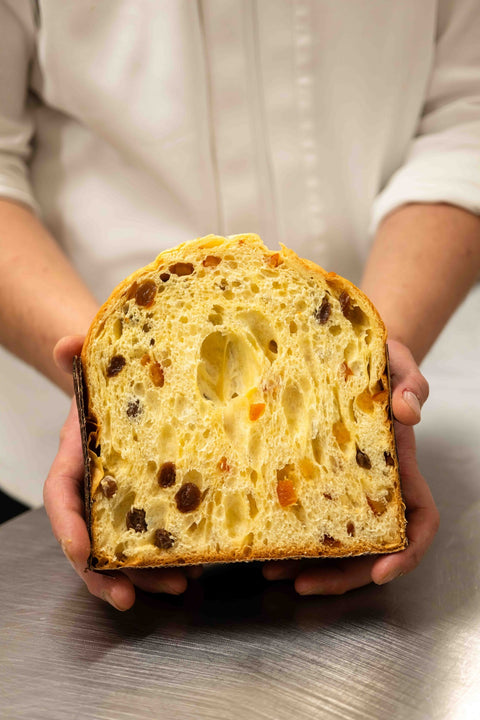
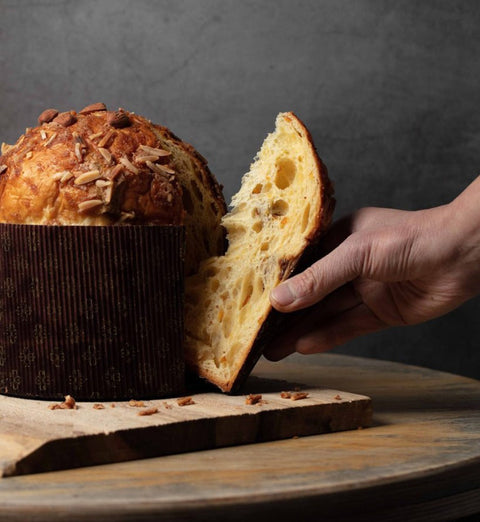
Working with an appropriate high-strength flour and long fermentation means letting time do the work that industrial chemistry does in just a few hours. Flavors develop differently, the crumb becomes stringy rather than cotton-like, and natural shelf life is extended without any additives. At Christophe Louie, our panettoni keep for up to five weeks precisely because the live sourdough starter and technical flour work together to create an environment unfavorable to unwanted microbial growth.
What I often observe is that enthusiasts give up after one or two disappointing attempts, concluding that panettone is too difficult. In the majority of cases, the problem is not the technique: it is the flour. A standard supermarket T55, even when worked well, cannot support a dough enriched with 40% butter and eggs over 72 hours. It is not a question of talent, it is a question of protein physics.
Investing in a special panettone flour is an important decision to ensure the success of the recipe. Everything else can be adjusted.
Would you rather buy than manage flour procurement?
Sourcing a W 370–390 high-strength flour, checking batches upon arrival, adjusting hydration according to harvest variations: this is the daily routine of an artisanal workshop. If you want the result without the logistics, Christophe Louie’s artisanal orange blossom panettone is available in the Marais boutique and for delivery throughout France.
Each panettone is crafted over 72 hours with a live lievito madre, Italian flours selected batch by batch, and has a natural shelf life of up to five weeks. No preservatives, no accelerated processes. For professionals (restaurants, hotels, fine grocery stores), B2B registration allows access to adapted terms and packaging. Order directly at christophelouie.com or visit the shop at 12 rue Dupetit-Thouars, Paris 3rd.
Useful sources and technical data sheets to consult
Before any purchase, check the batch technical data sheet with the supplier. The pages below are the most reliable sources for the W, P/L, and protein parameters of the flours mentioned in this article.
- Petra 6384 — BienManger.com: complete product sheet with technical description, absorption, and recommended use.
- Strong soft wheat flour type 00 — Tibiona: selection of type 00 panettone flours (Molino Dallagiovanna, Molino Grassi, and others), 5–12.5 kg packaging.
- Panettone Flour W 370–390 — Starfive: reference technical data sheet for Petra 6384, with W data and sourdough usage.
- Panettone+ — Agugiaro & Figna: example of enzyme-enriched flour for long fermentation, with shelf life data up to 60 days.
- Quotidie Magazine — technical flours for panettone: professional article on cutting techniques and the batch-by-batch testing recommended by artisans.
- How to choose a panettone? — Christophe Louie: buying guide and advice for identifying a quality artisanal panettone.