Panettone expiry date: what does the date on the packaging really mean?
In France, panettone is almost always subject to a DDM (minimum durability date), not a DLC (use-by date). In concrete terms, the phrase "best before" on your packaging indicates a gradual loss of quality, not a health risk after the date shown. It is a difference that changes everything in how you should react.
A true DLC (use-by date) according to Service-public concerns fragile products like fresh meat or dairy products that have not been heat-treated: beyond this date, there is a real health risk. Panettone, on the other hand, is a dry and sugary product, which is not conducive to rapid bacterial growth, explaining why manufacturers opt for a DDM.
Before diving into the detailed explanations, here are the three habits you should adopt:
- Check the exact wording on the packaging: "best before" means DDM, "use by" means DLC.
- Always store panettone in a dry place, away from heat and direct light.
- Discard the product without hesitation as soon as you see even the slightest trace of mold, no matter how small.
Key points
The date on a panettone is almost always a DDM, a benchmark for quality, and not a DLC, which is the only term that implies a real health risk after the date shown.
| Point | Details |
|---|---|
| DDM, not DLC | The term "best before" signals a loss of quality, not a health hazard. |
| Variable shelf life | Expect 3 to 6 months for industrial, 4 to 6 months for artisanal, and a few weeks for homemade. |
| Key storage | A cool, dry, and dark place protects the product much better than just following the date. |
| Freezing possible | Portion, wrap airtight, and consume within two to three months to preserve texture. |
| Mold, discard without debate | Any trace of mold requires throwing away the entire piece, even on an artisanal product. |
| Sourdough is a game changer | At Christophe Louie, the 72-hour fermentation with live sourdough naturally extends freshness without additives. |
Table of contents
- Panettone DLC or DDM: what French law really says
- How long does a packaged panettone keep?
- Which storage conditions extend freshness before opening?
- Opened fresh panettone: how many days before it goes off?
- Can you freeze a panettone, and how do you do it without ruining it?
- When should you throw away a panettone that has gone bad?
- Why does a natural sourdough panettone keep longer naturally?
- What we too often forget about panettone
- Where to find a sourdough panettone that really goes the distance?
- Sources
Panettone DLC or DDM: what French law really says
Confusion between these two dates leads to costly, unnecessary food waste, so it's best to clear it up immediately. Service-public clearly distinguishes two regimes: the DLC, labeled "use by," concerns microbiologically perishable foodstuffs and entails a real health risk if exceeded. The DDM, labeled "best before," only indicates a date after which the product may lose flavor, texture, or nutritional quality, without becoming dangerous.
Panettone belongs to this second category, along with almost all dry bakery products, biscuits, and long-life pastries. A panettone that has exceeded its DDM by a few days is not, from a regulatory standpoint, a safety issue: at worst, it will be a bit drier or less aromatic.
Key takeaway: one difference, two practical consequences
- DLC exceeded → product potentially dangerous, never consume.
- DDM exceeded → product is likely less good, but generally risk-free if the appearance, smell, and texture remain normal.
One point deserves your attention if you make a homemade panettone and freeze it: regulations require mentioning the freezing date when the product is subsequently refrozen or resold, a rule that also applies to artisans who offer frozen products for order. This obligation protects the consumer from invisible and potentially excessive storage.
Another important nuance: the DLC or DDM is only valid if the storage conditions indicated on the label have been respected. A broken cold chain, or in the case of panettone, storage in direct sunlight or a damp room, can invalidate the displayed date long before its theoretical deadline.
How long does a packaged panettone keep?
It all depends on who made it and how. The differences between an industrial panettone and an artisanal sourdough piece are considerable, and understanding why helps you interpret the date indicated on your own package.
Industrial panettone: major Italian brands sold in supermarkets often display DDMs indicating a long shelf life in the original packaging. Grand Frais confirms this longevity, provided the product remains protected from heat and humidity. This duration is explained by protective atmosphere packaging, thorough pasteurization, and sometimes food preservatives.
Artisanal panettone in specialty food stores: pieces sold at Eataly or similar retailers show shelf lives of four to six months packaged, a figure that varies greatly depending on the manufacturing process and the type of packaging used. These products do not always use the same packaging techniques as heavy industry but often benefit from careful packaging that limits air exchange.
Artisanal natural sourdough panettone, no additives: the window is shorter, with storage limited to a few weeks when the product is sold in a protective atmosphere, and a few shorter weeks for a panettone that is homemade or sold without specific treatment. This is the price to pay for the absence of preservatives, but good live sourdough partially compensates for this shorter duration with better natural stability.
Several factors explain these gaps:
- The presence or absence of live sourdough, which changes acidity and mold resistance.
- The addition of additives or preservatives, common in industry, rare for artisans.
- Type of packaging: vacuum-sealed, modified atmosphere, or simple air-permeable bag.
- The water content of the dough, which directly influences the drying speed.
- Whether or not it undergoes thermal pasteurization after baking.
If you are preparing a homemade panettone recipe, be aware that long fermentation with natural sourdough improves the stability of the finished product, a technical phenomenon that partly explains why well-fermented artisanal panettones often hold up better than expected, without, however, rivaling industrial durations.
Which storage conditions extend freshness before opening?
The date indicated on the packaging is only valid if you respect the accompanying storage conditions. A panettone stored improperly can degrade well before its DDM, while careful storage sometimes allows for slightly exceeding the date without significant loss of quality.
Three simple rules are sufficient in most cases:
- Choose a cool and dry place, ideally between 15 and 20 degrees, far from heat sources like an oven, radiator, or south-facing window.
- Absolutely avoid humidity, which promotes mold growth on the crust and accelerates the degradation of the crumb, even in closed packaging.
- Keep the product away from direct light, which degrades aromas and can slightly alter the color of the dough over time.
Eataly actually recommends exactly this combination, as heat, light, and humidity are the three main enemies of a packaged panettone, whether industrial or artisanal.
If the original packaging is damaged, punctured, or poorly resealed, no longer rely on the displayed date. A bag that lets air in exposes the product to accelerated drying and, more seriously, contamination by airborne mold. In this case, quickly transfer the panettone to an airtight container and mentally shorten its shelf life by several weeks.
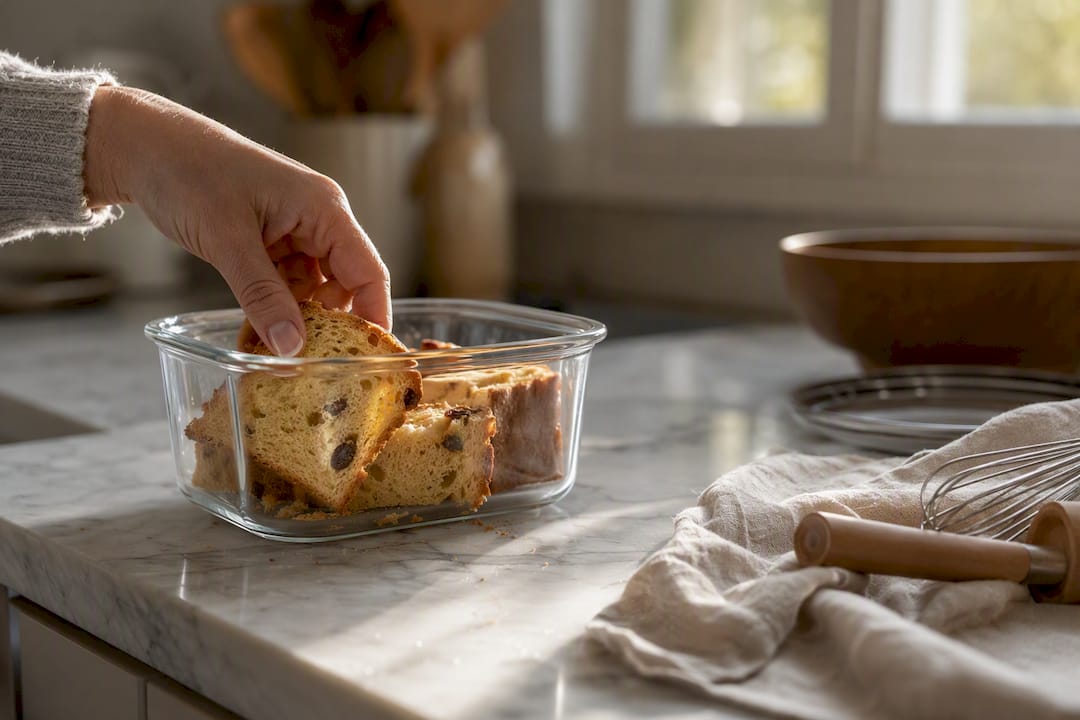
Pro tip: if you buy a panettone in bulk or sliced from an artisan, always ask for the production date: without this information, you cannot estimate a reliable DDM, and it is better to plan to consume it within the week.
To identify a panettone designed to age well from the moment of purchase, some selection criteria are worth checking before heading to the checkout, particularly the nature of the sourdough and the packaging method.
Opened fresh panettone: how many days before it goes off?
Once the packaging is open, the clock ticks differently. The DDM displayed on the pack is no longer worth much: it was calculated for a product that remained hermetically sealed, not for a panettone breathing in the open air after the first slice.
In practice, count on several days at room temperature for an opened panettone, provided it is well protected between tastings. After this period, the product does not necessarily become dangerous, but it significantly loses its softness and fragrance, which ruins the experience you were looking for when you bought it.
To extend this window, a few simple actions make the difference:
- Wrap the cut part in plastic wrap pressed tightly against the crumb, not just around the original packaging.
- Then store it in an airtight box or a resealable storage bag, which limits air exchange.
- Avoid the refrigerator for short-term consumption: the dry cold of the fridge paradoxically accelerates the drying of the crumb.
- Cut only the amount you need, leaving the rest of the loaf as compact as possible to limit the surface area exposed to the air.
750g recommends consuming a homemade panettone quickly once opened, as the characteristic stringy texture fades faster than in a processed industrial product.
If you find yourself with leftovers that are starting to dry out without being spoiled, don't throw them away: a slightly stale panettone turns very well into French toast, or crumbled into an impromptu tiramisu. That is often where the product reveals a second life just as tasty as the first slice.
Can you freeze a panettone, and how do you do it without ruining it?
Yes, and it is even one of the best ways to avoid waste for a product that one often buys in larger quantities than necessary, especially around the holidays.
Here is the method that best preserves the texture:
- Portion before freezing. Cut the panettone into slices or quarters rather than freezing it whole: this way you only defrost the desired amount.
- Wrap each portion hermetically, ideally in plastic wrap and then in a freezer bag, pushing out as much air as possible to limit crystal formation.
- Label with the freezing date. This gesture, mandatory from a regulatory point of view for any refrozen or resold product, is also simply useful for keeping track.
- Count two to three months maximum in the freezer for optimal texture. Beyond that, the crumb tends to lose its lightness and the aromas fade gradually, even if the product remains safe to consume.
- Defrost slowly in the refrigerator, for about twelve hours, rather than at room temperature or worse, in the microwave, which makes the crumb rubbery.
- Reheat briefly in the oven at low temperature or in the toaster for a few minutes to regain a softness close to that of the first day, a simple trick to bring a panettone back to life that has spent time in the freezer.
When should you throw away a panettone that has gone bad?
Some signs are unforgiving, and one must know how to spot them without hesitation to avoid any risk, however small.
Visible mold, even in small quantities: this is the number one alarm signal. Contrary to popular belief, cutting around a spot of mold is not enough on a product as airy and moist as panettone. Filaments invisible to the naked eye often spread far beyond the visible area; discard the entire piece.
Abnormal odor, sour, alcoholic, or simply "that doesn't smell like panettone anymore," should alert you even before tasting. A slimy or sticky texture to the touch, particularly on the crust, generally signals undesirable bacterial fermentation and not just a simple loss of freshness.
One must distinguish between two very different situations:
- Drying out is a quality issue, not a safety one. A dry, slightly hard panettone is still edible and easily recycled as a dessert.
- Contamination (mold, suspicious odor, abnormal texture) is a food safety issue. When in doubt, it is better to throw it away than to risk a digestive upset.
Recall that the DLC concerns products with real health risks after the date shown, whereas the DDM only guarantees optimal quality. A panettone showing these signs of deterioration must be discarded, whether the DDM is exceeded or not.
Why does a natural sourdough panettone keep longer naturally?
Live sourdough, also called lievito madre in Italy, fundamentally changes things. At Christophe Louie, the dough goes through a two-stage process spread over 72 hours, with a slow fermentation that develops a natural acidity capable of slowing down the development of mold, without resorting to any industrial preservatives.
The long 72-hour fermentation and live sourdough allow for prolonged natural preservation, up to five weeks, without industrial additives.
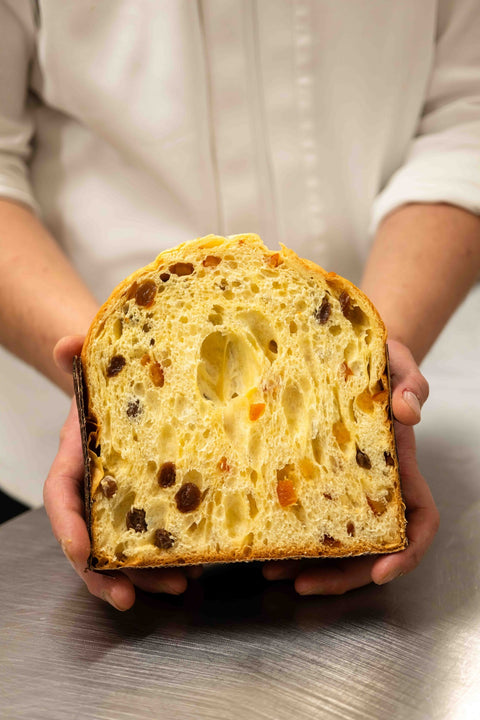
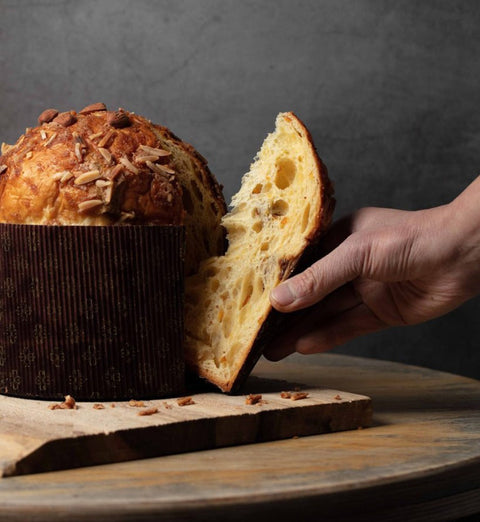
This duration is no technical coincidence. The fermentation process transforms the gluten structure, traps more air in the crumb, and creates that stringy texture so characteristic of a successful artisanal panettone. After baking, hanging the panettone upside down also prevents the crumb from collapsing under its own weight, a step that directly influences the stability of the product over time.
Some concrete benchmarks for this artisanal approach:
- The flours come from Italy for their specific technical qualities, all other ingredients being sourced in France.
- The house sells directly via its Marais boutique and online nationwide, with listings in fine grocery stores.
- This commitment is also reflected in the use of low-consumption electric ovens and the absence of night work in the workshop.
This approach partially explains why some panettones last so long without ever resorting to accelerated industrial processes.
What we forget too often about panettone
Most articles on this subject simply copy the legal definition of the DLC (use-by date) and the DDM (best-before date) and stop there. That is insufficient. What really matters is understanding that the displayed date depends entirely on the manufacturing process, and that two panettones bearing the same label can have radically different safety margins.
An industrial panettone stuffed with preservatives and a natural sourdough panettone do not age the same way, even if both display a DDM. The former relies on chemistry, the latter on a more subtle biological balance, where the acidity of the sourdough does the work. Many readers wrongly believe that an artisanal product necessarily keeps less well than an industrial one. It is sometimes the opposite: a long and well-controlled fermentation creates a natural resistance that the industry struggles to match without additives.
My conviction, after digging into the subject: always favor observing the product—the smell, the texture, the appearance—over the mechanical reading of a date. It is this reflex that avoids unnecessary waste as much as unpleasant surprises.
— Christophe
Where to find a sourdough panettone that truly goes the distance?
If this article has convinced you that a careful manufacturing process changes everything regarding preservation, you might as well choose a panettone designed with this logic from the start. Christophe Louie makes each panettone using a two-dough process spread over 72 hours, with a live sourdough starter that replaces industrial preservatives, for a natural freshness that lasts several weeks without artifice.
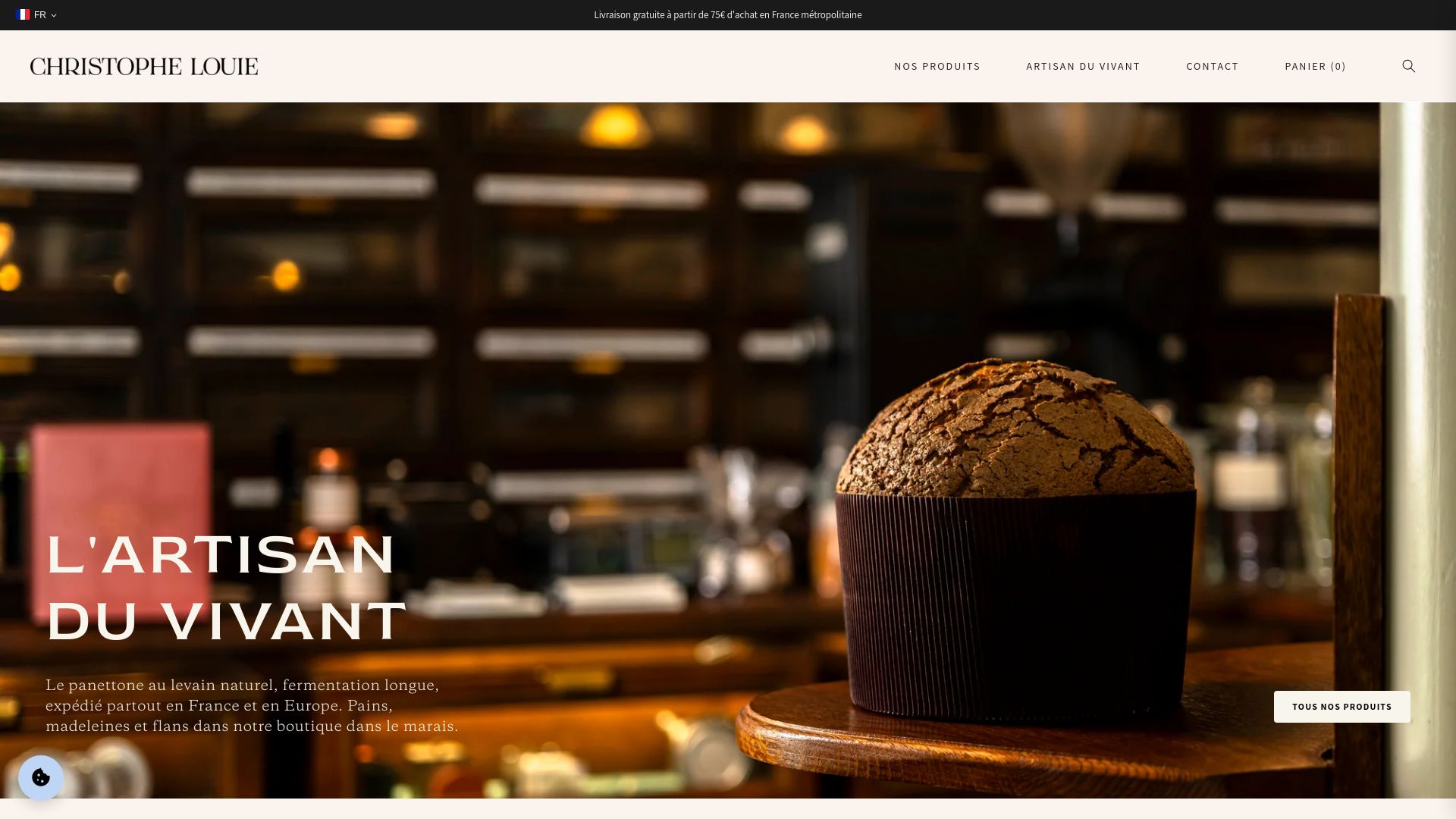
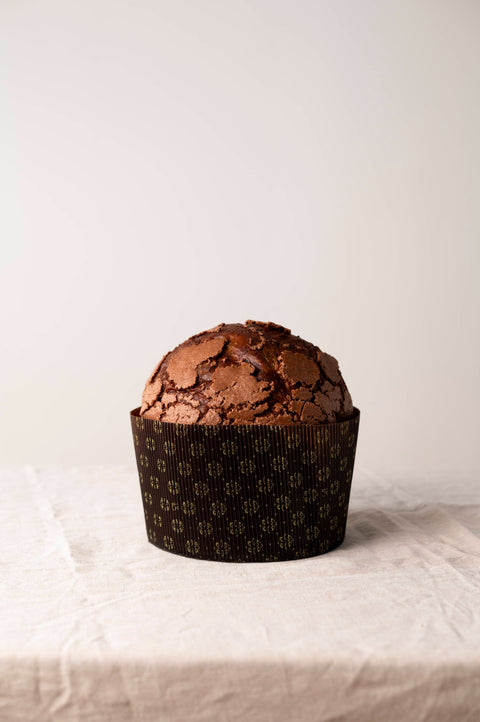
The house offers several varieties, including an orange blossom panettone that perfectly illustrates this artisanal approach, alongside chocolate, mandarin, or savory versions. Everything can be ordered directly online with delivery throughout France, or purchased at the boutique in the Marais, in Paris. If you are still unsure about which criteria to prioritize, the page dedicated to how to choose a panettone details the technical points to check before purchasing. To place an order directly, head to the Christophe Louie online shop.
Sources
To verify or delve deeper into the regulatory and practical information mentioned, here are the references used:
- Use-by date (DLC), best-before date (DDM), freezing | Service Public
- Panettone: Tips, storage, recipes, and prices - Grand Frais
- Artisanal Italian Panettone (Eataly France)