Fluffy savory brioche: 3 recipes and Thermomix tips
A successful savory brioche relies on three things: a butter-rich dough, controlled hydration, and fillings pre-treated before incorporation. Here are the essentials to get started now.
Express base dough (for 6 to 8 people):
- an appropriate amount of T45 or T55 flour
- several whole eggs
- an appropriate amount of lukewarm milk
- a moderate amount of unsalted butter (added at the end of kneading)
- a sachet of dried or fresh baker's yeast
- salt, to be kept away from the yeast
- a little sugar to activate the yeast
The 3 ready-to-follow variations:
- Ham and cheese: 45 min prep, 1 h 30 min rising, 30 min baking. Difficulty: easy.
- Bacon, Comté, and olives: 50 min prep, 1 h 30 min rising, 35 min baking. Difficulty: easy to intermediate.
- Sesame braided: 40 min prep, 2 h rising, 30 min baking. Difficulty: intermediate.
All three can be adapted for the Thermomix. Without a machine, simply add ten minutes of manual kneading.
Table of contents
- How to prepare savory brioche dough according to the chosen method?
- Ham and cheese savory brioche: the fluffy recipe step-by-step
- Bacon, Comté, and olive savory brioche for appetizers or picnics
- How to braid a savory sesame brioche?
- Why won't my brioche rise, and how to fix it?
- How to store and serve a savory brioche?
- Key points
- What I learned while working with savory brioche dough
- Prefer an artisanal brioche ready to eat?
- Sources and useful resources
How to prepare savory brioche dough according to the chosen method?
Savory brioche dough follows the same logic as its sweet counterpart, with one exception: salt plays a central flavor role here, not just a structural one. Always place it on the opposite side of the bowl from the yeast to avoid neutralizing the fermentation before it even starts.
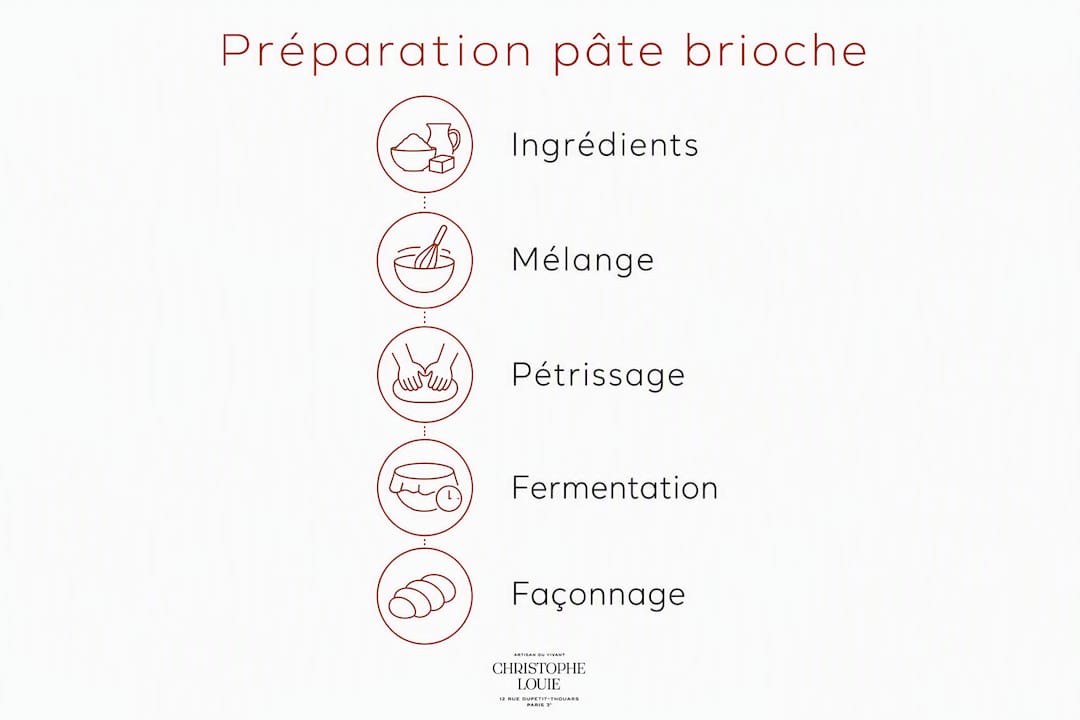
Ingredients and proportions for the master dough
| Ingredient | Quantity (for 6–8 pers.) | Role |
|---|---|---|
| T45 Flour | — | Structure and lightness |
| Whole eggs | 3 | Richness and binding |
| Lukewarm milk (30 °C) | — | Hydration and yeast activation |
| Unsalted butter | 120 g | Texture and fluffiness |
| Dry yeast | 7 g | Fermentation |
| Fine salt | 1 tsp (5 g) | Flavor and structure |
| Sugar | 1 tsp | Yeast activation |
The target hydration rate is around 55–60% (total liquids relative to the flour). With moist fillings like sautéed vegetables or cream cheese, reduce the milk by 10 to 15 ml to compensate.
Step-by-step method
- Dissolve the yeast in the lukewarm milk with the sugar. Wait 5 to 10 minutes: a slight foam should appear.
- In the bowl of a stand mixer (using the dough hook) or by hand, mix the flour and salt first, then add the eggs and the milk-yeast mixture.
- Knead for 8 minutes at medium speed (or 10–12 minutes by hand) until the dough pulls away from the sides.
- Incorporate the room-temperature butter, cut into small cubes, in three additions. Knead for another 5 minutes until you obtain a smooth and slightly shiny dough.
- Cover with a damp cloth. Let it proof for 1 to 1.5 hours at room temperature (ideally 24–26 °C), until the dough doubles in volume.
- Degas, shape according to your chosen variation, then let it rise a second time for 30 to 45 minutes before baking.
Thermomix adaptation
In the Thermomix, pour in the liquids first (milk, eggs), then the flour, the salt on one side and the yeast on the other. Knead for 3 minutes on dough mode. Add the pieces of butter and knead for another 2 minutes. The first proofing takes place directly in the closed bowl, away from drafts.
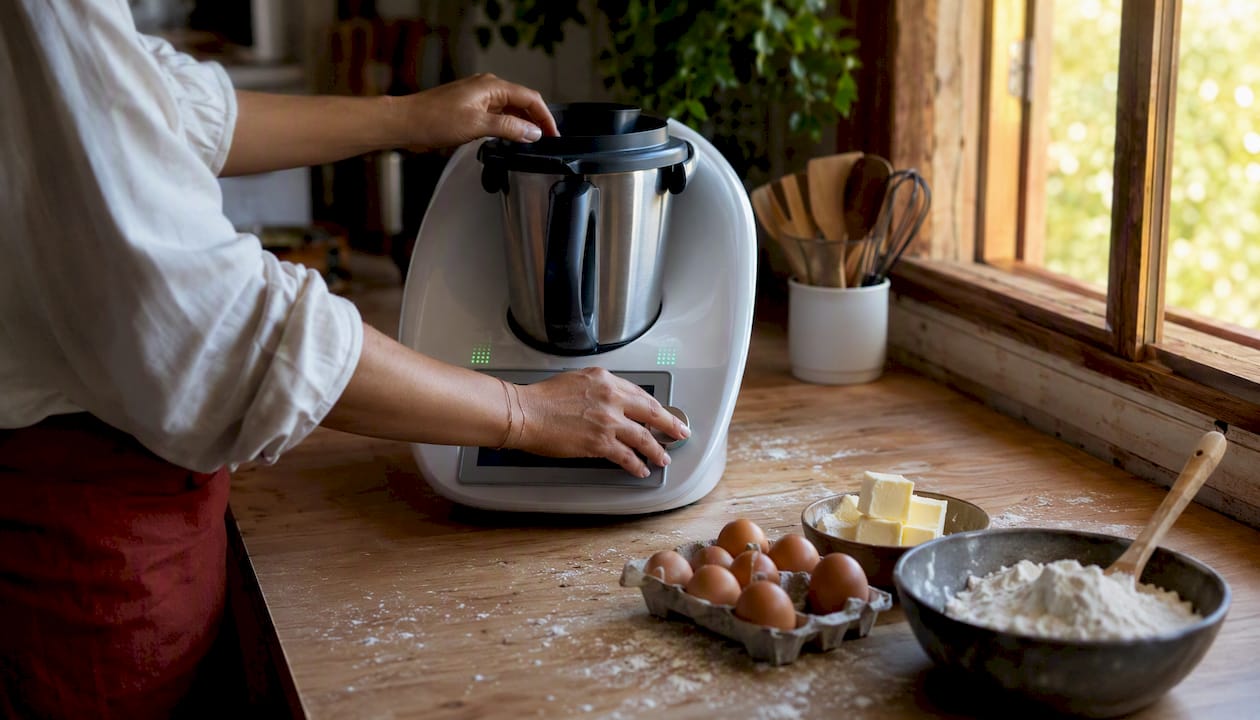
Pro tip: If your filling contains soft cheese or sautéed vegetables, slightly reduce the amount of butter (100 g instead of 120 g) to prevent the dough from becoming too greasy, which hinders rising.
Ham and cheese savory brioche: the fluffy recipe step-by-step
This version remains the most popular, and for good reason: the ham-and-cheese combination melts into the dough without weighing it down, provided you distribute the fillings well.
Recipe card:
- Servings: 6 to 8 people
- Preparation: 45 min
- Rising: 1 h 30 min
- Baking: 30 min at 180 °C
- Difficulty: easy
Additional ingredients:
- diced cooked ham
- grated cheese (Gruyère, Comté, or Emmental)
- an egg yolk for glazing
Steps
- Prepare the base dough according to the method described above. Let it rise for 1 hour.
- On a floured surface, roll the dough into a rectangle (about 30 × 20 cm, 1 cm thick).
- Distribute the diced ham and grated cheese evenly, leaving 2 cm of space along the edges.
- Roll the dough into a tight log. Place in a buttered loaf pan, seam side down.
- Cover and let rise for 30 to 45 minutes. The dough should slightly overflow the pan.
- Brush with an egg yolk diluted with a tablespoon of water. Bake at 180 °C (convection) for 30 minutes.
- Check for doneness by tapping the bottom: a hollow sound indicates it is cooked through.
Non-Thermomix variation: knead by hand on a lightly floured surface. The result is identical, simply count 12 minutes of kneading instead of 5.
Pro tip: Use grated cheese rather than whole slices. Slices create pockets of moisture that can make the crumb soggy; grated cheese distributes uniformly and melts without creating soft spots.
To avoid a soggy crumb, always drain moist fillings before incorporating them, and do not overload the dough rectangle.
Bacon, Comté, and olive savory brioche for appetizers or picnics
This version is directly inspired by the Entremont recipe with bacon, Comté, and olives, intended for 4 people and perfectly portable.
Recipe card:
- Servings: 4 to 6 people
- Preparation: 50 min
- Rising: 1 h 30 min
- Baking: 35 min at 175 °C
- Difficulty: easy to intermediate
Additional ingredients:
- smoked bacon bits
- grated Comté (Entremont or equivalent AOP)
- pitted green olives, drained and sliced into rings
- an egg yolk for glazing
Steps
- Sauté the bacon bits in a hot pan for 3 to 4 minutes until lightly browned. Drain on paper towels and let cool completely.
- Drain the olives and pat them dry with paper towels. This step is non-negotiable: olive oil slows down the rising process if it comes into direct contact with the yeast.
- Prepare the base dough. After the initial proof, gently incorporate the bacon, Comté, and olives by folding the dough over itself (do not knead again).
- Shape into a log or a braid (see next section), place in a pan or on a baking sheet.
- Let rise for 30 to 45 minutes, brush with egg yolk, then bake at 175 °C for 35 minutes.
For transport: let it cool completely before wrapping. Brioche that is still warm in an airtight bag will soften and lose its crispness. Wrap in parchment paper rather than plastic wrap to preserve the crust.
Possible substitutions:
- Smoked ham instead of bacon bits (same weight, no need to sauté)
- Beaufort or Gruyère if Comté is unavailable
- Black olives for a stronger flavor
How to braid a savory sesame brioche?
A braided brioche looks impressive, but the shaping is simpler than it seems. The key is strands of equal thickness and consistent tension while braiding.
Shaping steps
- After the first proof, divide the dough into three equal portions.
- Roll each portion into a rope of even length, starting from the center and working toward the ends to achieve uniform thickness.
- Pinch the three strands together at one end. Braid by alternating the right strand into the center, then the left strand into the center. Maintain light but constant tension.
- Pinch the other end and tuck both ends under the braid for a neat finish.
- Place on a baking sheet lined with parchment paper. Cover and let rise for 45 minutes to 1 hour.
- Brush with an egg yolk beaten with a tablespoon of milk. Generously sprinkle with sesame seeds (white, black, or mixed).
- Bake at 180 °C for 28 to 32 minutes. The braid should be deep golden brown and sound hollow.
For a stuffed version: flatten each rope slightly, place a thin line of firm cheese or chopped fresh herbs (chives, thyme), then seal by rolling before braiding. Do not overload: 30 g of filling per strand is enough.
Pro tip: For a shiny, even glaze, apply two coats: one before the second rising, and one just before baking. The first sets the color, the second provides the shine.
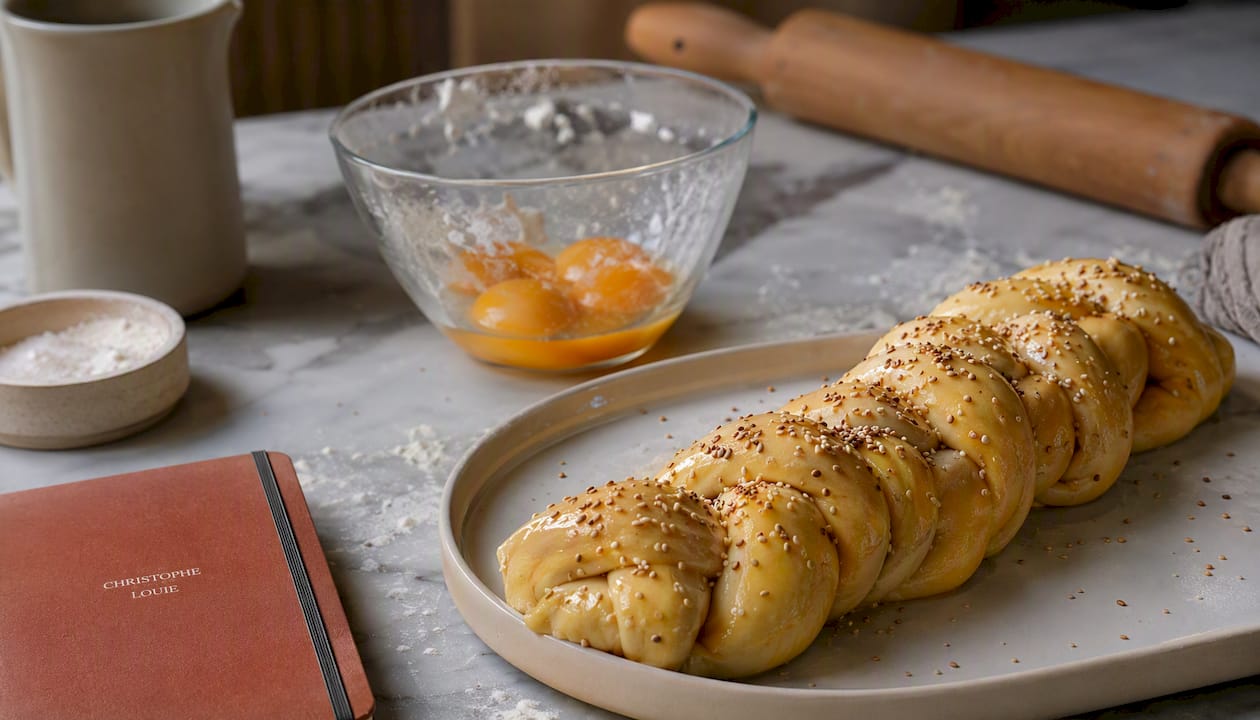
The sesame braid is just as suitable for appetizers, sliced, or served whole at the table, accompanied by a selection of aged cheeses.
Why won't my brioche rise, and how to fix it?
Most failures have an identifiable cause. Here is the diagnosis, in order of frequency.
The most common causes
- Inactive yeast: water too hot (above 40 °C, the yeast dies), expired yeast, or direct contact with salt. Always test the yeast in lukewarm milk before incorporating other ingredients.
- Dough too cold: below 22 °C, fermentation slows down significantly. Place the bowl in an oven that is turned off with a glass of hot water to create a homemade proofing chamber.
- Insufficient kneading: under-kneaded dough does not develop enough of a gluten network to trap fermentation gases. It should cleanly pull away from the walls and remain slightly sticky without being tacky.
- Filling too moist: vegetable juices or olive oil inhibit rising. Always sauté, drain, and cool before incorporation.
- Overworking the dough: dough worked too much after adding butter becomes elastic and resists rising. Stop as soon as the butter is absorbed.
The hollow sound test remains the most reliable indicator of internal doneness. Tap the bottom of the brioche with your fist: a dull, solid sound means the crumb is still raw in the center; a hollow, light sound indicates even baking. The golden color of the crust is not enough to guarantee the inside is cooked.
When to add salt? Always with the flour, never in direct contact with the yeast.
Before starting to knead: salt absorbs water and kills yeast cells via osmosis.
Pro tip: If your yeast doesn't foam after 10 minutes in lukewarm milk, discard it and start over with fresh yeast. Continuing with dead yeast guarantees a flat brioche.
The natural sourdough method pushes this logic even further: long, low-temperature fermentation develops more complex aromas and a stringier crumb, at the cost of requiring 12 to 24 hours of planning.
How to store and serve a savory brioche?
Storage and freezing
| Method | Duration | Advice |
|---|---|---|
| Room temperature (airtight container) | 2 days | Wrap in a clean cloth before closing |
| Refrigerator | 4 to 5 days | Risk of drying out; freezing is preferred |
| Freezing (whole or sliced) | 2 to 3 months | Wrap in plastic wrap then in a freezer bag |
To thaw, take the brioche out the night before in the refrigerator or let it sit for 2 hours at room temperature. Avoid the microwave for complete thawing: it makes the crumb rubbery.
Reheating: 5 minutes at 160 °C in the oven is enough to restore crispness to the crust. For an individual slice, 20 seconds in the microwave at medium power, no more. To keep the fluffiness over time, freezing in individual slices remains the best option.
Serving ideas depending on the occasion
- Appetizer: slice into thick pieces or cubes, serve warm with a charcuterie board or dips. The bacon, Comté, and olive version is particularly suitable. For a drink pairing, artisanal gin or a cocktail based on regional spirits complements the smoky notes of the bacon well.
- Picnic: wrap whole in parchment paper, serve with a green salad and a hard cheese.
- Main course: Serve in slices with a vegetable soup or a creamy velouté. The ham and cheese brioche acts as both bread and garnish.
Key points
Mastering savory brioche is based on three non-negotiable principles: salt separated from the yeast, pre-treated fillings, and hydration adjusted to the chosen filling.
| Point | Details |
|---|---|
| Salt and yeast separated | Always place salt with the flour, never in direct contact with the yeast. |
| Pre-treated fillings | Pan-fry bacon bits and vegetables; drain olives and moist cheeses before adding them. |
| Adapted hydration | Reduce milk by 10–15 ml if the filling is moist to avoid a dough that is too loose. |
| Hollow sound test | Tap the bottom of the brioche: only a hollow sound confirms it is baked through. |
| Christophe Louie | The natural sourdough brioche from our bakery applies these principles with long fermentation for a stringy, delicate crumb. |
What I learned while working with savory brioche dough
Savory brioche is often presented as a simple variation of sweet brioche. That is a shortsighted view. Savory fillings introduce variables that the sweet version does not have: moisture, extra fats, acidity from olives, and the natural salt of the cheese. Each of these variables can compromise the rise or make the crumb soggy if they are not anticipated.
What I observe most often in failed attempts is impatience regarding two specific points. First, incorporating butter too soon: if the dough hasn't developed its gluten network before adding fats, the butter coats the gluten strands instead of integrating with them, and the final texture is dense rather than stringy. Second, adding fillings directly without pre-cooking: raw bacon releases its fat during baking, un-drained vegetables release water, and the crumb has no chance of remaining airy.
Long fermentation changes the game on another level. With live sourdough, like the one we use at Christophe Louie for our artisanal sourdough brioches, the dough develops a slight acidity that strengthens the structure and naturally extends shelf life. It is not a technique reserved for professionals, but it requires organization: count on 12 to 24 hours of cold fermentation for a result that is noticeably different from using standard yeast.
My most concrete advice: weigh your ingredients, respect temperatures, and do not rush the second proof. A savory brioche that has had time to rise properly slices without crushing and keeps for two days without hardening.
Would you prefer an artisanal brioche ready to enjoy?
Making a homemade savory brioche requires time and precision. When the craving is there but the schedule is not, the Maison Christophe Louie offers a direct alternative: naturally leavened brioches shaped by hand, with a long fermentation that provides that stringy, delicate crumb impossible to achieve in under two hours.
The range includes sourdough brioches, sweet and savory versions of panettone, and pastries available in our Marais boutique or via delivery in Paris and throughout France. For sourdough lovers who want to discover what long fermentation really does to texture, the orange blossom panettone is a good introduction. Order online or stop by for click & collect at 12 rue Dupetit-Thouars, Paris 3rd.
Useful sources and resources
- Buttery savory brioche: detailed recipe — Le Boulanger Parisien: complete recipe sheet with tips on hydration and storage.
- Entremont recipe: savory brioche with bacon, Comté, and olives — Entremont: reference recipe for the bacon-Comté-olive variation with shaping method.
- Moist savory ham and melting cheese brioche — LesBonnesRecettes.fr: practical advice on salt placement and filling distribution.
- Filled cheese brioche — Croquant Fondant Gourmand: method for individual filled brioches, ideal for appetizers.
-
— YouTube: video demonstration on salt placement and yeast preparation.
- Sourdough brioche: traditional and moist recipe — Christophe Louie: natural sourdough method for a stringy crumb and extended shelf life.
- Storing homemade brioche — Christophe Louie: practical guide on storage, freezing, and reheating.
- Sourdough bakery-patisserie in Paris — Christophe Louie: introduction to our sourdough expertise and the range available in-store and online.