Natural sourdough bread: the guide for demanding customers
Naturally leavened sourdough bread is dough fermented slowly by wild yeasts and lactic acid bacteria, without industrial yeast. For a discerning buyer, the recommendation is straightforward: prioritize a sourdough panettone crafted over 72 hours by a house that documents its process and the origin of its flours. Christophe Louie, based in the Marais district of Paris, meets these criteria precisely: live sourdough starter (lievito madre), technical Italian flours (Grassi, Dalla Giovanna), manual shaping, and natural shelf life of up to five weeks. Long fermentation improves the bioavailability of B vitamins and minerals, partially reduces gluten content, and produces a natural acidity that slows staling.
Table of Contents
- Why is naturally leavened sourdough bread so different?
- Which flours should you choose for sourdough bread or panettone?
- What does a 72-hour process really look like?
- How to recognize a true sourdough panettone or bread?
- Storage: how long does a sourdough panettone last?
- What a discerning buyer must verify before ordering
- Key points
- What the 72-hour process really changes
- Christophe Louie’s 72-hour sourdough panettone, available all year round
- Technical resources for further exploration
Why is naturally leavened sourdough bread so different?
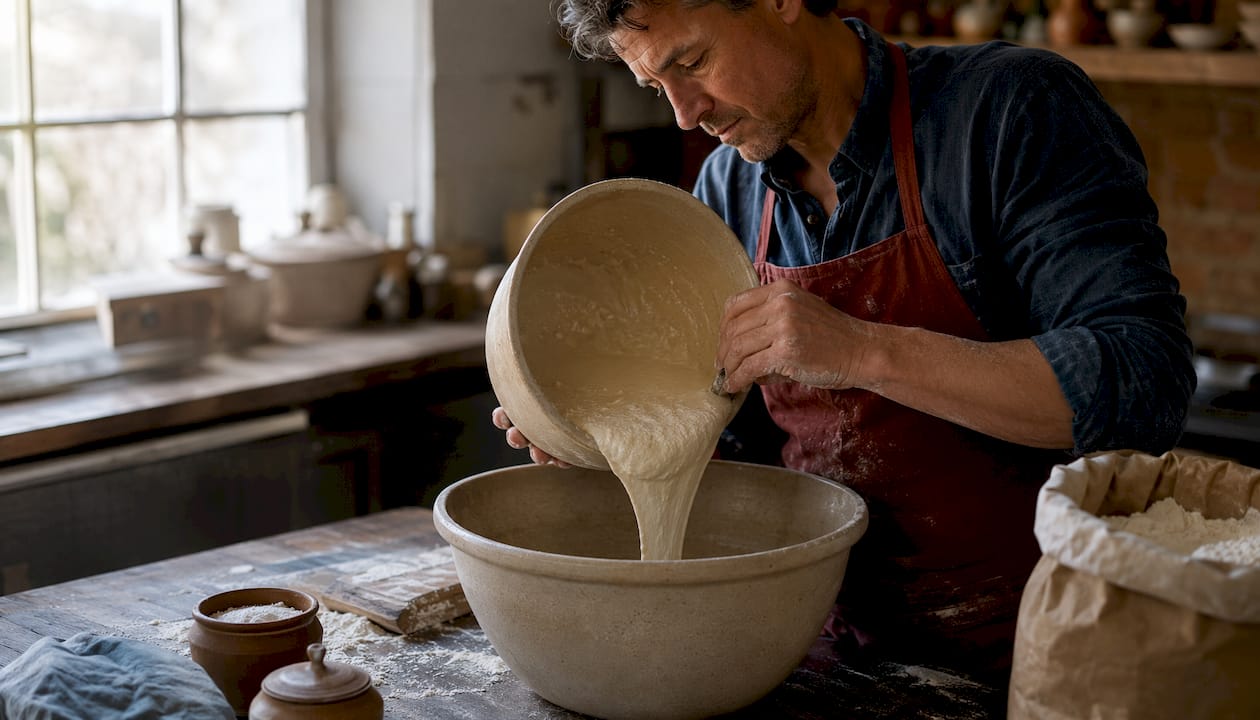
Natural sourdough is a living culture: wild yeasts and lactic acid bacteria coexist in a mixture of flour and water, which is maintained through regular feedings. These microorganisms ferment the sugars in the flour, producing CO₂ (which makes the dough rise) and organic acids (which provide flavor and protect the bread).
The effects are measurable. Fermentation reduces gluten content, increases the availability of B vitamins and minerals, and often contributes to a lower glycemic index compared to breads made with industrial yeast. The acidity produced also slows starch retrogradation, which explains the better natural shelf life.
Two techniques structure the artisanal process:
- Autolysis: mixing flour and water 30 minutes to 4 hours before incorporating the starter and salt. The starch breaks down, the gluten network forms without intensive kneading, and the dough becomes easier to handle, even at high hydration.
- Cold fermentation: bulk fermentation in the refrigerator between 8 and 10°C (46–50°F) for 12 to 24 hours develops more complex aromas and offers valuable organizational flexibility in an artisanal bakery.
- Hydration: 65–70% hydration offers a good balance between workability and an airy crumb; beyond 75–80%, the crumb becomes very open but the dough is more delicate to shape.
Pro tip: Long fermentation compensates for a large part of the variations in shaping and timing. An experienced artisan knows this: the precision of the gesture matters less than the health of the starter and the control of temperature.
Which flours should you choose for sourdough bread or panettone?
Flour is the primary lever of quality. Organic T65 stone-ground flour retains the germ and minerals that industrial extraction removes. For a country loaf (pain de campagne), a T80 or a blend with T150 adds aromatic depth. Ancient grains (spelt, khorasan, einkorn) offer more supple gluten and increased digestibility.
Panettone is a unique case. Its dough, enriched with eggs, butter, and sugar, requires flour with a very high protein content and highly extensible gluten, capable of holding a long fermentation without tearing. Italian mills Grassi and Dalla Giovanna have developed flours specifically formulated for this constraint: they are irreplaceable for achieving the characteristic stringy texture of artisanal panettone. Christophe Louie uses them for this precise reason.
| Flour type | Recommended usage | Structure | Aromas | Indicative hydration |
|---|---|---|---|---|
| Organic T65, stone-ground | Standard bread, sourdough baguette | Good | Mild, slightly nutty | 65–70% |
| T80 / semi-whole | Country bread, boule | Very good | Complex, slightly tangy | 75–80% |
| T150 / whole wheat | Whole wheat bread, rustic | Average | Pronounced, earthy | 75–80% |
| Ancient grains (khorasan, einkorn) | Specialty breads, digestibility | Good | Subtle, slightly sweet | 65–72% |
| Italian technical flours (Grassi, Dalla Giovanna) | Panettone, enriched brioches | Excellent | Neutral, supports added aromas | — |
Water also deserves attention: non-chlorinated water preserves the sourdough’s microorganisms. Salt, added after autolysis, regulates fermentation without killing the yeast.
What does a 72-hour process really look like?
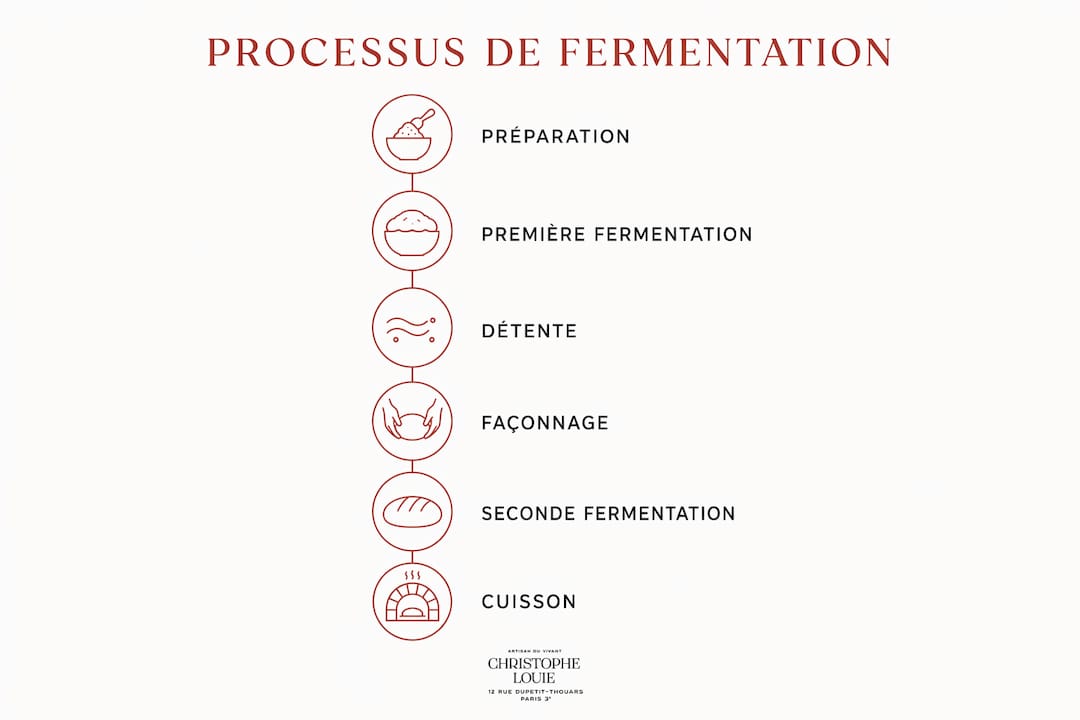
Understanding the steps allows you to verify a producer's claims. Here is the typical sequence for a long-fermented sourdough panettone:
- Feeding the starter (Day 3, morning): feed the lievito madre so it reaches its peak activity. A healthy starter doubles in volume in 4 to 6 hours at 24–26°C.
- First dough (Day 3, evening): incorporate flour, water, egg yolks, sugar, and starter. Long kneading to develop the gluten network. Bulk fermentation in a temperature-controlled environment (24–26°C) for 12 hours.
- Autolysis and second dough (Day 2, morning): incorporate butter, flavorings, candied fruits, or chocolate. Further kneading, then partial autolysis to soften the dough.
- Manual shaping (Day 2, afternoon): divide, round, and place in paper molds. The movement must be delicate so as not to degas the dough.
- Long proofing in the cold (Day 2 evening → Day 1 morning): fermentation at 8–10°C for 12 to 24 hours. This is where complex aromas and the stringy crumb are built.
- Return to room temperature and baking (Day 1): remove molds, let proof at room temperature, then bake. The Dutch oven or deck oven method at 250°C creates the thermal shock that sets the crust.
- Inversion and cooling: panettones are turned upside down immediately after baking to prevent the crumb from collapsing. Minimum 12 hours of rest before packaging.
Pro tip: Mastering temperature is the primary organizational tool. One degree too much during proofing and the dough over-ferments; one degree too little and it doesn't reach its volume. Serious artisans invest in temperature-controlled fermentation chambers.
How to recognize a true sourdough panettone or bread?
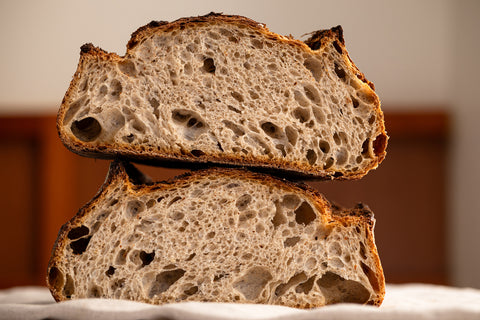
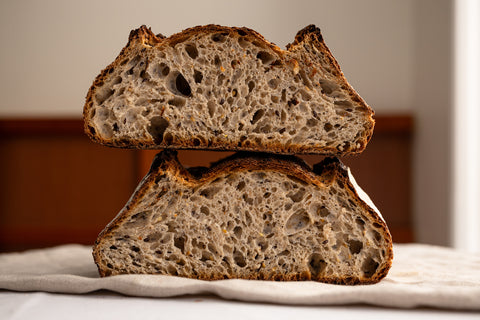
The positive signs are precise and reproducible. An airy, irregular crumb with holes of varied sizes indicates active fermentation. The crust should be caramelized and sound hollow when tapped. The aroma is complex: slightly tangy, with notes of fermented butter and sourdough, never uniformly sweet.
For the starter itself, the float test is the simplest field check: a spoonful of starter placed in a glass of water should float. If it sinks, the starter is not active enough and requires an additional feeding before incorporation.
Warning signs are just as clear: a uniformly sweet taste without acidity, a compact and uniform crumb, a total absence of fermentation aroma, or the presence of additives (ascorbic acid, emulsifiers) in the ingredient list. An industrial panettone is also recognizable by its excessive lightness and lack of stringiness when pulled apart.
Storage: how long does a sourdough panettone last?
Artisanal sourdough bread keeps significantly better than industrial yeast bread, thanks to the natural acidity produced by lactic acid bacteria. This acidity inhibits mold growth and slows staling.
A sourdough panettone crafted according to a long process and packaged in a protective atmosphere can naturally keep for several weeks without additives, provided the storage conditions recommended by the producer are respected.
For standard bread, expect 5 to 7 days at room temperature in a kitchen towel or paper bag. Avoid the refrigerator, which accelerates starch retrogradation. Panettone should be kept in its original packaging, away from heat and humidity, ideally between 15 and 18°C.
Some ideas for using a high-end product: sliced thin and slightly warmed in the oven (150°C for 5 minutes), the panettone reveals its aromas. It pairs remarkably well with aged blue cheese or slow-extracted specialty coffee. Leftover panettone can be transformed into French toast or fragrant breadcrumbs for desserts.
What a discerning buyer must verify before ordering
Before placing an order, ask the producer these questions:
- What type of starter do you use (wheat, rye, lievito madre) and how often do you feed it?
- What is the total duration of the process, from the first dough to baking?
- Where does your flour come from? Is it organic, stone-ground, or technical Italian flour (Grassi, Dalla Giovanna) for panettone?
- What are the delivery conditions and the protective packaging used?
- What is the guaranteed shelf life, and under what conditions?
To evaluate the artisanal quality of a finished product, the same criteria apply as in spirits or gastronomy: traceability of raw materials, mastery of the process, and consistency between the promise and the product in hand.
| Criterion | Discerning level | Warning sign |
|---|---|---|
| Flour sourcing | Organic, stone-ground, or technical Italian flours | Generic, unidentified flour |
| Process | Ideally documented 72 h | "Artisanal" without duration details |
| Sourdough | Lievito madre or daily maintained chef starter | Unspecified starter/yeast blend |
| Storage | Up to five weeks without additives (panettone) | Additives in the ingredient list |
| Packaging | Protective atmosphere, rigid packaging | Simple plastic bag |
To go further in your selection, the guide on how to choose a panettone details the technical and sensory criteria to apply.
Key points
Quality sourdough bread rests on three inseparable pillars: a living starter maintained regularly, flours adapted to the product, and a documented long fermentation.
| Point | Details |
|---|---|
| Long fermentation | A 72 h process improves digestibility, aroma, and natural preservation. |
| Flour choice | Organic stone-ground for bread; Grassi or Dalla Giovanna for panettone. |
| Field quality test | The starter float test and crumb stringiness are the two most reliable indicators. |
| Natural preservation | A well-packaged sourdough panettone lasts up to five weeks without additives. |
| Christophe Louie | Parisian house specializing in 72 h sourdough panettone, with documented sourcing and two-dough process. |
What the 72-hour process really changes
The mention "72 hours" on a panettone is not a marketing gimmick. It is a real technical constraint that mechanically excludes industrial shortcuts. A panettone produced in 8 hours with baker's yeast may resemble the original in appearance, but it will never have its stringiness, controlled acidity, or natural shelf life.
What I have observed, after years spent in demanding kitchens like Le Jules Verne and La Grande Épicerie, is that most customers underestimate one point: the quality of the starter is more important than anything else. Exceptional flour with a tired starter will yield a mediocre result. Conversely, a healthy, daily-refreshed starter compensates for part of the shaping imperfections. This is why at Christophe Louie, the lievito madre is treated as the heart of the process, not as one ingredient among others.
Sourcing Italian flours is not a choice of prestige. Grassi and Dalla Giovanna formulate flours with high extensible protein content, specifically calibrated to hold a double long fermentation. Without them, the dough tears during the second mix. The sourdough bakery/pastry shop we have built relies on these technical choices, not on marketing ploys.
Christophe Louie’s 72-hour sourdough panettone, available all year round
Christophe Louie offers a range of sourdough panettones crafted according to the 72-hour process, available in sweet and savory versions: the orange blossom panettone, the Classico with candied fruits, and seasonal creations (tangerine, truffle, cacio e pepe). The range also includes sourdough breads, brioches, and madeleines, available all year round.
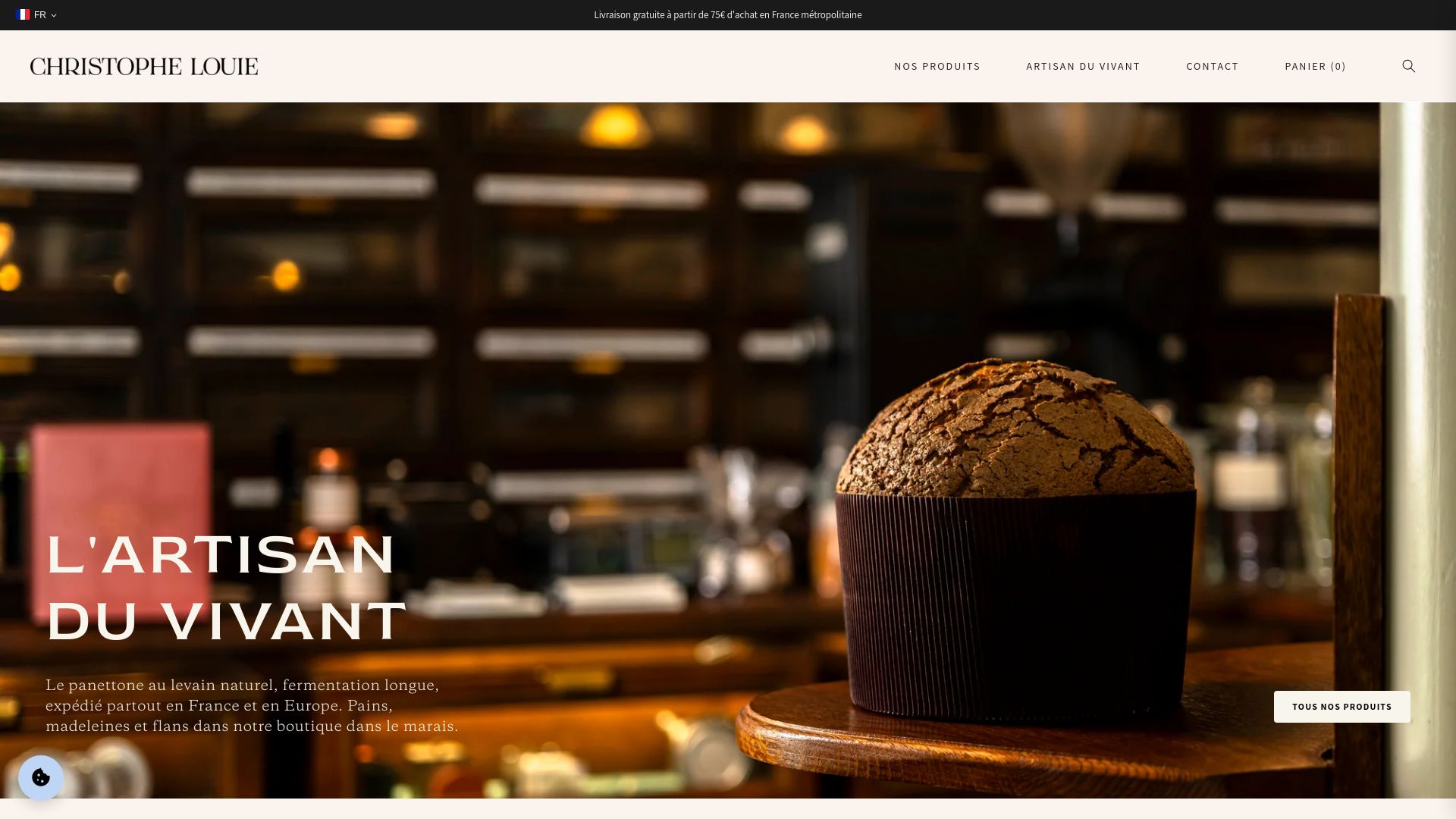
The boutique is open at 12 rue Dupetit-Thouars, Paris 3rd, with on-site click & collect. Delivery is available across Paris and throughout France via the website christophelouie.com. For professionals (hotels, restaurants, gourmet grocers, corporate gifting), a dedicated B2B channel is available with adapted formats and packaging. Each order comes with guarantees regarding the process and preservation. To place an order or request a professional quote, go directly to the online purchase page.
Technical resources for further reading
The following sources support the technical claims in this article:
- painaulevain.fr: health benefits, nutrient bioavailability, choice of organic and stone-milled flours.
- droledepain.fr: mastery of long fermentation, autolysis, cold fermentation at 8–10 °C.
- hellonelo.com: accessible process, long fermentation, and tolerance to execution variations.
- astucesdegrandmere.net: sourdough float test, Dutch oven baking method.
- pekis.net: recommended hydration (65–70%), natural preservation of sourdough bread.