Storing madeleines: the method that keeps them perfectly soft
To keep madeleines soft for several days, forget the refrigerator: store them in an airtight metal or glass container at room temperature, where they will last for 3 to 5 days. Beyond that, freeze them individually; they will then keep for 2 to 3 months. The only trap to avoid: packing them while still warm, as the accumulating moisture softens the shell and causes the hump to lose its characteristic crunch.
In short:
- The best solution for keeping madeleines soft is to store them at room temperature in a metal or glass container, avoiding packing them while still warm.
- Freezing allows you to preserve their texture for up to three months if they are wrapped individually and thawed gently at room temperature or in a low-heat oven.
- Store them in a dry place, away from heat and light, and let them cool completely before storage to prevent them from losing their crunch.
- The refrigerator is not recommended unless they contain a perishable filling or sensitive ingredients, as the cold quickly dries out the batter.
- Modifying the recipe with invert sugar or honey, as well as using a mixture of butter and oil, can extend the period during which the madeleines remain soft.
Table of contents
- How to store madeleines at room temperature
- Freezing and thawing procedure for optimal storage
- The refrigerator: why avoid it and when to use it
- Modifying the recipe to help with storage
- How to revive slightly dry madeleines
- Chef's advice: professional practices adapted for the home
- Fresh or frozen: which strategy suits your lifestyle?
- A simple alternative: artisanal madeleines ready to enjoy
- Perspective: why most advice ignores the real problem
- Sources
- Frequently asked questions
How to store madeleines at room temperature
The most neglected step isn't the container, it's the timing. A madeleine coming out of the oven releases steam for several long minutes. Sealing it in a box immediately traps that moisture against the shell, turning the crunch into a soft surface by the very next day.
The choice of container matters as well. Metal and glass isolate better from air and light than a simple plastic bag, and avoid the condensation effect that makes the pastry rubbery when it is still warm at the time of closing. A tin-style biscuit box works very well for daily use.
A few simple adjustments can prolong freshness:
- Place a small piece of fresh bread or a sugar cube in the box: they capture residual moisture without drying out the pastry, a tip widely echoed by amateur pastry forums.
- Store the box in a dry place, away from heat sources (oven, radiator) or direct light.
- Avoid opening the box too often; each opening reintroduces ambient air with varying humidity.
Pro tip: never mix madeleines of different textures in the same box; the one just out of the oven will humidify those from the day before within a few hours.
Freezing and thawing procedure for optimal storage
Freezing remains the only reliable method to go beyond five days without losing texture, provided you follow a precise sequence.
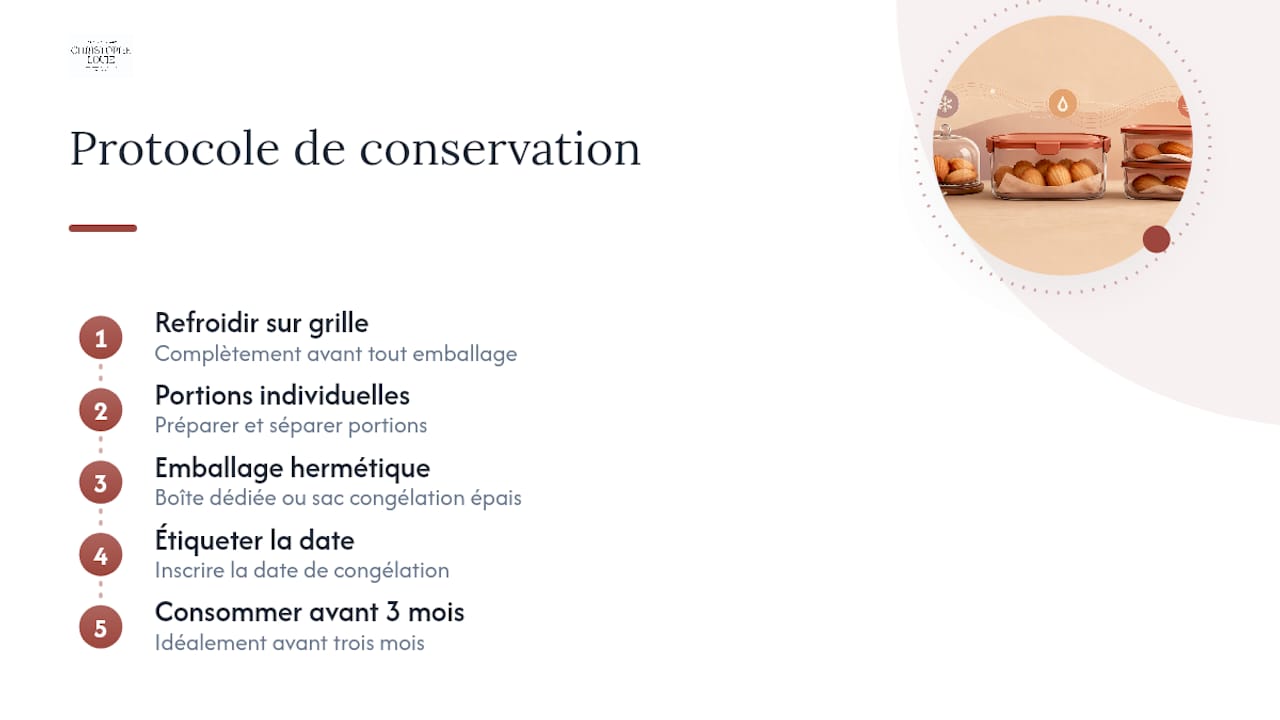
- Let the madeleines cool completely on a wire rack. If you have the time, slide them into the freezer flat on a tray for an hour before wrapping: this pre-freezing prevents them from becoming deformed or sticking to one another.
- Wrap each madeleine individually in plastic wrap or parchment paper. Individual wrapping limits the absorption of odors from the freezer, a point confirmed by specialized home storage guides.
- Collect the portions in a freezer bag or airtight container, pressing out as much air as possible before closing.
- Count on a duration of 2 to 3 months to maintain satisfactory taste and texture. Beyond this time, they remain edible but lose flavor finesse.
- For thawing, take the madeleines out at room temperature an hour or two before enjoying them. If you want to regain the original crunch, place them in a low-heat oven for a few minutes afterwards.
The only real risk with freezing is freezer burn linked to poor wrapping. A film that lets air through is enough to give them a "freezer taste," even after only three weeks.
The refrigerator: why avoid it and when to use it
The cold of the refrigerator crystallizes the butter in the batter, which paradoxically accelerates staling instead of slowing it down. This is one of the most common mistakes made by those who think they are doing the right thing by storing their madeleines in the cold: the texture becomes dry and crumbly in less than two days.
There are, however, legitimate exceptions:
- Madeleines filled with a fresh cream or ganache: the perishable filling requires cold storage.
- Any preparation containing an element based on raw eggs or unstabilized dairy products.
If you must refrigerate them, wrap them hermetically to limit contact with cold, dry air, then let them return to room temperature before serving. A cold madeleine straight from the refrigerator always has less taste than a tempered one.
Modifying the recipe to help with storage
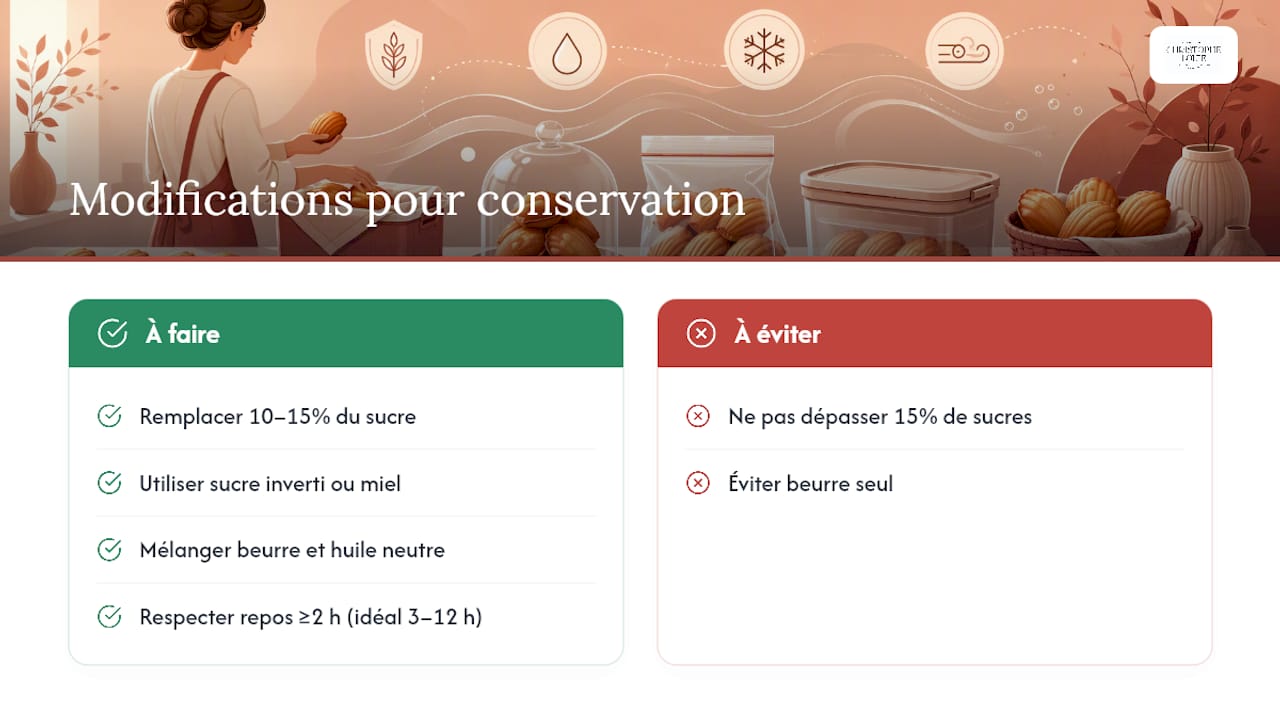
Storage also depends on preparation, even before baking. Replacing 10 to 15% of the usual sugar with invert sugar or honey changes things: these sugars retain moisture thanks to their hygroscopic properties, which keeps the crumb soft for longer. Be careful with the dosage, however: beyond 15%, the crumb structure changes and browning increases during baking.
The choice of fat also plays a role. Butter alone provides the characteristic taste of a madeleine, but a mixture of butter and neutral oil slightly improves stability over time, because oil remains liquid in the cold while butter hardens.
Finally, do not neglect letting the batter rest. Two hours at a minimum, an entire night ideally: this resting time conditions not only the famous madeleine hump, but also its ability to stay soft once baked. Our recipe for madeleines without artificial flavorings details this rest time, between 3 and 12 hours depending on the desired texture.
How to revive slightly dry madeleines
A madeleine that has lost its softness is not lost forever. A trip to the oven at 150°C (300°F) for 3 to 5 minutes reactivates the texture without drying it further, provided you watch the baking closely.
The microwave also works, but with caution:
- Wrap the madeleine in a slightly damp cloth.
- Never exceed 5 to 8 seconds, otherwise the texture becomes rubbery and unrecoverable.
- Always prefer the oven if you have the time; the result is significantly more consistent.
Pro tip: if the madeleine is too dry to be revived, crumble it over plain yogurt, turn it into express French toast, or use it as a crumble base. Nothing goes to waste.
Chef's advice: professional practices adapted for the home
In the workshop, mastering the cooling on a wire rack before any packaging is a non-negotiable rule; you never save time by wrapping too quickly. Reusable packaging (dedicated airtight containers, high-quality thick food-grade freezer bags) avoids micro-leaks of air that ruin a multi-week freeze. For small home productions, prepare individual portions and label the freezing date: beyond three months, memory always plays tricks on the real age of a batch.
Fresh or frozen: which strategy suits your lifestyle?
The choice depends on three criteria: your frequency of consumption, available freezer space, and your attachment to the taste of something just out of the oven. A family that snacks daily will prefer frequent small batches; an occasional host or someone looking for a gourmet gift would benefit from freezing a large batch in advance, ready to pull out at the right moment.
A simple alternative: artisanal madeleines ready to enjoy
If organizing cooling, wrapping, and rotating airtight containers takes you more time than enjoying them, Christophe Louie offers another path: artisanal madeleines prepared according to the same principles of rested batter and controlled baking, available at the shop in the Marais, or via delivery in Paris and throughout France via the online store.
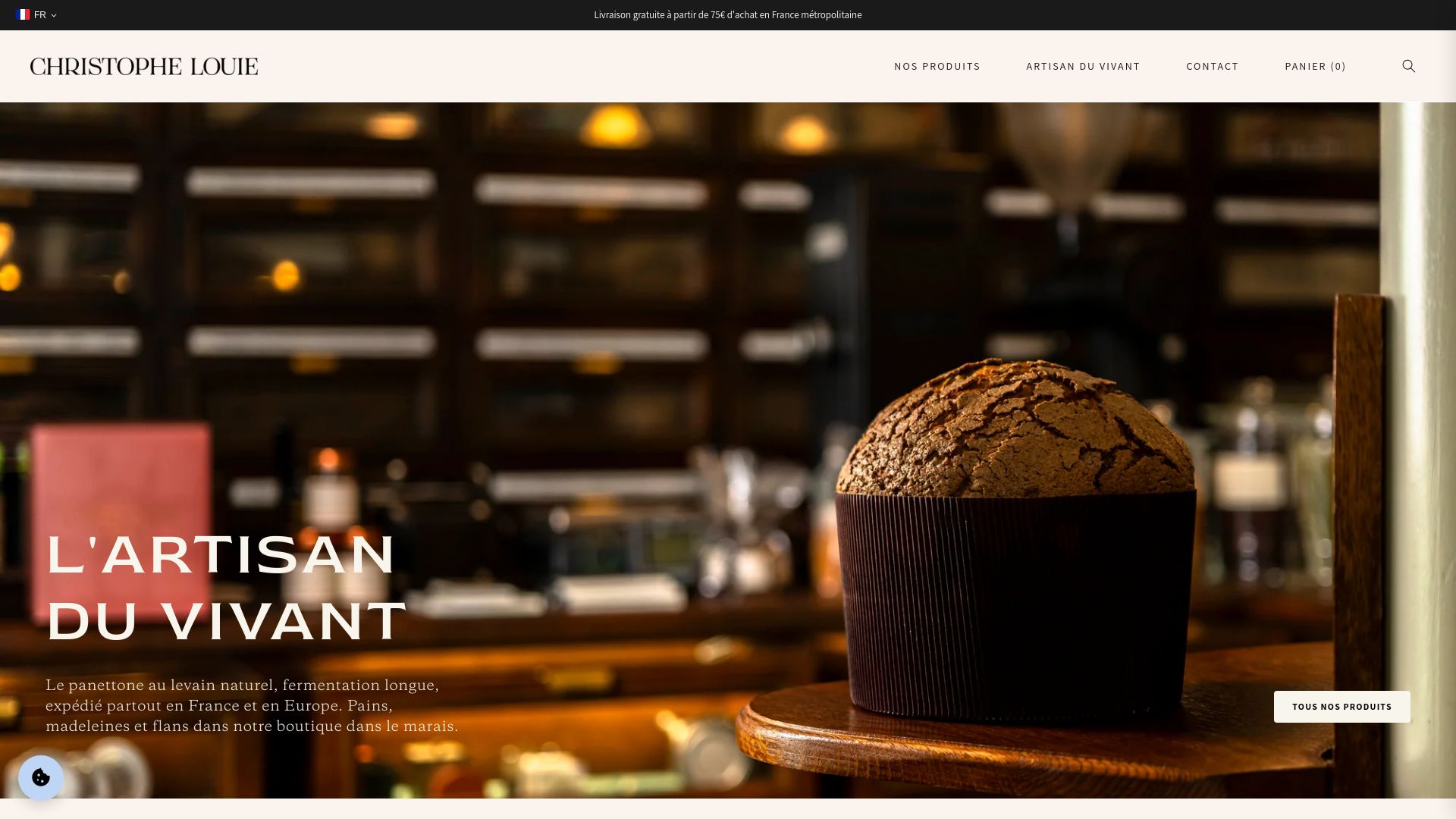
The concrete advantage over poorly anticipated homemade preparation: packaging designed from the start to last for several days without losing its softness, as well as a variety of flavors that facilitates prolonged storage. It is also a practical option for a gourmet gift or a professional order without the need for freezer management. Discover the complete collection of madeleines and pastries or check the products available for fast delivery to receive your fresh madeleines within a few days.
Perspective: why most advice ignores the real problem
Most guides focus on the container, whereas the real success factor happens before: complete cooling and resting the batter. An airtight box will never fix a madeleine packed while hot or a batter baked without sufficient rest. Treat storage as the last step of a recipe, not as a post-hoc fix.
— Christophe
Sources
For more depth, consult CuisineAZ on real shelf life, Cuisine Magazine on cooling and packaging, and Mary-Madeleine on oven-revival techniques. These sources detail the methods mentioned here.
- After-school snack: How long can you really keep homemade madeleines?
- Madeleines: all the secrets to success
- How to keep your homemade madeleines for as long as possible
Frequently asked questions
What is the shelf life of madeleines?
At room temperature in an airtight box, count on 3 to 5 days; frozen and well-wrapped individually, they maintain their quality for up to 2 to 3 months.
What can I do with expired or overly dry madeleines?
Crumble them over yogurt, turn them into express French toast, or use them as a crumble base rather than throwing them away.
How long can madeleine batter be kept in the refrigerator?
Batter is generally kept in the refrigerator in a closed container, which corresponds to the rest time recommended before baking to obtain the characteristic hump.
Is it possible to make madeleines the day before?
Yes, it is even advised: prepare the batter the day before for a full night of rest, then bake them the same day and let them cool on a wire rack before storing them in an airtight container.