

Panettone stiff starter: hydration, flour and schedule
To succeed with a panettone, you need a stiff starter hydrated between 40 and 50%, a high-strength flour like Manitoba or "gruau" flour, and at least three refreshments before incorporation into the dough.
Three benchmarks to remember before starting:
- Target hydration: 40 to 50% for a firm and workable dough.
- Fermentation temperature: maintained between 25 and 28°C throughout the refreshment cycle.
- Ratio in the final dough: the starter generally represents 25 to 30% of the total flour weight.
Key points
| Point | Details |
|---|---|
| Starter hydration | Aim for 40 to 50% to obtain a firm texture capable of supporting butter and egg yolks. |
| Suitable flour | Choose a high-strength flour like Manitoba or "gruau" to withstand long fermentations. |
| Refreshment rhythm | Perform at least three refreshments spaced 3 to 5 hours apart before use. |
| Fermentation temperature | Maintain 25 to 28°C throughout the cycle to stabilize starter activity. |
| Final cooling | Hang the panettone upside down for at least 12 hours to prevent the crumb from collapsing. |
| Ready-to-use alternative | Christophe Louie offers a 72-hour sourdough panettone using this same double-dough process. |
Table of contents
- Ingredients and equipment for preparing a stiff panettone starter
- How to create or convert a starter into a stiff starter?
- What refreshment rhythm to adopt for an active starter?
- How to integrate the stiff starter into the panettone dough?
- Baking and cooling: the phase where everything can go wrong
- What to do when the starter or dough presents problems?
- What artisanal practice teaches about the stiff starter
- What distinguishes a real stiff starter from a simple recipe followed to the letter
- Want a sourdough panettone without going to the bakery?
- Sources
Ingredients and equipment for preparing a stiff panettone starter
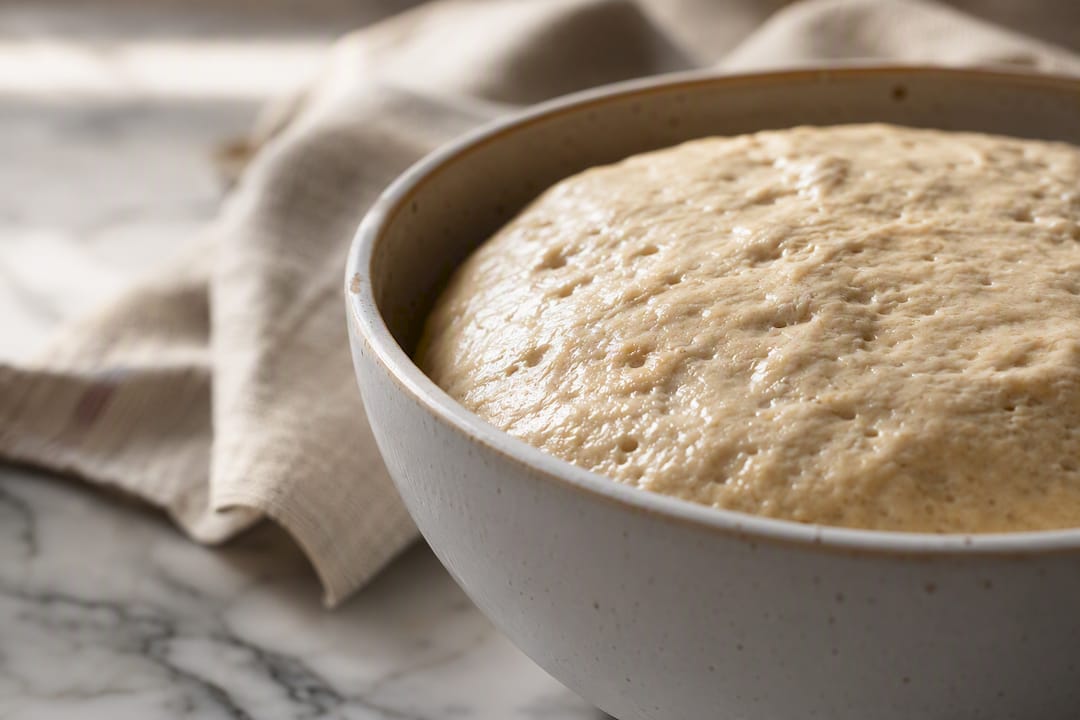
A strong bread-making flour makes all the difference. "Gruau," Manitoba, or a technical flour like Caputo can withstand the long fermentations and intensive kneading that panettone requires, where a standard T55 flour would collapse under the weight of the butter. Many Italian artisans actually use the same flour to feed the starter as they do for the final dough, which facilitates the enzymatic transition between the two.
As for equipment, nothing sophisticated:
- A high-strength flour (Manitoba, "gruau," or an equivalent strong bread-making flour available locally).
- Non-chlorinated water, ideally filtered or left at room temperature for a few hours.
- A digital scale accurate to the gram, a kitchen thermometer, a clean container.
- Plastic wrap or a perforated lid, and paper panettone molds if you are aiming for the traditional shape.
The quality of the flour directly influences the final airy structure: weak flour will result in a dense crumb, regardless of the care given to the starter.
How to create or convert a starter into a stiff starter?
Two paths lead to a usable stiff starter: starting from scratch or converting an existing liquid starter.
To start from scratch:
- Mix 50g of high-strength flour and 50ml of lukewarm water, let it rest for 24 hours at room temperature.
- Perform a first refreshment with equal parts (1:1:0.5, i.e., one part starter, one part flour, half part water) to begin firming up the texture.
- Repeat this refreshment every 24 hours for 5 to 7 days, until regular activity is observed.
- Then move to a 1:2:1 ratio (one part starter, two parts flour, one part water) to gradually bring the hydration down to the 40 to 50% target.
To convert an existing liquid starter, the rule is patience: reducing hydration all at once weakens the microbial flora and causes the starter to lose strength.
If the peak arrives too early and falls quickly, the starter is still young; if it stagnates, the temperature is probably too low.
Pro tip: Always keep a small sample of your stiff starter before attempting a hydration conversion. In case of failure, you start over from the stable strain rather than starting everything from the flour again.
What refreshment rhythm to adopt for an active starter?
An "active" (or "energized") starter, i.e., one sufficiently active to support an enriched dough, is obtained with at least three closely spaced refreshments before incorporation, spaced 3 to 5 hours apart. This tight rhythm reduces accumulated acidity and boosts the lifting power just before use.
Temperature remains the most neglected factor by amateurs, as explained in this blog post · Gin de Chimay on temperature control and frequent errors. Maintaining fermentation between 25 and 28°C stabilizes activity and avoids excessive acidification that would give the finished product an overly sharp taste. In home kitchens, several simple solutions work:
- An oven turned off with only the light bulb on often maintains 26 to 28°C.
- A makeshift proofing box (cooler with a bowl of hot water replaced periodically) works well in winter.
- A heating pad set to the minimum, under the container, is suitable if you monitor the temperature closely.
A successful refreshment shows a clear peak and an elastic texture that does not excessively stick to the fingers. Too slow? Increase by one or two degrees. Too fast and acidic? Lower slightly and shorten the interval between refreshments.
How to integrate the stiff starter into the panettone dough?
Traditional panettone follows a double-dough process, and the stiff starter is the engine for both stages. Professional proportions provide about 150g of stiff starter for 500g of flour, which is a ratio close to 30% of the flour weight, a base that works just as well at the amateur level as it does in artisanal production.
- First, mix the starter with the flour and water until a homogeneous dough is obtained, without adding the butter yet.
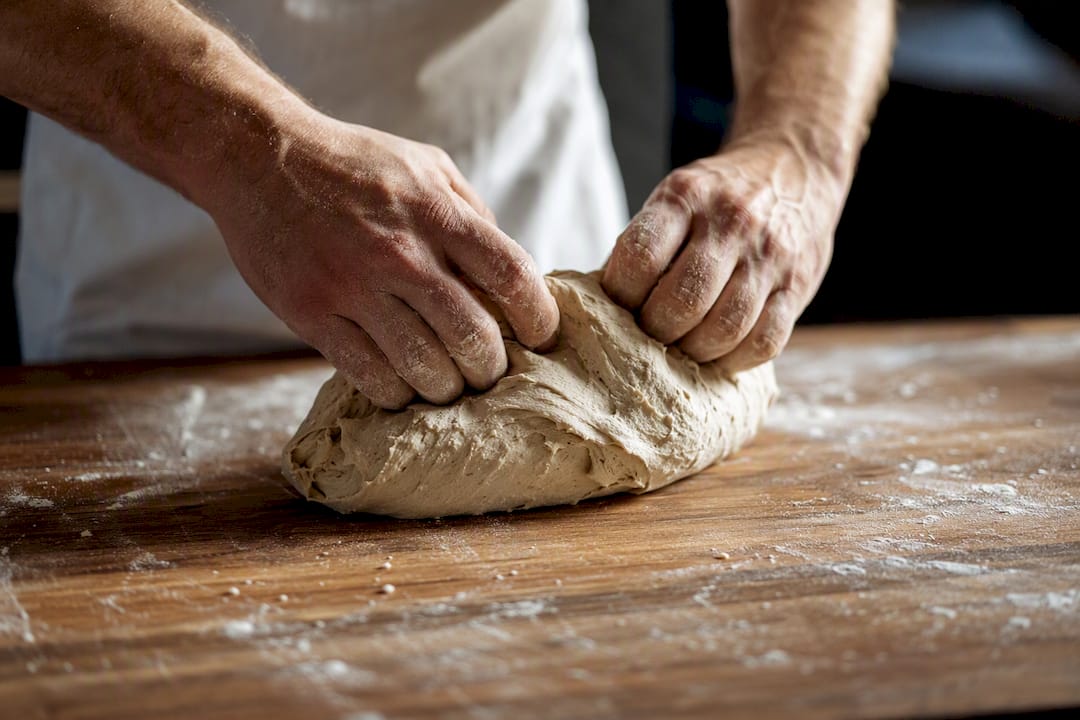
- Incorporate the butter gradually, in small quantities, once the dough is well-bound. Adding the fat too early breaks the gluten network being formed.
- Let this first dough ferment for about 12 hours at a controlled temperature, until it triples in volume.
- Prepare the second dough by incorporating sugar, eggs, flavorings, and candied fruits or raisins previously soaked, then let it rise for 4 to 6 hours before placing it in the mold.
Candied fruits must be drained and lightly floured before incorporation; otherwise, their moisture will destabilize the crumb structure during the final rise.
Baking and cooling: the phase where everything can go wrong
Baking generally starts at 180°C for the first ten minutes, then continues at 165-170°C until the heart of the panettone reaches 94 to 98°C, a long bake that protects the stringy crumb without drying it out on the surface.
Points of vigilance for a home oven:
- Cover the top with aluminum foil after 15-20 minutes if the coloring is happening too fast.
- Check the core temperature with a probe rather than visually, as the crust often browns before baking is complete.
- Prepare your skewers or rods in advance: the hanging must be immediate upon exiting the oven.
Cooling upside down for at least 12 hours is not a purist's whim. It is what prevents the crumb, still fragile, from collapsing under its own weight while it sets in a stretched position.
What to do when the starter or dough presents problems?
A starter that is too acidic smells like vinegar rather than yogurt: increase the frequency of refreshments (every 3 hours) for a day, or lower the hydration by a few points for the next refreshments.
- Dough that falls after rising: the kneading was probably insufficient, or the fermentation ran too fast due to an ambient temperature that was too high.
- Persistent under-fermentation: raise the temperature by 1 to 2°C, or question the actual strength of the starter with a test refreshment before restarting the whole dough.
- Starter that no longer doubles: this is often a sign of chronic under-feeding; correct this by returning to a 1:1:0.5 ratio for two or three cycles.
Pro tip: Note the time of each refreshment and the time of the peak in a notebook. After three panettones, you will know the exact rhythm of your starter better than any generic recipe could tell you.
What artisanal practice teaches about the stiff starter
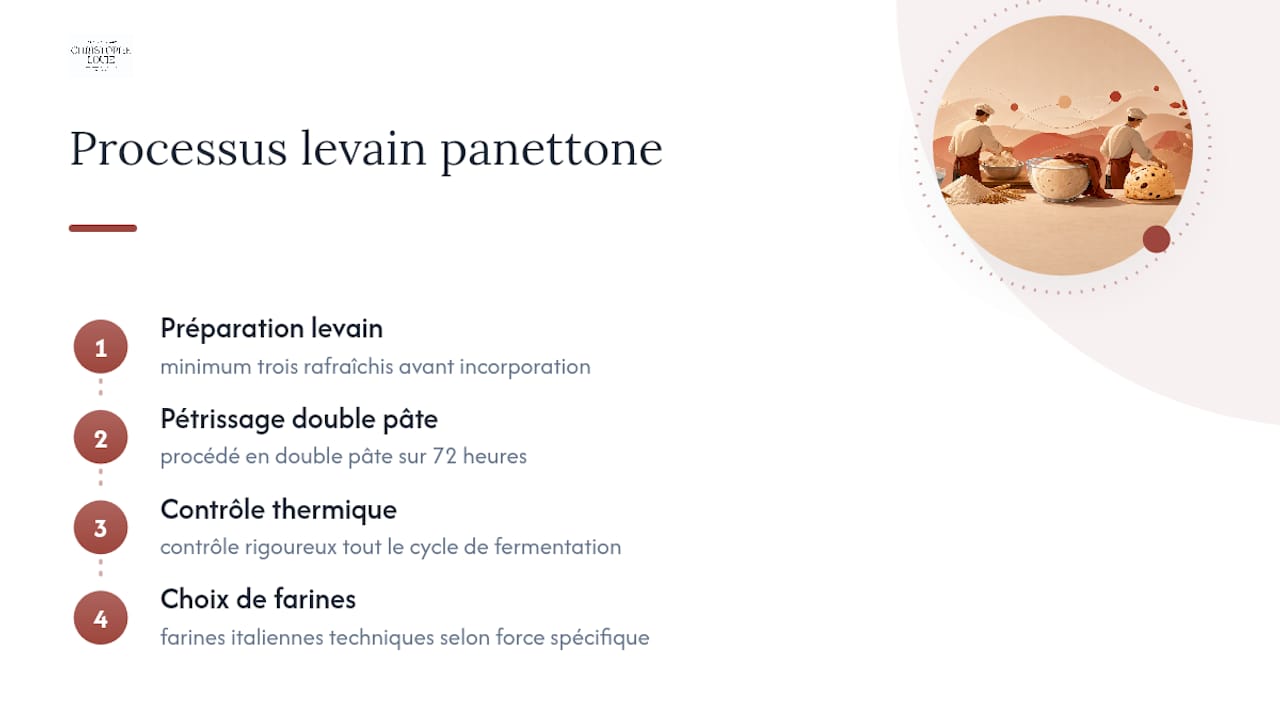
At Christophe Louie, sourdough panettone follows a double-dough process spread over 72 hours, a duration that is by no means arbitrary: it gives the starter time to develop the complex aroma and stringy texture that distinguish an artisanal panettone from an accelerated industrial version.
Three technical choices consistently reappear in professional practice: technical Italian flours chosen for their specific strength, rigorous thermal control throughout the fermentation cycle, and a minimum of three refreshments before any incorporation. Readers who want to go further in managing lievito madre daily will find a complete development on maintaining the strain between two batches.
What distinguishes a real stiff starter from a simple recipe followed to the letter
Most tutorials treat the stiff starter as a secondary variable, a technical detail buried between the ingredient list and the shaping. This is a perspective error. The starter is the only living element of the entire recipe: its strength at the moment of incorporation determines on its own whether your panettone will rise correctly or remain as dense as a failed cake.
The most persistent misconception is that a starter "that works" is enough. This is the whole point of the closely spaced refreshments before use: they are not meant to feed the starter; they are meant to strengthen it for the challenge that awaits it.
If you only remember one priority, it should be this: watch the temperature before watching the clock. A starter at 22°C and a starter at 27°C do not tell the same story, even with an identical refreshment schedule on paper.
Want a sourdough panettone without going to the bakery?
All these steps, from the first refreshment to the upside-down cooling, require time, a precise scale, and a good dose of patience.
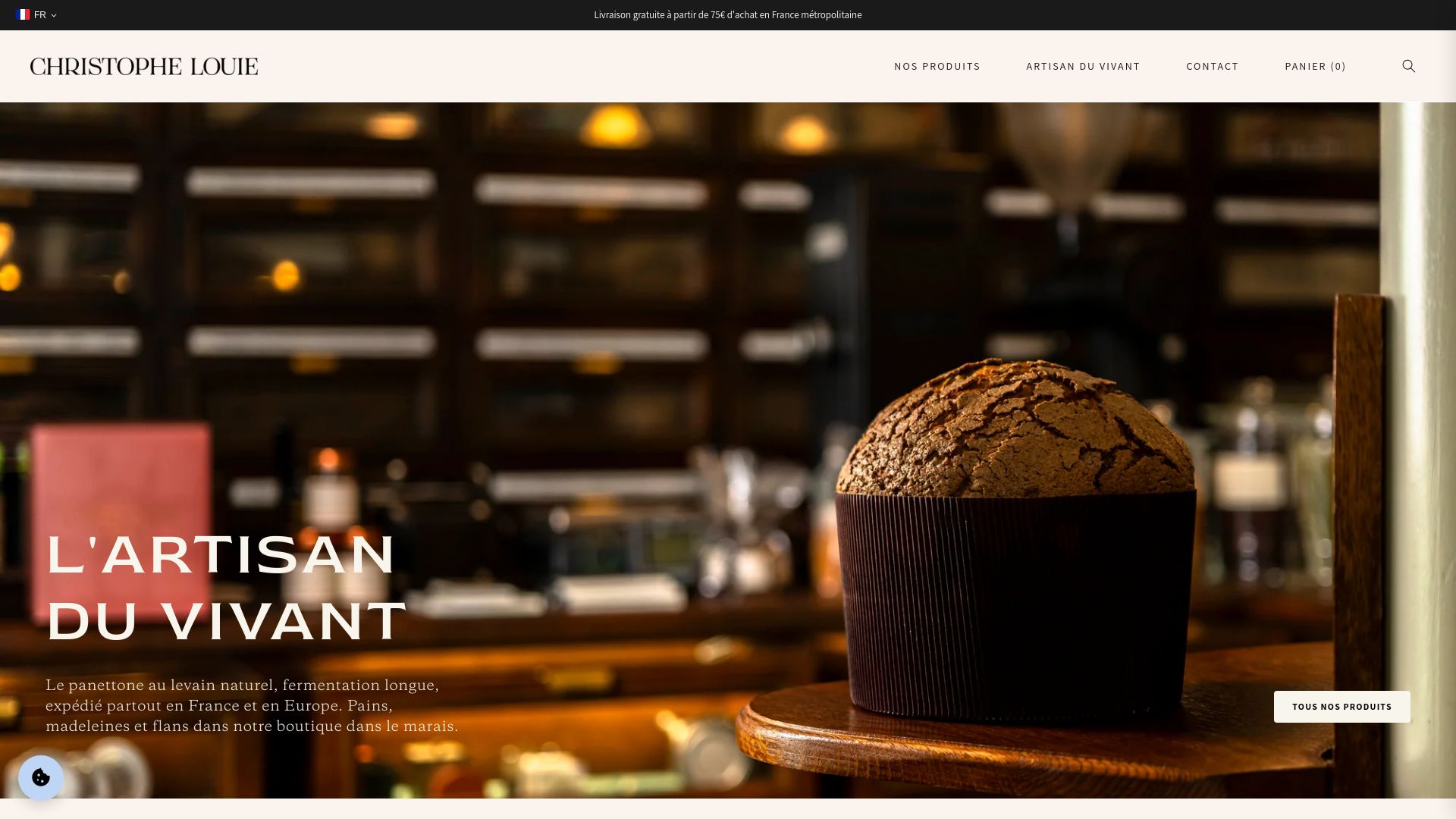
The product's natural shelf life, up to five weeks without additives, stems directly from this long fermentation that you have just learned to master at home. The house offers the recipe in several versions, including an artisanal orange blossom panettone that well illustrates this aromatic signature peculiar to natural sourdough. If you are still hesitating between making your own panettone or ordering one, the how to choose a panettone page details the criteria that make the difference between an industrial product and a real sourdough panettone. Order online or visit the shop in the Marais to discover the stringy texture that only a well-managed stiff starter can produce.
Sources
To learn more: the complete guide to lievito madre and why choose a sourdough panettone.
- Liquid starter or stiff starter: which one to choose for better fermentation?
- Sourdough panettone: the real recipe (guide)
- Panettone recipe — Éditions Larousse
- Panettone day 3: baking and cooling (Nicrunicuit)