

Candied fruit panettone: the sourdough recipe that works every time
Candied fruit panettone is a large Italian brioche whose success depends on two things: a live sourdough starter managed through a long fermentation, and candied fruits that are macerated and then coated in flour before being incorporated. Three elements make the difference between a compact dough and a stringy, delicate crumb: the quality of the sourdough, kneading that correctly emulsifies the butter, and cooling upside down immediately after baking.
In short:
- The use of a live sourdough starter with long fermentation is essential for obtaining a stringy crumb and an airy texture in the panettone.
- The quality and preparation of the candied fruits, especially their prior maceration, strongly influence the taste and final outcome of the cake.
- Cooling upside down after baking is crucial to prevent the crumb from collapsing as it cools.
- Fermentation at a controlled temperature, around 26 to 28°C (79–82°F), must be strictly followed to ensure optimal rising.
- The artisanal method requires a two-dough process over 72 hours, with manual shaping and special care in the selection of ingredients.
Table of contents
- What ingredients and proportions for a candied fruit panettone?
- How to organize the two doughs over 48 to 72 hours?
- How to prepare candied fruits before incorporating them?
- Which fermentation temperatures and durations should be followed?
- Why cool the panettone upside down after baking?
- How to store and slice a candied fruit panettone?
- What are the possible variations without losing the dough's structure?
- What Christophe Louie's expertise reveals about the method
- How to identify quality candied fruits for a panettone?
- Can raisins be replaced in the panettone recipe?
- How to present and decorate a candied fruit panettone?
- What the sourdough method really changes
- Where to find a candied fruit panettone ready to eat
- Sources
- Frequently asked questions
What ingredients and proportions for a candied fruit panettone?
A professional recipe for two to three panettones generally relies on a strong, high-gluten flour capable of withstanding several days of fermentation without collapsing. You count on average around 500g of flour per liter of final dough, with a high ratio of eggs and yolks, butter incorporated gradually, and between 25% and 30% of the total weight in candied fruits and raisins—a percentage confirmed by traditional pasty sourdough recipes.
For candied fruits, it is best to choose firm, translucent pieces without crystallized sugar on the surface, cut into small, regular cubes for even distribution in the crumb. Some professionals buy mixes specifically calibrated for panettone, such as the lemon, orange, and citron mix sold in 2.5kg packaging, a practical solution when you want to avoid quality discrepancies between different brands of candied fruits.
Here are the key ingredients to gather before starting:
- Strong flour (Manitoba type or Italian equivalent with high gluten content)
- Active natural sourdough starter or fresh yeast depending on the chosen method
- Butter at room temperature, incorporated in several stages
- Whole eggs and extra yolks for color and softness
- Candied fruits (orange, lemon, citron) and raisins
- Honey or citrus paste for flavoring the second mix
- Orange and lemon zest, vanilla, salt
Honey plays a discreet but real role in the final impasto: added in small quantities, it provides softness and an aromatic note that complements the classic sugar without overpowering the taste of the fruits. For an alcohol-free version, the rum soak can be replaced with lukewarm water infused with orange blossom or citrus juice.
How to organize the two doughs over 48 to 72 hours?
The traditional Italian method is based on a two-dough process, with successive additions of butter, egg yolks, and aromatic pastes like candied orange peel before the final incorporation of candied fruits, a sequence well-documented by reference Italian recipes. Here is how to structure the schedule:
- Refresh the sourdough starter two to three times in the 24 hours preceding the kneading, until it doubles in volume in four to six hours. Fresh yeast can replace natural sourdough for a faster version, at the cost of less longevity and a less complex aroma.
- Knead the first dough by mixing flour, water, sugar, and refreshed sourdough, then incorporate the butter in three or four stages to obtain a homogeneous emulsion. This step directly conditions the stringy texture of the crumb.
- Let this first dough rise for twelve to fourteen hours at a cool room temperature (around 26 to 28°C / 79–82°F), until it triples in volume.
- Prepare the second dough by adding flour, egg yolks, honey or citrus paste, salt, and aromatics to the risen first dough. Knead until you have a smooth, elastic dough that pulls away from the sides.
- Incorporate the drained, lightly floured candied fruits and raisins as the last step of kneading to prevent them from sinking to the bottom of the mold.
- Shape by hand, according to the pirlatura technique which consists of rolling and folding the dough onto itself to create the tension necessary for a beautiful vertical rise.
- Let rest in the mold for an additional four to six hours, until the dough reaches almost to the rim of the panettone mold.
This two-stage organization clearly distinguishes panettone from a classic brioche: each phase builds the strength of the dough needed to support the weight of the candied fruits without collapsing during baking. A detailed guide on long fermentation allows you to delve deeper into each temperature check if you want to reproduce this schedule at home.
How to prepare candied fruits before incorporating them?
Maceration changes everything: professional recipes recommend soaking raisins and sometimes candied fruits in rum or lukewarm infused water for thirty minutes to several hours, a practice confirmed by several pastry technical sheets. The objective is twofold: slightly rehydrate the dried fruits and give them an aromatic note that will diffuse into the crumb.
- Drain the fruits carefully before incorporation so as not to soak the dough
- Cut large pieces of candied fruit into 5–8 mm cubes for even distribution
- Coat the whole thing in a thin layer of flour before adding it to the dough, which prevents the fruits from falling to the bottom during the rise
- Adapt the flavor of the soak according to the panettone's orientation: classic dark rum, orange blossom, or mandarin juice for a sweeter version
Pro tip: If your candied fruits are very sweet, slightly reduce the sugar in the second dough to maintain a clear balance between sweetness and the acidity of the candied citrus.
Which fermentation temperatures and durations should be followed?
Temperature control is probably the most underestimated step by amateur bakers. Achieving the structure of a panettone depends as much on the organization of the schedule as on the recipe itself—a technical success that hinges on just a few degrees.
- First dough proofing: 26 to 28°C (79–82°F) for 12 to 14 hours
- Final proofing of the second dough in the mold: 26 to 28°C (79–82°F) for 4 to 6 hours
- An active sourdough starter doubles in volume in 4 to 6 hours at temperate room temperature
- Sign of a good rise: the dough forms a regular dome above the rim of the mold, without sagging on the sides
If the dough stagnates, the room is probably too cool: move it closer to a gentle heat source (e.g., an oven turned off with the light on) rather than increasing the rising time, which risks over-fermenting the sourdough. A guide on precise fermentation temperatures details each stage if you want to refine your own schedule.
Why cool the panettone upside down after baking?
Baking a candied fruit panettone is generally done at 160–170°C (320–338°F) for 50 to 60 minutes depending on the size of the mold, monitoring the color, which should remain golden without browning excessively.
- Check for doneness in the center with a probe or skewer: it should come out dry.
- Possibly make a cross incision on top before baking, or add a glaze based on powdered sugar and egg white at the end of the process.
- As soon as it comes out of the oven, pierce the base with long metal skewers and immediately hang the panettone upside down.
- Leave it suspended for several hours, often all night, until completely cooled.
This inverted suspension is the most critical technique of the entire recipe, a recommendation reiterated by reference Italian guides: without it, the weight of the highly aerated crumb collapses on itself while cooling, and all the work of the rise is lost in a few minutes. Pro tip: Use long skewers planted in a cross at the base to properly distribute the weight and prevent the panettone from sliding during the night.
How to store and slice a candied fruit panettone?
An artisanal panettone managed via long fermentation naturally keeps much longer than an industrial brioche, often several weeks when the method respects a live sourdough starter and avoids accelerated processes.
- Wrap in food-grade paper, then in plastic wrap to limit drying out
- Store at room temperature, away from direct light, never in the refrigerator, which accelerates staling
- Slice with a long-bladed serrated knife, cutting delicately so as not to compress the honeycombed crumb
- Use remaining slices for French toast, sweet French toast, or simply toasted with a little butter
Panettone also remains a highly appreciated gourmet gift: its long shelf life makes it particularly suitable for end-of-year gifting, without the risk of it drying out before being enjoyed.
What are the possible variations without losing the dough's structure?
Honey, when present in the second mix, softens the final texture and slightly extends the freshness of the panettone by retaining moisture in the crumb. Beyond the classic candied fruit version, several variations can be integrated without upsetting the balance of the recipe, provided a few simple rules are followed.
- For a chocolate version, replace some of the candied fruits with dark chocolate chips, slightly reducing the added sugar
- For a citrus version, strengthen the orange and citron zest rather than adding fresh fruits, which are too moist for the structure
- For a savory version, remove the sugar and candied fruits entirely in favor of olives, herbs, or cheese, while keeping the same sourdough method
- Always compensate for adding a moist ingredient by slightly reducing the liquid in the dough, so as not to weaken the rise
What Christophe Louie's expertise reveals about the method
An artisanal pastry house conducts its signature panettone using a two-dough process spread over 72 hours, with a live sourdough starter maintained daily rather than industrial yeast. This duration is not an arbitrary choice: it corresponds to the time required for natural fermentation to develop both the strength of the dough and the aromatic complexity that distinguishes an artisanal panettone from a standard candied fruit brioche.
- Shaping is done entirely by hand according to the pirlatura technique, described in the guide on manual shaping
- Flours of specific technical quality are used, while other ingredients are sourced locally.
- The stiff sourdough used in the workshop follows a precise refreshment schedule that conditions the entire subsequent fermentation
- This technical rigor contributes to the product's prolonged natural shelf life, without the need for additives.
How to identify quality candied fruits for a panettone?
The quality of candied fruits often makes more of a difference than the recipe itself, a point underestimated by many amateur bakers. A correctly made candied fruit should be translucent, slightly shiny, and supple under the tooth, never hard or crystallized on the surface.
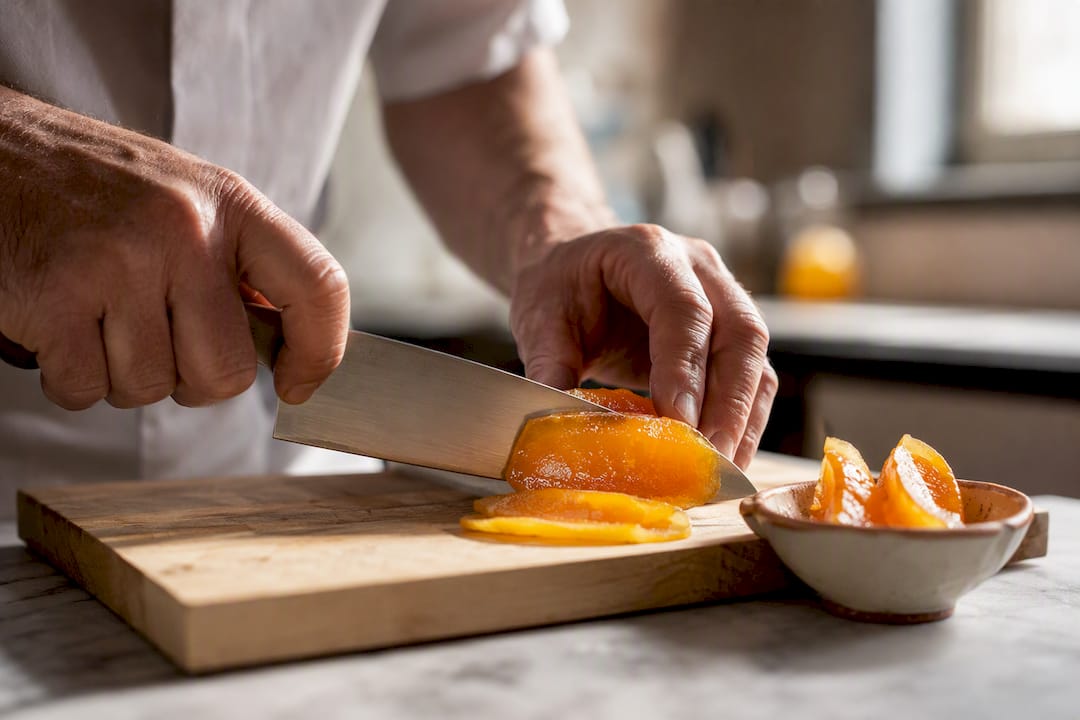
Be wary of cubes that are too opaque or have an artificially bright color: this is often a sign of overly rapid candying, with a sugar syrup that has not had time to properly penetrate the fruit's flesh. The result in the mouth is fruit that remains crunchy or fibrous rather than melt-in-the-mouth, and which provides an unpleasant bitterness instead of a tangy sweetness.
Opt for whole citrus peels that you chop yourself rather than cheap pre-packaged dice, which are often coated in an excess of sticky syrup. Smell the fruit before buying if possible: good candied orange or citron preserves a clean citrus note, without any smell of burnt sugar or chemical preservatives. Candied fruits sold in bulk by an artisan confectioner generally offer better consistency in size and texture than low-cost industrial bags.
Finally, check the ingredient list when available: good candied fruit contains only fruit, sugar, and sometimes a little lemon juice for preservation. The presence of artificial colors or flavors almost always betrays an entry-level product, which will produce a duller result in the mouth once incorporated into the dough.
Can you replace raisins in the panettone recipe?
Raisins are traditional in Italian panettone, but there is no obligation to stick to them if their texture or taste does not suit you. Several alternatives work well provided you follow the same logic: dried fruits of comparable size and moisture content, macerated and then lightly dusted with flour before incorporation.
Dried cranberries provide a more marked acidity that contrasts pleasantly with the sweetness of honey and candied fruits, while maintaining a texture similar to raisins after maceration. Dried figs cut into small dice make for a denser and more fragrant panettone, reserved for lovers of deep flavors. Finely chopped dates also work, but their natural sugar content requires reducing the sugar added to the dough slightly so as not to unbalance the final result.
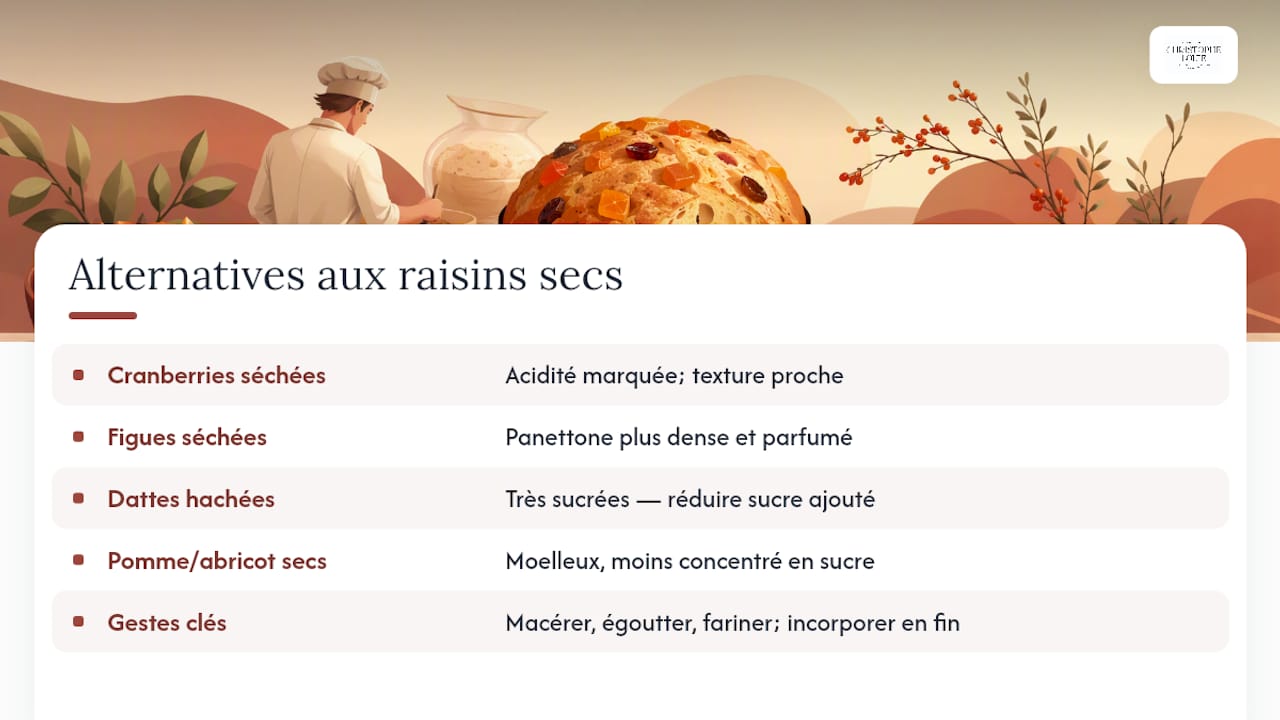
For a version lower in sugar, pieces of dried apple or dried apricot, cut small and briefly macerated, provide softness without the sugary concentration of classic raisins. Whatever alternative you choose, keep to the same principle: drain carefully after maceration, coat with a fine layer of flour, and incorporate at the very end of kneading to prevent the pieces from falling to the bottom of the mold during proofing.
The only real risk is excess moisture: dried fruit that is poorly drained after soaking releases water into the dough and weakens the structure obtained after hours of patient fermentation.
How to present and decorate a candied fruit panettone?
The final presentation of a panettone relies as much on its silhouette as on the decoration itself. A good proof naturally yields a high, regular dome without cracks or side sagging: half the presentation work is already done before even adding any glaze.
The traditional Italian glaze, based on icing sugar, egg whites, and sometimes almond flour, is applied just before baking and cracks slightly in the heat to form a thin, sweet crust. You can add slivered almonds or pearl sugar for visual relief, taking care not to overload the top to the point of weighing down the final rise.
For a more understated presentation, a simple dusting of icing sugar after complete cooling is enough to highlight the natural golden crust of the dough. Some pastry chefs prefer a cross-shaped incision on top before baking, which opens naturally in the heat and reveals the stringy crumb when sliced, a visual effect appreciated for end-of-year gifting.
Packaging also counts in the final presentation: classic greaseproof paper tied with a ribbon, or a rigid cardboard box, protects the airy crumb while offering a look worthy of a gourmet gift. This is one of the advantages of panettone compared to other holiday pastries: its long natural shelf life allows it to be given several days in advance without fear of it drying out before being enjoyed.
What the sourdough method really changes
Most online recipes present long fermentation as a simple matter of patience. This is false, or at the very least incomplete: what really matters is temperature control at each phase, much more so than the total duration displayed. Sourdough proofed too hot will go faster, but will result in a tight crumb and a flat taste, regardless of the total calendar time.
The most common mistake among amateur pastry chefs is not incorrect dosing of candied fruits, but underestimating butter emulsification. Dough that does not properly absorb the butter in multiple additions will always result in a compact crumb, even with excellent sourdough and impeccable candied fruits. This is a technical point that few recipes really detail, and it explains the majority of failed panettones.
If you only remember one priority before starting, it should be this: master kneading and emulsification before worrying about the choice of candied fruits. The quality of the ingredients never makes up for poorly prepared dough.
— Christophe
Where to find a candied fruit panettone ready to enjoy
Reproducing this method at home requires time, a maintained sourdough starter, and a tight 72-hour schedule, which is not always compatible with a busy holiday agenda. One house offers an alternative: an artisanal method using live sourdough, with manual shaping and long fermentation, without you having to monitor every temperature threshold yourself.
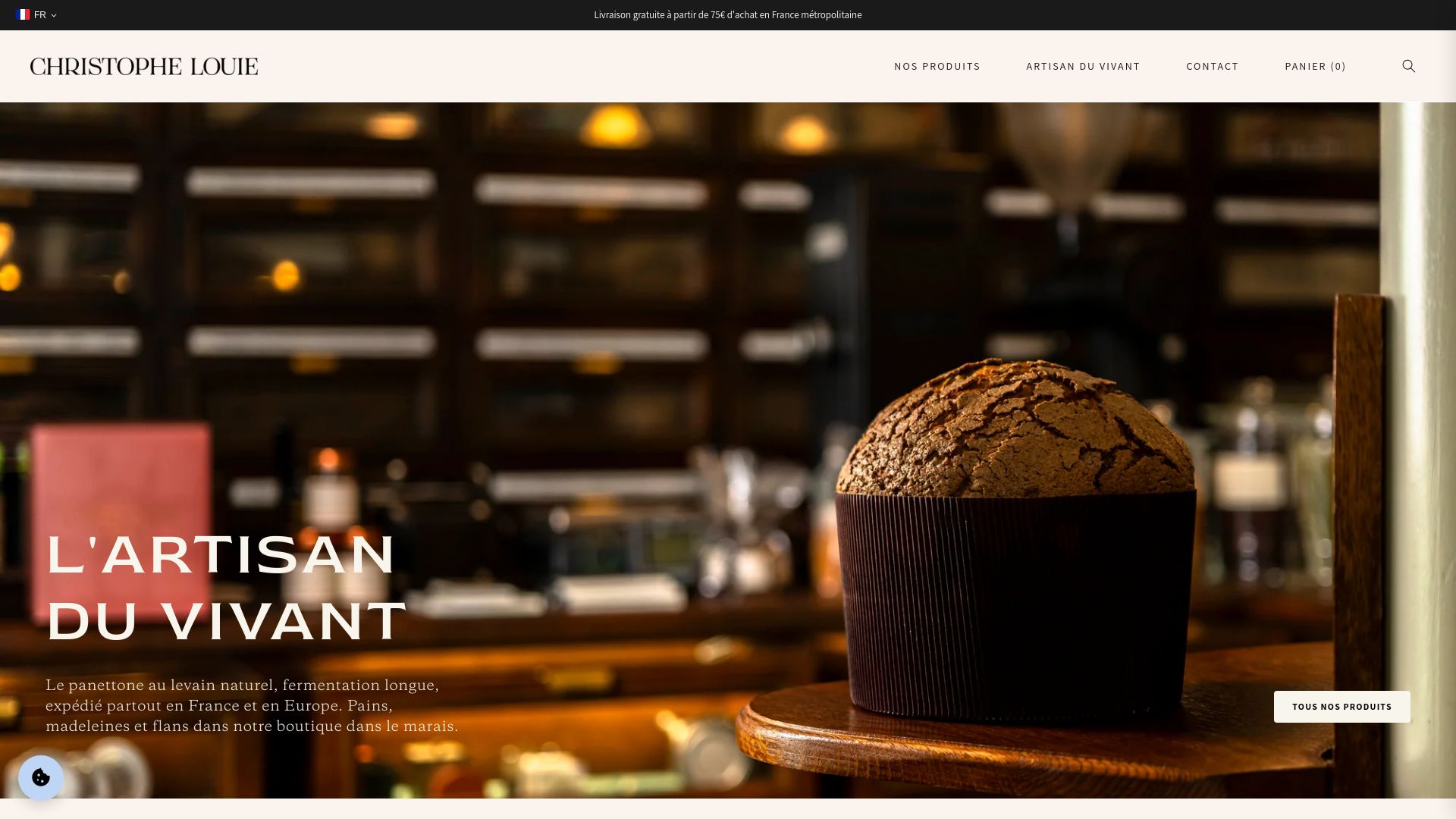
The panettone collection brings together classic candied fruit versions as well as scented versions, such as the orange blossom panettone, all conducted according to the same two-dough 72-hour process. On each product page, check the ingredient list and the origin of the sourdough before buying: this is the best indicator of a truly artisanal panettone rather than an industrially accelerated one, a criterion detailed on the how to choose a panettone page. A physical shop and a website allow for online ordering with delivery, or collection via click and collect.
Sources
To delve deeper into panettone technique, the GialloZafferano entry details the two-dough process and the use of citrus pastes. The Meilleur du Chef recipe offers a complete numbered walkthrough over approximately 48 hours, useful for visualizing each phase. The La Cuisine Italienne guide remains the reference on upside-down cooling, a step that should never be neglected. Finally, to organize a broader holiday schedule around this type of pastry, these holiday meal prep tips provide a complementary practical angle.
Frequently Asked Questions
What exactly is a panettone?
Panettone is a large Italian brioche originating from Milan, enriched with butter, eggs, and candied fruits, traditionally leavened with natural sourdough over several days. Its stringy texture and prolonged shelf life distinguish it from classic short-fermentation brioches.
What is the traditional panettone recipe?
The traditional recipe relies on a two-dough process carried out with a live sourdough, where butter, egg yolks, and aromatic pastes are incorporated gradually before the candied fruits, according to the method described by GialloZafferano. The complete schedule generally spans 48 to 72 hours, including proofing, manual shaping, and upside-down cooling after baking.
Is there a panettone recipe signed by a well-known chef?
Several celebrity chefs and pastry chefs have published their own versions of panettone, adapted for home bakers with proofing times sometimes shortened using yeast. The method remains globally the same: two doughs, gradual incorporation of butter, and candied fruits added at the end of kneading.
Why does artisanal panettone cost more than a classic brioche?
The price reflects production time, often 72 hours for a live sourdough versus a few hours for an industrial yeast brioche. The selection of strong flours, the maceration and manual coating of candied fruits, and hand-shaping add labor costs not present in accelerated processes. The prices of Christophe Louie panettones can be viewed directly on the panettone collection page.